On this page
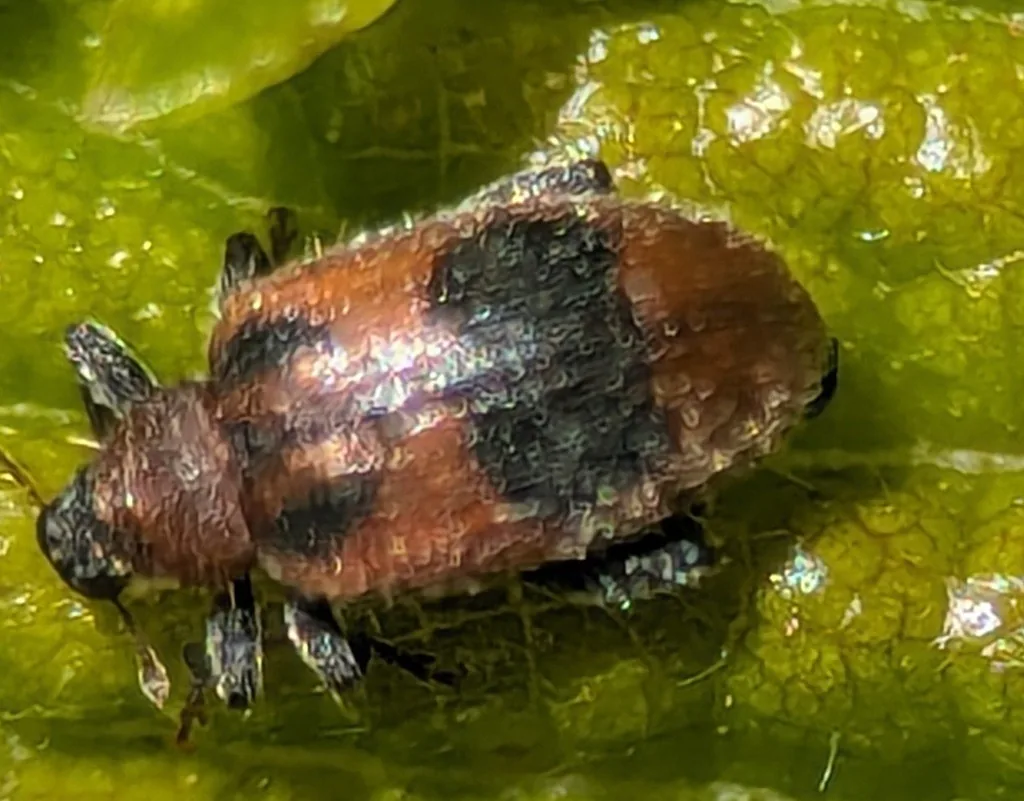
How to identify it
Look-alikes
| Look-alike | How to tell them apart |
|---|---|
| Elm leaf beetle | Elm leaf beetle adults also chew holes in elm leaves, but its larvae skeletonize leaves rather than mining them.[1][2] |
| Elm leafminer (sawfly) | Elm leafminer makes large blotch mines in the center of the leaf that are not winding and don't end at the leaf edge.[2] |
Where it lives
Common in Europe, it was first found in the U.S. in 1982; CSU recognized it in Colorado in 2008 and now reports it widespread there.[1][2]
Biology and life cycle
Adults spend winter near previously infested elms and move to the trees in spring, laying eggs along leaf veins.[1][2]
Larvae mine the leaves for a few weeks and pupate in the mine; new adults emerge in late spring or summer and feed until they seek winter shelter.[1][2]
There is one generation a year.[2]
Damage and signs
- It feeds mainly on Siberian elm, Chinese elm and hybrids with Asian parentage and rarely on American elm.[1][2]
- Adults feed on the underside of leaves, leaving a thin layer that dries and drops out, so heavily fed-on foliage looks lacy.[1][2]
- Damage is mostly cosmetic, though heavy feeding on new transplants or stressed trees can cause severe defoliation.[1]
Health risk
Control
Prevention
Treatment is usually unnecessary because the damage mainly affects the tree's appearance.[1]
Pesticides
If treatment is wanted, UMN suggests a systemic insecticide such as imidacloprid applied in early spring; follow the label.[1]
Common questions
- Why do my Siberian elm leaves have brown tips and tiny holes?
- European elm flea weevil larvae mine the leaf tips and adults chew small holes from below.[1][2]
- Does elm flea weevil kill elms?
- No; the damage is mostly cosmetic, though heavy feeding can weaken stressed or newly planted trees.[1]
- Do I need to spray?
- Usually not. If you choose to treat, UMN suggests a systemic product in early spring.[1]
Sources
- University of Minnesota Extension, “European elm flea weevil.” extension.umn.edu/garden-and-home/yard-and-garden/yard-and-garden-insects/european-elm-flea-weevil (accessed 2026-10-15)
- Colorado State University Extension (Colorado Insects of Interest, W. Cranshaw), “European Elm Flea Weevil (Colorado Insect of Interest).” wci.extension.colostate.edu/wp-content/uploads/sites/14/2017/03/EuropeanElmFleaWeevil.pdf (accessed 2026-10-15)
- iNaturalist, “Orchestes alni taxon page (order and family).” www.inaturalist.org/taxa/142280 (accessed 2026-10-06)