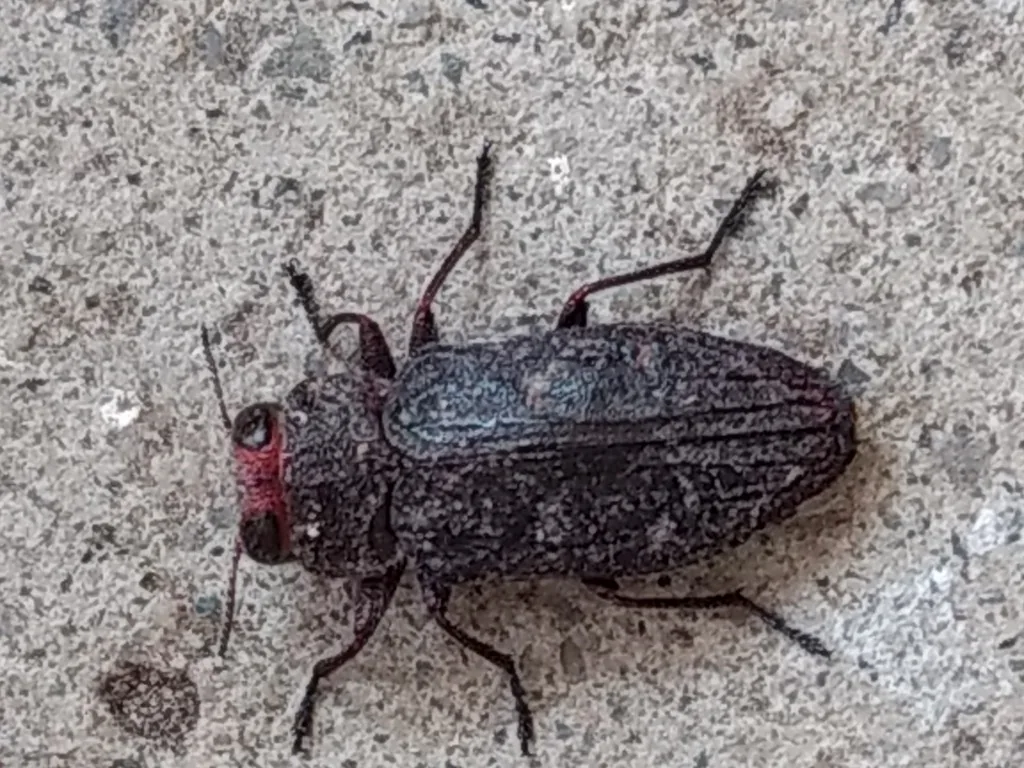
How to identify it
Look-alikes
| Look-alike | How to tell them apart |
|---|---|
| American plum borer | Shares hosts with flatheaded borers; check which borer is present before acting.[2] |
Where it lives
It's the most common of at least 69 Chrysobothris species in California and attacks dozens of broadleaf, fruit and nut trees and ornamentals.[1]
Biology and life cycle
Each female lays about 100 eggs singly on bark, and larvae tunnel in the cambium.[1]
Mature larvae overwinter under bark and pupate in spring; adults fly mostly April through August.[1]
There's usually one generation a year.[1]
Damage and signs
Health risk
It feeds on trees only; UC IPM mentions no risk to people.[1]
Control
Prevention
Plant well-adapted species, avoid trunk and root injuries, and water properly; drought stress invites borers.[1]
Whitewash young trunks with indoor white latex diluted with equal water, or wrap them, to prevent sunburn.[1]
Sanitation
Prune out limited infestations, remove dying trees, and don't stack fresh-cut wood near trees; solarize it under clear plastic.[1]
Biological control
The wasp Trigonura californica and a predatory mite attack the larvae.[1]
Common questions
Sources
- University of California Statewide IPM Program, “Pacific Flatheaded Borer (Pests in Gardens and Landscapes).” ipm.ucanr.edu/PMG/GARDEN/FRUIT/PESTS/pacfltheadbor.html (accessed 2026-10-06)
- University of California Statewide IPM Program, “American Plum Borer (Pests in Gardens and Landscapes).” ipm.ucanr.edu/PMG/GARDEN/FRUIT/PESTS/amerplumbor.html (accessed 2026-10-06)
- iNaturalist, “Chrysobothris mali taxon page (order and family).” www.inaturalist.org/taxa/455233 (accessed 2026-10-06)