On this page
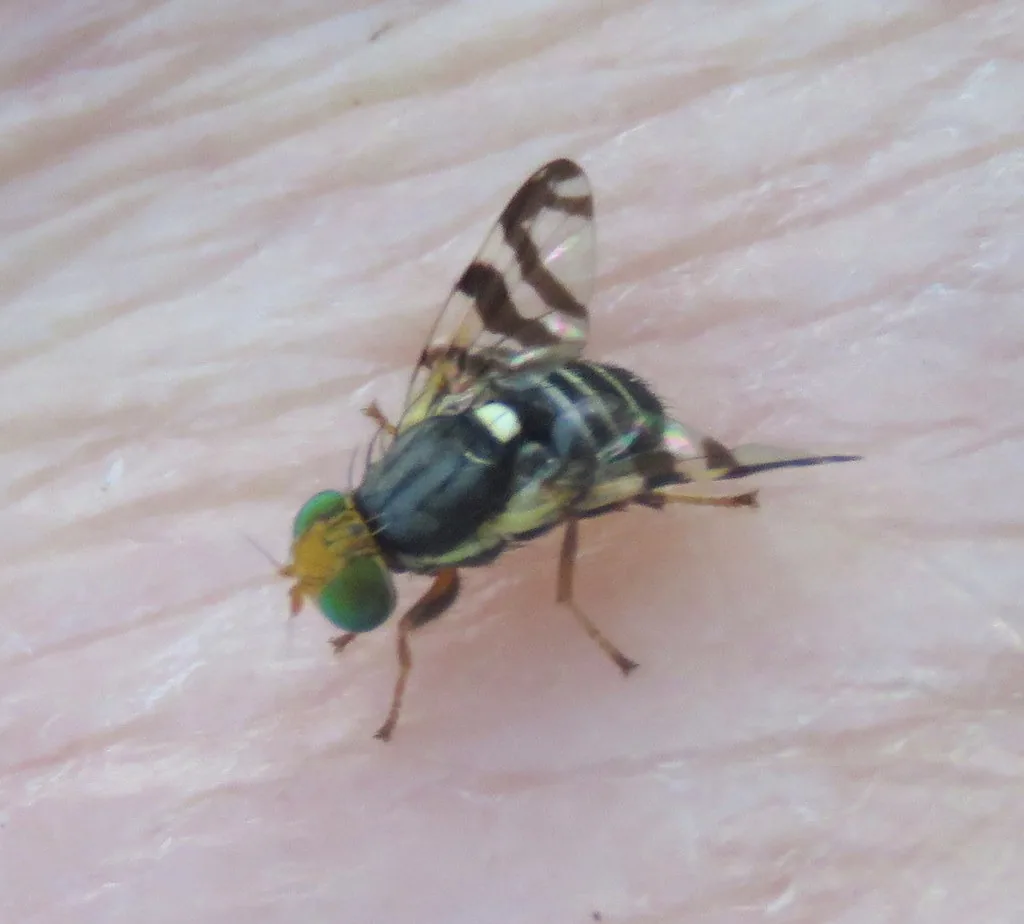
How to identify it
Look-alikes
| Look-alike | How to tell them apart |
|---|---|
| Cherry fruit fly (eastern) | A related Rhagoletis fly; the western cherry fruit fly is the Pacific Northwest and Utah species.[1][2] |
| Spotted-wing drosophila | Another fly that infests ripe cherries; the PNW handbook notes the spinosad fruit fly bait used for cherry fruit fly is not for spotted-wing drosophila.[1] |
Where it lives
Found in the Pacific Northwest and Utah, where it is the main insect pest of sweet and tart cherries.[1][2][3]
Biology and life cycle
It overwinters in the soil under host trees, and a few pupae can stay there up to three years.[1][2]
Adults emerge from mid-May to early June until the end of July, feed on honeydew and pollen, and after 7 to 10 days lay eggs under the cherry skin without visible marks.[1][2]
There is one generation a year, and it lives only on cherry, including wild bitter cherry.[1][3]
Damage and signs
Health risk
Control
Prevention
Grow early-maturing varieties and pick within 8 to 9 days of catching the first flies; watch for adults from May to mid-July.[1][2]
Sanitation
Pick and remove every cherry each season, including fallen fruit; few flies complete their life cycle when all fruit is picked early.[1][3]
Pesticides
Home-labeled insecticides such as spinosad must be applied before eggs are laid and repeated through harvest; protect bees by not spraying during bloom.[1][2]
Common questions
- Why are there white worms in my cherries?
- In the West, usually western cherry fruit fly maggots.[1][2]
- Why does my backyard tree matter?
- Most western cherry fruit flies in the Pacific Northwest live in home trees, and commercial cherries have zero tolerance for maggots.[1][3]
- What is the easiest fix?
- Pick every cherry early and leave none on the tree or ground.[1][3]
Sources
- Pacific Northwest Pest Management Handbooks (OSU, WSU, UI), “Cherry-Western cherry fruit fly (Pacific Northwest Insect Management Handbook).” pnwhandbooks.org/insect/tree-fruit/cherry/cherry-western-cherry-fruit-fly (accessed 2026-10-16)
- Utah State University Extension (Integrated Pest Management), “Western Cherry Fruit Fly (fruit pest fact sheet).” extension.usu.edu/planthealth/ipm/notes_ag/fruit-west-cherry-ff.php (accessed 2026-10-16)
- Washington State University Extension, “Western Cherry Fruit Fly (Chelan-Douglas tree fruit pest management).” web.archive.org/web/20240919171828/extension.wsu.edu/chelan-douglas/agriculture/treefruit/pestmanagement/cherryfruitfly/ (accessed 2026-10-16). Archived copy (Internet Archive, captured 2024-09-19); the original page https://extension.wsu.edu/chelan-douglas/agriculture/treefruit/pestmanagement/cherryfruitfly now returns 404 (checked 2026-10-16).
- iNaturalist, “Rhagoletis indifferens taxon page (order and family).” www.inaturalist.org/taxa/779395 (accessed 2026-10-06)