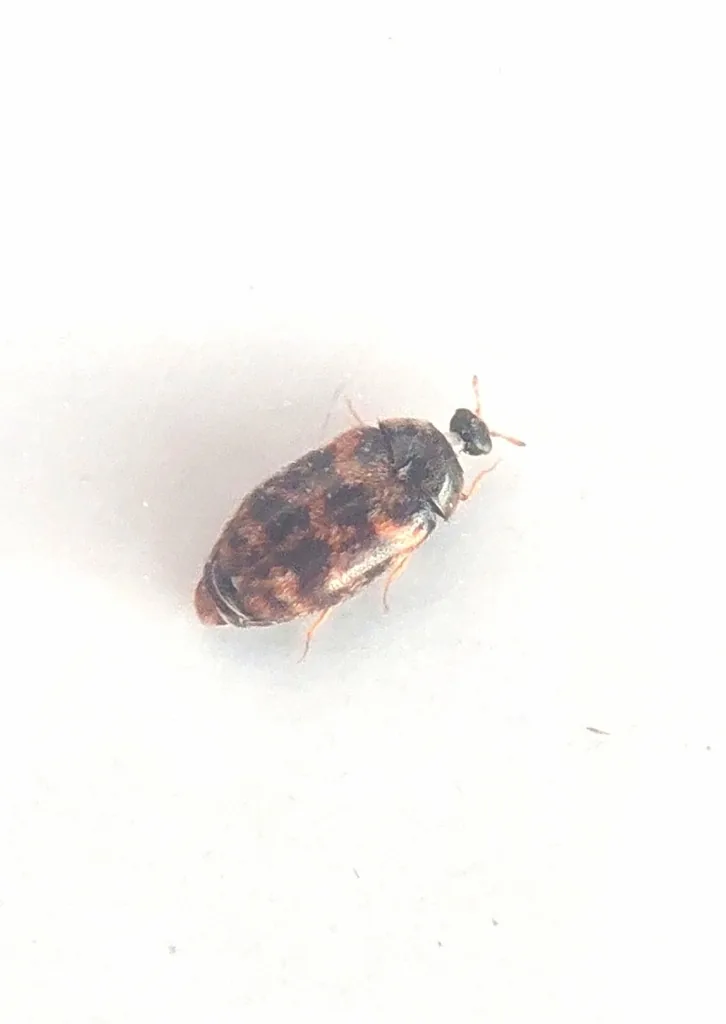
How to identify it
- Adults are oval beetles about 1/8 inch long, usually brownish black with a mottled brown and yellowish pattern of wavy bands or faint patches on the wing covers.[2][1][3]
- Larvae grow to about 1/4 inch and range from yellowish white to dark brown as they age, lighter than many other dermestid larvae.[1][3]
- The last few abdominal segments of the larva carry dense tufts of stiff, spear-tipped hairs, and a tail of long, thin hairs trails from the tip.[1][2]
- Adults vary a lot in appearance and the group is hard to identify, so Purdue suggests sending specimens to an expert for confirmation.[1]
Look-alikes
| Look-alike | How to tell them apart |
|---|---|
| Carpet beetles | Household carpet beetles mostly feed on animal materials like lint, hair, wool and dead insects, while warehouse beetle larvae usually develop in stored plant foods.[3] |
| Cigarette beetle | About the same size but cylindrical and uniformly light brown, without the mottled pattern; its grubs are covered in long, silky hairs rather than spear-tipped tufts.[2] |
| Khapra beetle | A close relative under quarantine restriction; unlike the khapra beetle, the warehouse beetle can fly.[1] |
Where it lives
A pest of homes and stored-food warehouses; it is one of the dermestids most often found in Colorado homes, and UC IPM lists it among the beetles that commonly attack pantry foods.[3][2]
Biology and life cycle
Females lay up to about 90 eggs, singly and loosely in processed food or in cracks of whole kernels, and the eggs hatch in about a week.[2][1]
In warm conditions the whole life cycle from egg to adult can take about 45 days, and the species can produce more than one generation a year.[2][3]
Fully grown larvae can enter a resting state called diapause and delay pupating for as long as two years.[1]
The species is very cold tolerant; larvae aren't killed by six days at about 34 degrees Fahrenheit.[1]
Larvae are very active and wander off to find new food sources, which spreads an infestation to other packages.[2]
Damage and signs
- Reported foods include cereals, flour, cornmeal, oatmeal, pasta, candy, cocoa, cookies, nuts, dried peas and beans, spices, milk powder, pet food, fish meal, dead insects and dead animals.[2][1]
- In grain it can't chew into whole kernels, but it feeds on the broken kernels usually present.[1]
- Pantry pests foul food with their bodies, hairs and droppings, and may bring in microbes that spoil food in warm, humid storage.[2]
Health risk
Warehouse beetle hairs shed into food can irritate the mouth, throat and digestive tract if eaten, so throw out any food found infested with this beetle.[2][1]
Control
Prevention
For several months afterward, keep susceptible foods in containers with tight-fitting lids or in the refrigerator or freezer; plastic bags aren't enough.[2]
Remove rodent and insect nests near the home and replace old rodent baits, since pantry insects can breed in them.[2][3]
Sanitation
Find and get rid of every infested item; check opened and forgotten packages, pet food, bird seed and decorative items, and seal and remove infested packages from the house.[2][4]
Vacuum shelves with a crevice attachment and wash them with soap and water before putting clean food back.[2][4]
Traps and physical control
Items you want to keep can be frozen at 0 degrees Fahrenheit for several days or heated to kill all life stages; large items need longer to penetrate.[3][4]
Use multi-species pantry pheromone traps that attract warehouse beetles to catch leftovers after cleanup, and re-inspect food whenever new beetles turn up.[2]
Pesticides
UC IPM does not recommend insecticides for pantry pests, and Colorado State notes sprays alone don't control dermestids without a thorough cleanout.[2][3]
Common questions
- Can I eat food that had warehouse beetles in it?
- No. Their shed hairs can irritate your mouth, throat and digestive tract, so UC IPM advises throwing out any food infested with this beetle.[2]
- Why do warehouse beetles keep coming back after I clean?
- Wandering larvae may have spread to other packages, and some can rest for up to two years before maturing, so keep inspecting and use sealed storage for months.[2][1]
- Can warehouse beetles fly?
- Yes. Adults can fly, which helps tell them apart from their quarantined relative, the khapra beetle.[1]
Sources
- Purdue University Cooperative Extension Service, “Stored Product Pests: Warehouse Beetle, E-230 (October 2018).” www.extension.entm.purdue.edu/publications/E-230/E-230.html (accessed 2026-10-06)
- University of California Statewide IPM Program, “Pest Notes: Pantry Pests, Publication 7452.” ipm.ucanr.edu/home-and-landscape/pantry-pests/ (accessed 2026-10-06)
- Colorado State University, Department of Agricultural Biology, “Dermestid beetles.” agsci.colostate.edu/agbio/ipm-pests/dermestid-beetles/ (accessed 2026-10-06)
- University of Kentucky Entomology, “ENTFACT-612: Stored Product Pests in the Pantry.” entomology.mgcafe.uky.edu/ef612 (accessed 2026-10-06)
- iNaturalist, “Trogoderma variabile taxon page (order and family).” www.inaturalist.org/taxa/233048 (accessed 2026-10-06)