On this page
How to identify it
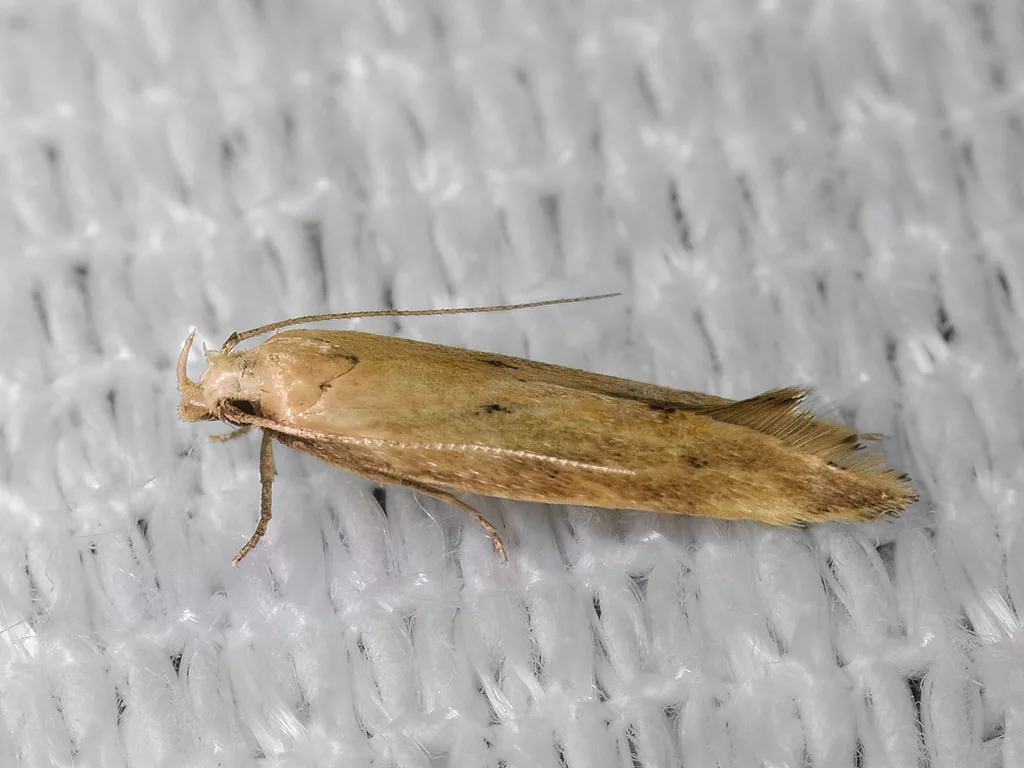
- Adults are small buff, tan or yellowish-brown moths. Sources size them differently: about a 1/2-inch wingspan (USDA, Kentucky ef156, Missouri), 1/2 inch long (Kentucky ef612), or about 1/4 inch (6.5 mm) long (Kansas State).[6][1][3][2][7]
- The hind wings carry a fringe of long hairs, and the leading edge of the hind wing is drawn out at the tip into a narrow 'pointing finger', a feature that helps separate it from clothes moths.[7][1][2][3]
- Eggs are white when laid and soon turn reddish. The caterpillars stay inside the kernel, so they are rarely seen; the mature caterpillar spins a silk cocoon there and becomes a reddish-brown pupa.[6]
Look-alikes
| Look-alike | How to tell them apart |
|---|---|
| Indian meal moth | Its front wings are two-toned, pale gray and coppery brown, and its caterpillars feed on the food surface and leave silk webbing rather than living inside whole kernels.[2][4] |
| Webbing clothes moth | Clothes moths shun light and usually turn up in closets, while Angoumois grain moths fly actively around the house.[3] |
| Rice weevil | Weevils leave similar exit holes in kernels, so finding the adults settles it: weevils are dark brown beetles with prominent snouts.[1] |
Where it lives
Found in all parts of the world and especially injurious in the South, where it attacks grain both in the field and in storage; in the North it survives the winter mainly as larvae inside stored kernels or in scattered wheat in straw. GBIF's public U.S. records are thin, about 30 since 1990 from 13 states on the map, most from Mississippi and Texas.[6][9]
Biology and life cycle
Females lay eggs on or between kernels, on wheat heads, or on exposed tips of corn ears in the field. Counts vary widely: USDA's handbook gives an average of 40 eggs per female and up to 389 under favorable conditions, and a 2023 laboratory study recorded about 290 eggs per female on maize and about 159 on barley.[6][1][8]
Each newly hatched caterpillar bores into a kernel, covers the hole behind it, and feeds inside until it becomes a moth.[1][6][7]
Before pupating, the caterpillar chews a round exit hole but leaves a thin film or flap over it, which the moth pushes through. These 'windows' are easier to see on corn than on wheat.[1][6][7]
Development time depends on temperature: about 30 days at 86 degrees F and 40 days at 77 degrees F (Kentucky); sources also give about 5 weeks (USDA, Missouri) and about 6 weeks (Kentucky ef612). Development stops below about 61 degrees F and 30% relative humidity.[1][6][3][2]
Adults don't feed. There are usually four or five generations a year, with larvae dormant in the coldest months, and 10 to 12 in heated warehouses.[1]
It is the only stored-product pest known to infest standing grain in the field: moths fly to wheat fields in May and lay eggs on the developing grain.[1][6]
Damage and signs
- It attacks all the cereal grains, most often corn and wheat, plus barley, rye, oats, rice and other seeds; it usually infests only whole grains and is not a problem in flour or meal.[6][2][7]
- In bins of small grain or shelled corn it infests only the top few inches, but in ear corn it may infest the whole lot. Decorative ear corn and popcorn are common sources of moths in homes.[7][2][3]
- An infested kernel is mostly hollow with a round exit hole and weighs about 20 percent less than a sound one. Infested grain usually has an unpleasant odor, and animals may refuse to eat it.[1]
Health risk
Adult moths don't feed at all; the risk is spoiled food, since pantry pests may introduce microbes that rot food and can form mycotoxins in warm, humid storage.[1][4]
Control
Prevention
Store grain products in containers that seal tightly, and keep infrequently used grains and flours in the freezer if you can.[3][2][4]
Sanitation
Check all susceptible foods, including popcorn, whole grains, seeds and decorative corn, and throw out infested items in tightly sealed bags taken outside.[3][2]
Empty the storage area and clean the shelves with a vacuum and hot, soapy water.[3][2]
Traps and physical control
Whole grains worth saving can be heated to 130 degrees F for at least 30 minutes or held in a deep freezer at 0 degrees F for at least four days. Don't heat popcorn, and don't heat or freeze seeds you plan to plant, because it can affect germination.[3]
Decorative ear corn can be heated at 155 degrees F for about 20 minutes with the oven door propped open, or held in a non-self-defrosting freezer at 0 degrees F for 4 days.[2]
Sticky traps baited with the moth's sex attractant can show whether moths are still present.[1][4]
Pesticides
Sources differ on household sprays: UC IPM does not recommend insecticides for any pantry pest, while Missouri lists a pyrethroid crack-and-crevice treatment after cleaning as optional. Kentucky notes spraying infested corn with a liquid insecticide is unlikely to work, since the caterpillars are inside the kernels.[4][3][1]
When to call a professional
In bins and cribs, fumigation is what kills caterpillars inside kernels, and it is costly, dangerous work that needs special equipment and knowledge.[1]
Common questions
- Is the small tan moth in my kitchen a clothes moth?
- Possibly not. Angoumois grain moths fly around rooms and have finger-like hind wing tips, while clothes moths avoid light and stay in closets.[3][2]
- Where do Angoumois grain moths come from?
- They usually arrive inside infested whole grain, often popcorn or decorative ear corn, and eggs may even be laid on the grain in the field before harvest.[2][3][1][6]
- Why can't I find any caterpillars?
- The caterpillars live hidden inside individual kernels, so the first signs are usually moths and kernels with small round holes.[1][7]
Sources
- University of Kentucky Entomology, “ENTFACT-156: Insect Pests of Stored Grain: Angoumois Grain Moth.” entomology.mgcafe.uky.edu/ef156 (accessed 2026-11-11)
- University of Kentucky Entomology, “ENTFACT-612: Stored Product Pests in the Pantry.” entomology.mgcafe.uky.edu/ef612 (accessed 2026-11-11)
- University of Missouri Extension, “G7370: Stored Product Pests (revised September 2017).” extension.missouri.edu/publications/g7370 (accessed 2026-11-11)
- University of California Statewide IPM Program, “Pest Notes: Pantry Pests, Publication 7452.” ipm.ucanr.edu/home-and-landscape/pantry-pests/ (accessed 2026-11-11)
- iNaturalist, “Sitotroga cerealella taxon page (order and family).” www.inaturalist.org/taxa/231089 (accessed 2026-11-11)
- USDA Agricultural Research Service, “Stored-Grain Insects (Agriculture Handbook No. 500).” www.ars.usda.gov/ARSUserFiles/2863/pdfdocuments/StoredGrainInsects.pdf (accessed 2026-11-11)
- Kansas State University Research and Extension, “Stored Products Pest Control (Pesticide Application Training, Category 7B, S-16).” bookstore.ksre.ksu.edu/download/stored-products-pest-control-7b_S16 (accessed 2026-11-11)
- Sci Rep, via PubMed, “Life table study of Sitotroga cerealella on different cereals (Salim et al. 2023).” pubmed.ncbi.nlm.nih.gov/37415093/ (accessed 2026-11-11). Cited from the PubMed abstract.
- Global Biodiversity Information Facility (GBIF), “Sitotroga cerealella: occurrence records in the U.S., 1990-2026 (GBIF occurrence search).” api.gbif.org/v1/occurrence/search?taxonKey=1849209&country=US&hasGeospatialIssue=false&occurrenceStatus=PRESENT&year=1990%2C2026&facet=stateProvince&facetLimit=400&limit=0 (accessed 2026-11-11). State counts are records reported (iNaturalist research-grade, museum specimens, surveys), not abundance.