On this page
How to identify it
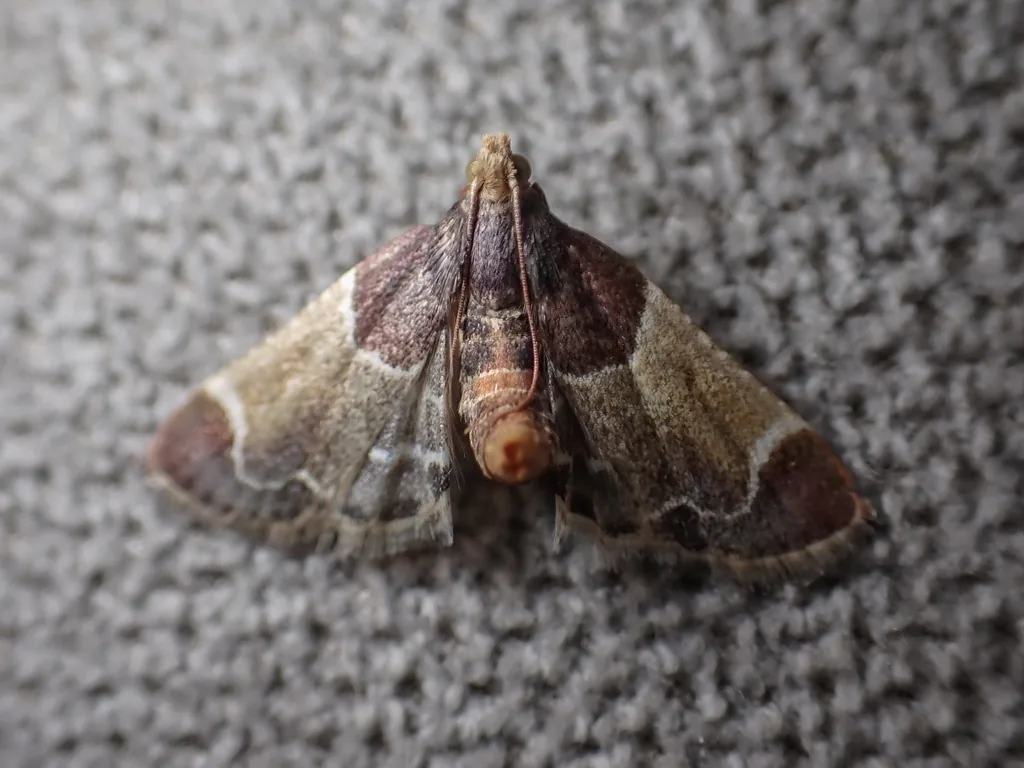
- The forewings are light brown with dark brown patches at the base and tip, and two wavy white lines cross each forewing, so the wing reads as bands of brown and yellow separated by narrow white lines.[2][1]
- The wingspan is about 1 inch, a bit larger than the Indianmeal moth.[2][1]
- Grown caterpillars are whitish and about 3/4 inch to 1 inch long, with a dark head and darkened segments just behind it, and the body often tinged orange toward the ends.[2][1]
- The caterpillars spin tough silk tubes mixed with bits of food and feed from the open ends, leaving masses of silk, droppings and food.[2][1]
Look-alikes
| Look-alike | How to tell them apart |
|---|---|
| Indianmeal moth | Both are pyralid pantry moths, and Indianmeal moth larvae leave a very similar mass of silk and droppings in infested seed. The Indianmeal moth is smaller, with a wing expanse of nearly 3/4 inch, has copper, black and beige scales and holds its wings differently.[1][2] |
Where it lives
USDA describes it as widely distributed, and the University of Tennessee as found throughout the temperate world.[2][1]
Biology and life cycle
The caterpillars feed on cereals, cereal products, hay and many kinds of dried plant material, and prefer food that is damp, spoiled or otherwise in poor condition. Stored in moist places, though, sound wheat and cereal products can be badly damaged too.[2][1]
They are often found in damp, cool places: seeds in moist basements, beans in expansion joints and spilled grain in pipe chases.[1][2]
The female lives about a week and lays 200 to 400 eggs. Grown larvae leave their tubes and spin silk cocoons, often covered with food particles, to pupate.[2]
In summer, egg to adult takes 6 to 8 weeks, so several generations can be produced in a year.[2][1]
Along with the Indianmeal moth, it is one of the flour moths most often reported in grain warehouses.[2]
Damage and signs
- Larvae web seeds together into masses and can chew through burlap sacks, spinning whitish cocoons where sacks touch.[2]
- In one Tennessee case, larvae turned seed in a moist basement that had been vacant for three years into a heavy mound of droppings, silk and seed on the floor.[1]
- It is mostly considered a minor pest.[1]
Health risk
The University of Tennessee and USDA describe damage to stored food and seed only, and mention no bites, stings or other risk to people.[1][2]
Control
Prevention
Dry the area out with fans or dehumidifiers and repair leaks, since meal moth larvae favor damp places and damp, spoiled food.[1][2]
Keep them out
Check for signs of rodents, which can stash seed. If you find them, set traps and seal the places where they get in.[1]
Sanitation
Find and remove everything the larvae could be feeding on: seeds, grain, flour and similar food, including stored bird seed or seed that mice have cached.[1]
Pesticides
If needed, an insecticide applied to cracks and crevices can kill larvae or pupae missed during cleanup.[1]
Insect tea
In parts of southern and southwestern China, meal moth larvae are part of a traditional food: 'insect tea' is made from the droppings of larvae reared on a plant-based diet. Researchers who rebuilt the process in a lab found the tea carries a rich bacterial community, much of it traced back to the insect and its droppings.[3][4]
Where sources disagree
Generation time: USDA gives 6 to 8 weeks from egg to adult in summer, while the University of Tennessee says development can be completed within 8 weeks.[2][1]
Larva size: USDA gives about 1 inch when fully grown, and the University of Tennessee 3/4 inch to 1 inch.[2][1]
Common questions
- How did meal moths get into my basement?
- They breed in damp, spoiled seed and grain, so look for bird seed, stored seed or a mouse's food cache. Tennessee traced one infestation to seed on the floor of a moist, long-vacant basement.[1][2]
- Is the meal moth the same as the Indianmeal moth?
- No. Both are pyralid pantry moths, but the meal moth is larger, about an inch across, and its forewings show brown and yellow bands separated by thin white lines, while the Indianmeal moth has copper, black and beige scales.[1][2]
Sources
- University of Tennessee Entomology and Plant Pathology, “The Meal Moth, Pyralis farinalis (L.) (K. Vail, Insec(tc)ure newsletter vol. 4 no. 5, May 12, 2023).” epp.tennessee.edu/wp-content/uploads/sites/267/2023/11/2023-05MealmothV4I5.pdf (accessed 2026-11-11)
- USDA Agricultural Research Service, “Stored-Grain Insects (Agriculture Handbook No. 500, issued 1978, revised 1986).” www.ars.usda.gov/ARSUserFiles/2863/pdfdocuments/StoredGrainInsects.pdf (accessed 2026-11-11)
- Frontiers in Microbiology, via PubMed, “Microbiome-guided exploration of the microbial assemblage of the exotic beverage 'insect tea' native to southwestern China (2019).” pubmed.ncbi.nlm.nih.gov/32063890/ (accessed 2026-11-11)
- Mitochondrial DNA Part B, via PubMed, “The complete mitochondrial genome sequences of two insect-tea producers in Pyralidae from South China: Pyralis farinalis and Orthopygia glaucinalis (Mao, Li and Yang 2019).” pubmed.ncbi.nlm.nih.gov/33366217/ (accessed 2026-11-11)
- iNaturalist, “Pyralis farinalis taxon page (order and family).” www.inaturalist.org/taxa/199870 (accessed 2026-11-11)