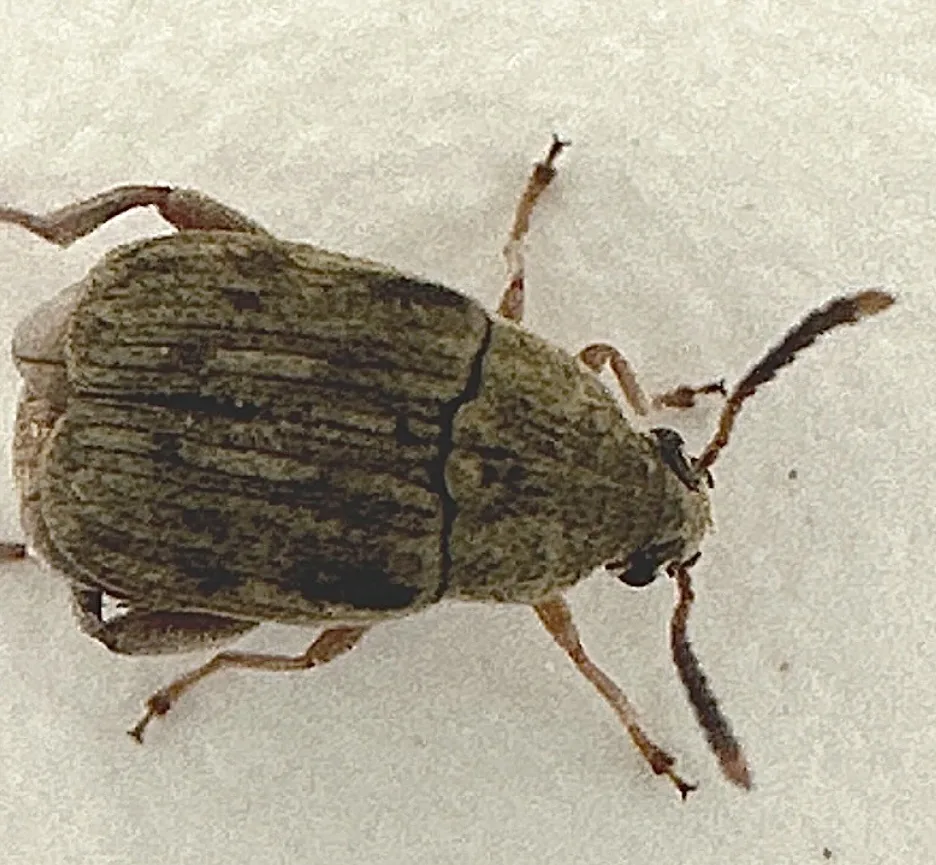
How to identify it
- Adults are about 1/8 inch long, olive brown mottled with dark brown, gray or cream markings, with reddish legs and antennae.[1][2]
- The body is somewhat teardrop-shaped and narrows evenly toward a small head.[3][2]
- The hind thigh carries one large and two small spines, visible with a hand lens.[1]
- The surest sign is beans with neat round holes where adults have emerged; several larvae may develop in one bean.[1][3]
Look-alikes
| Look-alike | How to tell them apart |
|---|---|
| Granary weevil | A true weevil with a distinct snout that develops inside whole grain kernels; the bean weevil isn't a true weevil and develops in legume seeds.[4][1] |
| Rice weevil | Another snouted grain weevil that attacks whole grain rather than dry beans and peas.[4][1] |
| Cowpea weevil | A related bean pest whose wing covers are tipped with black and carry two large black dots.[2] |
Where it lives
The bean weevil occurs throughout the United States, infesting legumes both in the field and in storage.[1]
Biology and life cycle
Females lay an average of 75 eggs, singly or in clusters near beans, or loosely among stored beans and through cracks in pods.[1][3]
Larvae and pupae develop inside the bean, and adults chew out through a round hole in the seed coat.[3][1]
The life cycle takes 21 to 80 days, and indoors the beetles breed continuously in dried legumes kept warm.[1][2]
Adults are strong fliers and don't feed on the legume seeds.[2][1]
Damage and signs
Health risk
The concern is food loss: larvae hollow out beans and contaminate stored legumes, which are best thrown out once infested.[3][2]
Control
Prevention
Keep food storage areas dry with good ventilation, and check stored legumes regularly.[2]
In the garden, plant weevil-free seed and remove and destroy bean plants right after harvest; insecticide treatment isn't recommended.[3]
Keep them out
Inspect incoming beans for beetles and store all susceptible foods in pest-proof containers.[2]
Sanitation
Find and dispose of infested legumes, clean up spills and storage areas, and keep legumes in regular rotation.[2]
Common questions
- Where did the little beetles in my dry beans come from?
- Bean weevil infestations can start in the field or garden before harvest, then keep breeding in storage.[1][3]
- Should I spray my pantry for bean weevils?
- No. Throw out infested legumes, clean the storage area and keep beans in sealed containers; insecticides aren't recommended.[2][3]
Sources
- University of Florida, Department of Entomology and Nematology, “Bean weevil, Acanthoscelides obtectus (stored product pests image gallery).” entnemdept.ufl.edu/projex/gallery/dl/stored_product_pests/text/bean_weevil.htm (accessed 2026-10-06)
- Utah State University Extension, Integrated Pest Management, “Bean and Cowpea Weevils (Nuisance Pests).” extension.usu.edu/planthealth/ipm/notes_nuisance/bean-cowpea-weevils (accessed 2026-10-06)
- University of California Statewide IPM Program, “Bean Weevils (Home and Landscape).” ipm.ucanr.edu/home-and-landscape/bean-weevils/ (accessed 2026-10-06)
- Purdue University Extension Entomology, “E-237: Rice, Granary, and Maize Weevils (November 2018).” www.extension.entm.purdue.edu/publications/E-237/E-237.html (accessed 2026-10-06)
- iNaturalist, “Acanthoscelides obtectus taxon page (order and family).” www.inaturalist.org/taxa/212223 (accessed 2026-10-06)