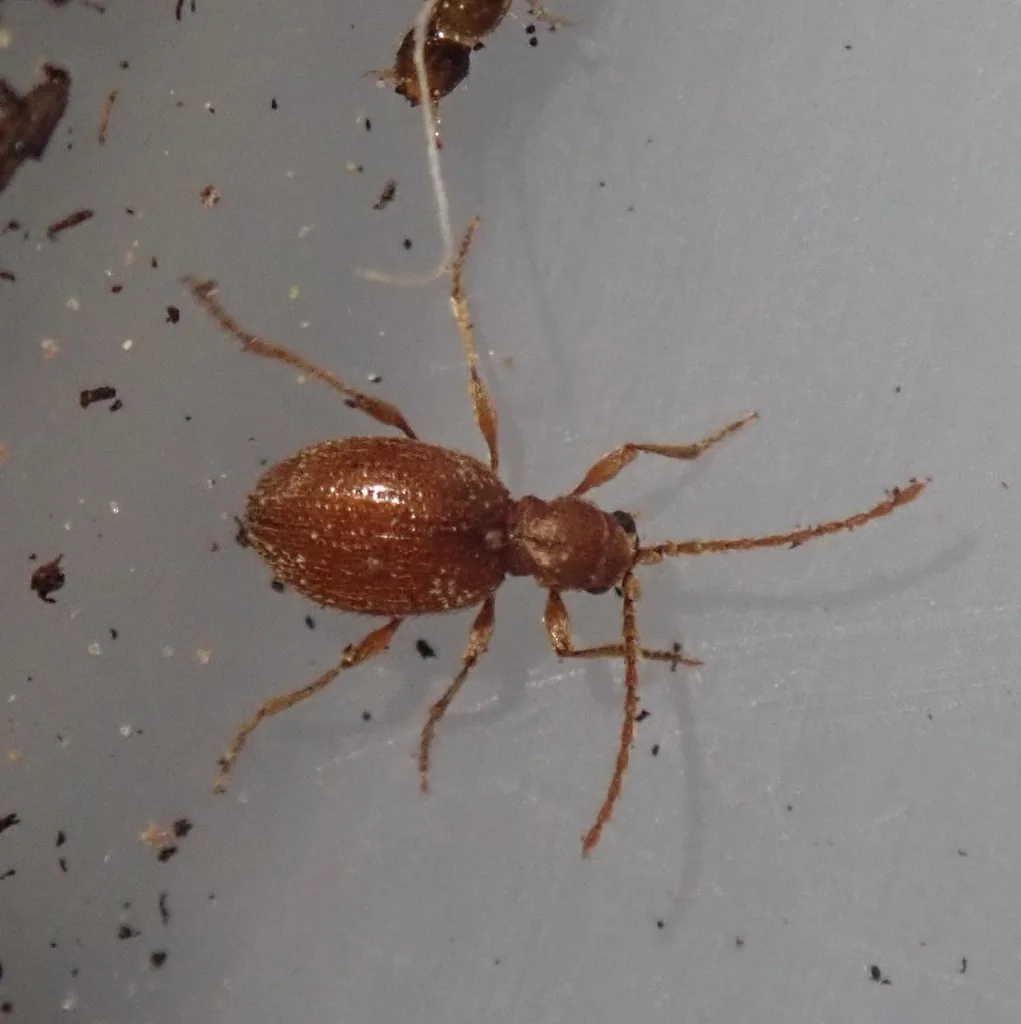
How to identify it
- Adults are 1 to 5 mm long, with long, thin, hairy legs and antennae that give them a spider-like look.[1][4][3]
- The body is usually oval or globular, and the thorax is narrower than the wing covers; the head is usually hidden from above.[1]
- Colors range from pale yellowish brown to reddish brown or nearly black, and some species are two-toned.[1]
- Female whitemarked spider beetles have two white patches on each wing cover, while the golden spider beetle is covered in silky golden-yellow hairs.[2][5]
- Larvae are C-shaped, dirty white grubs with three pairs of legs.[1][4][5]
Look-alikes
| Look-alike | How to tell them apart |
|---|---|
| Spiders | Spider beetles only resemble spiders because of their long legs and rounded bodies; they are beetles, with wing covers and threadlike antennae.[1][4] |
| Rice weevil | Grain weevils have long snouts and develop inside whole kernels, while spider beetles scavenge on many kinds of loose food and debris.[4][1] |
Where it lives
Found throughout the world, especially in colder regions, where some stay active even at freezing temperatures.[1][3]
Biology and life cycle
Females lay up to about 100 eggs on or near food, though most species lay fewer; the golden spider beetle lays 20 to 40.[1][5]
Development from egg to adult ranges from under two weeks to more than three months depending on the species.[1][4]
Spider beetles tolerate cold well but need easy access to water.[3]
Some species can fly, and the golden spider beetle is nocturnal, hiding in dark cracks during the day.[1][5]
Damage and signs
- They feed on broken grain, grain products, seeds, dried fruit, dried meat, fish meal, feathers, wool, hair and rodent droppings.[1][3]
- Because they eat so many plant and animal materials, the source of an infestation can be hard to find.[1]
- They are among the most common beetles in moldy, old food, and old bird nests can also harbor them.[3][5]
- Larvae may bore into packaging to pupate, contaminating products with droppings and silk.[5]
Health risk
The Natural History Museum calls the golden spider beetle not harmful to health; the concern is spoiled food, since pantry pests may introduce microbes that form mycotoxins.[5][6]
Control
Prevention
Store flour and other grain products in tightly sealed containers, and remove old or unused food regularly.[3][5][4]
Keep food cupboards dry and ventilated, and reduce cracks and crevices where the beetles can hide.[5]
Sanitation
Good sanitation is the main fix, since spider beetles are usually a problem only where food has been left too long or debris has built up.[3][1]
Check every susceptible food and throw out infested items in a sealed bag taken outside.[4]
Vacuum debris from cracks and corners of storage areas, then scrub with hot water and detergent.[3]
Traps and physical control
Infested material worth saving can be heated to 120 to 130 degrees F for two to three hours.[3]
Pesticides
Washington State University lists no recommended insecticide treatment for spider beetles.[3]
Common questions
- Why do I see spider beetles in winter?
- Many spider beetles are cold-tolerant and can stay active even at freezing temperatures, unlike most pantry pests.[1][3]
- Are spider beetles actually spiders?
- No. They are beetles; the name comes from their long legs and rounded bodies.[4][1]
- I cleaned the pantry and still see them. Why?
- They feed on many things besides food, including rodent droppings, feathers and dead insects, so the source may be somewhere other than the pantry.[1][3]
Sources
- University of Florida, Entomology and Nematology Department, “A spider beetle, Gibbium aequinoctiale (stored product pests image gallery).” entnemdept.ufl.edu/projex/gallery/dl/stored_product_pests/text/spider_beetle.htm (accessed 2026-10-06)
- University of Florida, Entomology and Nematology Department, “Whitemarked spider beetle, Ptinus fur (stored product pests image gallery).” entnemdept.ufl.edu/projex/gallery/dl/stored_product_pests/text/whitemarked_spider_beetle.htm (accessed 2026-10-06)
- Washington State University Extension, “Spider beetle (PestSense fact sheet).” pestsense.cahnrs.wsu.edu/fact-sheet/spider-beetle/ (accessed 2026-10-06)
- University of Missouri Extension, “G7370: Stored Product Pests (revised September 2017).” extension.missouri.edu/publications/g7370 (accessed 2026-10-06)
- Natural History Museum, London, “Golden spider beetle (Niptus hololeucus) identification guide.” www.nhm.ac.uk/take-part/identify-nature/common-insect-pest-species-in-homes/golden-spider-beetle-niptus-hololeucus-identification-guide.html (accessed 2026-10-06)
- University of California Statewide IPM Program, “Pest Notes: Pantry Pests, Publication 7452.” ipm.ucanr.edu/home-and-landscape/pantry-pests/ (accessed 2026-10-06)
- iNaturalist, “Ptinus fur taxon page (order and family).” www.inaturalist.org/taxa/131939 (accessed 2026-10-06)