The short answer
- Get the relative humidity below 50 percent. Penn State and Clemson say low humidity stops mold growth and booklouse development, and Clemson says it kills booklice directly. Minnesota says psocids don't survive when humidity falls below 45 to 50 percent.[1][2][4]
- Use a dehumidifier, moisture absorber or fans to dry the room, and keep the air moving.[1][4][8]
- Fix whatever is making the spot damp: leaky pipes or roofs, sweating pipes, poor attic or crawlspace ventilation, wet cardboard, or new drywall and plaster that haven't dried yet.[1][2][4][6]
- Throw out food that has booklice in it, vacuum crumbs from shelves and cracks, and keep dry goods in tightly sealed glass or heavy plastic containers.[1][3][4]
- Insecticides are normally not needed. Extension sources say booklice rest where sprays don't reach and that sprays don't work while the moisture problem remains.[1][2][4]
- Booklice don't bite, aren't lice and don't spread disease. Clemson notes they are suspected of aggravating asthma.[1][2][5]
Related profiles
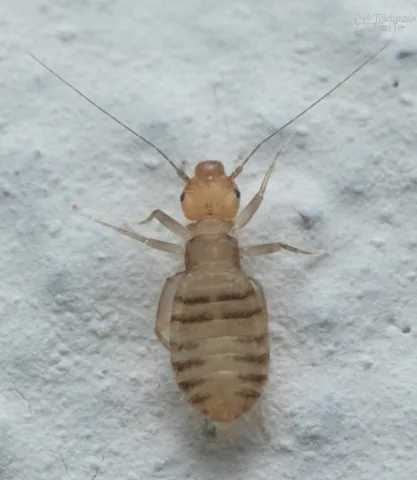 Booklice
Liposcelis species and other psocids (family Liposcelididae)
Booklice, also called psocids, are tiny insects that feed on mold and fungi. Finding them indoors usually means high humidity or a moisture problem, and drying things out is the most effective control.
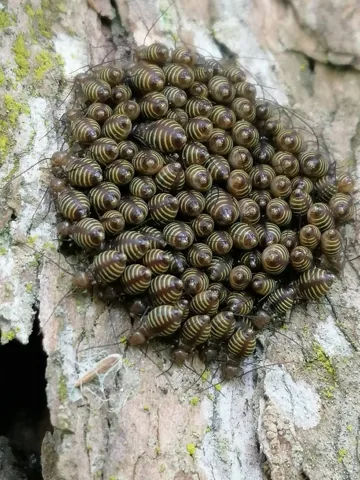 Barklice
Archipsocus nomas, Cerastipsocus venosus and other bark-dwelling psocids (order Psocodea)
Barklice are tiny, soft-bodied insects that live on tree bark. Some species blanket trunks and limbs in silky webbing or move over the bark in herds, but they feed on lichens, fungi and debris and do not harm the tree.
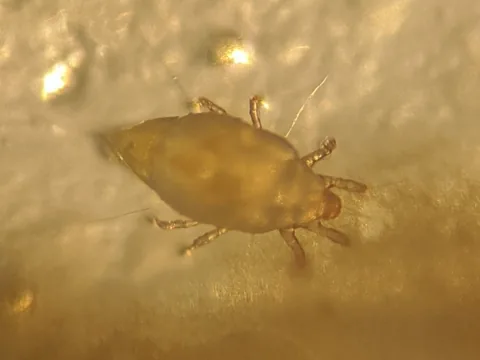 Mold Mite
Tyrophagus putrescentiae
Mold mites are tiny mites that feed on mold and fungi, so they show up only where food or surfaces stay damp. Tyrophagus putrescentiae, a relatively common one, infests high-fat and high-protein stored foods.
No photo yet
Grain Mite
Acarus siro
The grain mite, also called the flour mite, is a tiny, pale mite that multiplies in damp flour, grain and other stored foods. When numbers get high, the food, the bag or the shelf looks like it is covered in moving dust.
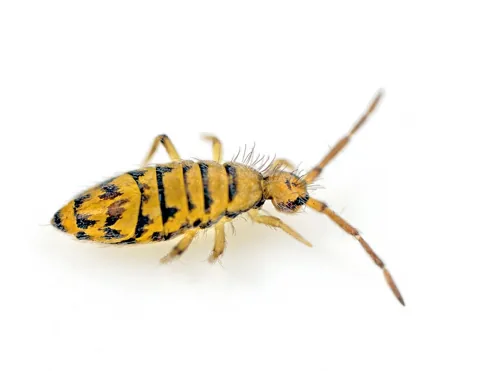 Springtail
Collembola (shown: Entomobrya sp.)
Springtails are tiny jumping creatures that sometimes appear in large numbers in moist spots indoors. They don't bite or sting and don't damage furniture or food; their presence indoors points to a moisture problem.
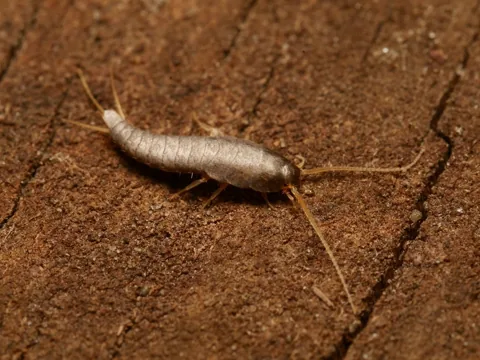 Silverfish
Lepisma saccharinum
Silverfish are nocturnal, wingless insects that hide by day and graze at night on paper, book bindings, starch in clothing and dry foods, preferring damp, warm places such as laundry rooms.
First, make sure they're booklice
Booklice are psocids in the family Liposcelididae, wingless relatives of the barklice that live outdoors on tree trunks. The name is misleading: they are not lice, they don't bite people or pets, and they can't sting.[1][4][7][2]
- Size: Penn State gives 1 to 2 mm for booklice and Clemson about 1/25 inch; Utah State's fact sheet says 1 to 4 mm. Washington State says psocids in general are usually 1/16 to 1/8 inch. A Pacific Northwest handbook calls them about the size of a pinhead.[1][2][5][3][8]
- Color and shape: pale cream, yellowish, tan or gray, sometimes nearly clear in the young. They are soft and flattened, with long thread-like antennae and a broad head with a large, nose-like front plate.[1][2][5][3]
- Wings: indoor booklice are wingless. Winged psocids are usually barklice that wandered in from outdoors.[4][5][9]
- How to spot them: tap a box, book or food package you suspect onto a dark surface, and the small, light-colored insects show up against it. Utah State's school pest guide notes they look like small specks and a hand lens helps.[9][6]
- Not a bed bug: an adult bed bug is about three times as long as an adult booklouse and rounder, with a head narrower than its body; a booklouse's head is nearly as wide as its body. A newly hatched bed bug is about the size of an adult booklouse. Our bed bug look-alikes guide has more side-by-side marks.[1]
- Not a young silverfish: silverfish damage paper and fabric directly, while Penn State says booklice don't. Our silverfish and firebrat guide covers how to tell the two apart.[1]
Why you have them: moisture and mold
Booklice feed on molds and fungi. Indoors they're found where mold can grow: on damp paper, books and bindings, wallpaper, cardboard, and flour and other stored grain. When they seem to be eating a book or a bag of flour, they are actually eating the mold on it.[1][2][5][4]
They need warmth and damp air. Clemson lists 75 to 82 degrees F and 75 to 90 percent relative humidity as ideal, and the museum pest fact sheet says populations increase at 65 percent humidity and above. Minnesota says people commonly find them in summer.[2][9][4]
- New homes and remodels: Clemson says booklice sometimes build up in large numbers in newly built buildings, because fresh plaster and drywall can hold a lot of moisture that supports mold. Penn State describes walls closed up with drywall before they dried.[2][1]
- Common spots: around damp books, leaking or sweating pipes, wall voids and cardboard boxes, on windowsills, around light fixtures and under boxes.[6][9]
- Houseplants on windowsills: Penn State says leaving an air space under potted plants helps keep humidity and mold down there.[1]
- Stored food: Utah State says booklice in stored grain mean the grain is too warm and moist. Minnesota says psocids in food indicate a fungal or mold problem. Some wingless species infest flour, sugar and cereal.[5][4][3]
- They multiply fast without mates. Many species are all female and reproduce without males. Penn State says a female can lay about 60 eggs in warm months; the museum pest fact sheet gives 20 to 50 depending on the time of year.[5][9][1]
- Life cycle: under 1 month in warm weather (Penn State), about one month on average (Clemson), and as little as 25 days in ideal conditions (Utah State). In cool conditions it can take more than three months. Utah State gives 1 to 8 generations a year depending on species; Washington State says more than six under good conditions.[1][2][5][9][3]
Step 1: Bring the humidity down
This is the fix every source puts first. Penn State says getting relative humidity below 50 percent prevents mold growth and booklouse development, so a dehumidifier, moisture absorber or other way of drying a room or a specific area can be very effective. Clemson says low humidity directly kills booklice and that they can die within weeks if it stays low.[1][2][4][9]
- Target: below 50 percent (Penn State, Clemson, the museum pest fact sheet); Minnesota says psocids don't survive below 45 to 50 percent. For mold in general, EPA advises keeping indoor humidity below 60 percent, ideally between 30 and 50 percent.[1][2][9][4][10]
- Measure it: EPA notes relative humidity can be measured with a moisture or humidity meter sold at hardware stores.[10]
- Dry the air: run a dehumidifier in damp rooms and basements, and use fans to air out rooms and keep air moving.[4][8][5]
- Vent moisture outdoors: EPA says to vent clothes dryers, stoves and other moisture-producing appliances to the outside where possible, and to open doors and windows when practical.[10]
- How long it takes: in a laboratory study at Oklahoma State, four stored-product Liposcelis species held at 43 or 50 percent humidity at 30 degrees C all died within 8 to 16 days, depending on species and humidity, while populations kept at 75 percent grew. The study suggests a set humidity can work for psocid control.[11]
Step 2: Find and fix the damp spot
A dehumidifier helps, but sources say the lasting fix is the water problem underneath. Penn State and Clemson say to correct leaks and moisture problems; EPA says to fix plumbing leaks and other water problems as soon as possible and dry items completely.[1][2][10]
- Leaks: repair leaking pipes and roofs.[1][2][10]
- Condensation: EPA says moisture collecting on windows, walls or pipes is a sign of high humidity; dry the surface and reduce the source. Insulating a sweating pipe stops condensation on it.[10]
- Spills and water damage: EPA says that if wet materials are dried within 24 to 48 hours, in most cases mold won't grow.[10]
- Attic and roof: Minnesota suggests checking for poor attic ventilation, trees overgrowing the roof and leaf litter in the eaves.[4]
- Crawlspaces: Minnesota says a pest management company can check whether a crawlspace is dry and well ventilated.[4]
- Outside walls: Utah State's school guide suggests removing leaf litter from around the outside of the building.[6]
- New construction: if moisture is trapped inside a wall, Penn State says holes may have to be cut in the drywall so the wall void can dry out.[1]
Step 3: Deal with moldy food, books and boxes
Clemson says to remove food items that support mold growth and thoroughly clean the infested area. Penn State says stored food with booklice should be thrown out, since it's contaminated with mold and booklouse droppings. For the other bugs found in pantries, see our pantry pests guide.[2][1]
- Pantry: find the infested package and get rid of it, then check nearby products to see if the insects have spread. Vacuum and clean food debris from cracks and corners of shelves.[3][1]
- Storage: keep dry goods in tightly sealed containers of heavy plastic, glass or other tough materials, since pests can get into cardboard and light plastic. Utah State adds the freezer as an option. Washington State suggests buying dry goods in amounts you'll use in a few months.[3][1][5]
- Books and papers: store them in well-ventilated, uncluttered areas, and keep boxes, bags, books and papers off the floor.[2][4][9]
- Cardboard: Minnesota says booklice can become a problem when stored cardboard gets wet.[4]
- Visible mold: Utah State says to clean up existing mold as much as possible, noting you may not be able to see all of it. EPA says to scrub mold off hard surfaces with detergent and water and dry completely; porous materials such as ceiling tiles and carpet may have to be thrown away. For mold covering more than about 10 square feet, EPA points to its larger remediation guidance.[5][10]
- Small numbers: Minnesota says a few psocids can be ignored or simply removed, for example with a vacuum.[4]
Heat and freezing for books and keepsakes
Museums and archives deal with booklice in collections. The museum pest IPM fact sheet says most species are killed by heat treatment above 55 degrees C, except Liposcelis paeta, and that freezing below -18 degrees C generally works, except against Liposcelis bostrychophila, which allergy researchers in Japan describe as a common household pest. Since each method misses at least one species, dry the storage area too.[9][12]
Do you need an insecticide?
Usually not. Penn State says pesticides aren't normally necessary because fixing the water problem works better. Clemson says booklice are easily killed by insecticides but often rest where treatment is hard to apply, and humidity control alone can be very effective. Minnesota goes further: insecticides don't work if moisture is still a problem, and products sold to homeowners are generally not effective against psocids.[1][2][4]
- Where sources allow a spray: Utah State says that if an insecticide is needed, use one labeled for indoor use against booklice or crawling insects, and be cautious in food preparation areas and with long-residual products. Iowa State says residual sprays should be applied very lightly, only where booklice are abundant and people and pets won't be exposed. A Pacific Northwest handbook lists labeled crack-and-crevice treatment where appropriate.[5][7][8]
- Sources disagree on value: Utah State, Iowa State and the Pacific Northwest handbook describe a limited spray as an option, while Minnesota says consumer products generally don't work on psocids. All agree moisture control comes first.[5][7][8][4]
- Don't treat food: throw out infested food instead, and be cautious with insecticides in food preparation areas. Always read and follow the label.[1][5][3]
- Monitors and sticky traps: Utah State's school guide notes booklice are very common in pest monitors, which can help you see where they are concentrated. Our sticky trap guide covers placement.[6]
Are booklice harmful?
They don't bite, aren't known to carry disease, and don't infest people or pets. Damage is usually minor: Penn State says they don't damage paper or fabric directly, though Clemson says damp books can be harmed when booklice feed on moldy paper and binding glue.[1][5][2][9]
- Allergies: Clemson says booklice are suspected of aggravating asthma. In a Japanese study of 185 adults with allergic asthma, 41 (22 percent) had antibodies to booklice, and the researchers identified a new booklouse allergen.[2][12]
- Contaminated food: a 2025 case report from Japan described severe anaphylaxis in a man who ate oatmeal infested with Liposcelis bostrychophila. The authors describe it as the first such case reported in Japan; it's one more reason to discard infested food.[13][1]
- Sources differ in tone: Penn State says booklice don't affect human or animal health. Clemson's asthma concern and the studies above suggest some people do react to them.[1][2][12]
Common questions
- What kills booklice?
- Dry air. Holding relative humidity below 50 percent prevents mold and booklouse development, and in a laboratory study all life stages of four species died within 8 to 16 days at 43 or 50 percent humidity.[1][2][11]
- Why do I have booklice in my new house?
- New plaster, drywall and framing can hold moisture that supports mold, and booklice build up feeding on it. Run dehumidifiers and fans to dry the building; if moisture is trapped inside a wall, Penn State says the wall void may need to be opened so it can dry.[2][1][4]
- Will a dehumidifier get rid of booklice?
- It is the main tool sources recommend, as long as it brings the room below about 50 percent and the leak or damp spot behind it is also fixed.[1][4][2]
- Can booklice live in my bed or on me?
- No. They are not lice, don't feed on people and can't bite. If something is biting you, it isn't booklice; our bed bug look-alikes guide covers the usual suspects.[4][7][1]
- Do I have to throw out food with booklice?
- Yes. Penn State says food with booklice is contaminated with mold and droppings and should be discarded; store the rest in sealed containers.[1][3]
- Should I spray for booklice?
- Usually not. Insecticides don't solve the moisture problem, and Minnesota says homeowner products generally don't work on psocids.[1][2][4]
Photo credits
- Booklice: (c) Luis Fernando Valdez Ojeda, some rights reserved (CC BY) — via iNaturalist, CC BY 4.0
- Barklice: (c) Alejandro Alfredo Aguirre, some rights reserved (CC BY) — via iNaturalist, CC BY 4.0
- Mold Mite: cgmayers, public domain (CC0), via iNaturalist
- Springtail: AJ Cann, public domain (CC0), via iNaturalist
- Silverfish: (c) Alexis Tinker-Tsavalas, some rights reserved (CC BY) — via iNaturalist, CC BY 4.0
Sources
- Penn State Extension, “Booklice (S. Jacobs; revised July 2024 by M. Skvarla).” extension.psu.edu/booklice (accessed 2026-11-10)
- Clemson Cooperative Extension Home & Garden Information Center, “Booklice, HGIC 2403 (D. A. Oswalt, E. P. Benson, P. A. Zungoli).” hgic.clemson.edu/factsheet/booklice/ (accessed 2026-11-10)
- Washington State University Pestsense, “Psocids (booklice or barklice).” pestsense.cahnrs.wsu.edu/fact-sheet/psocids-booklice-or-barklice/ (accessed 2026-11-10)
- University of Minnesota Extension, “Psocids (barklice, booklice) (J. Hahn, S. Kells).” extension.umn.edu/garden-and-home/home-maintenance/household-insects/booklice-barklice (accessed 2026-11-10)
- Utah State University Extension and Utah Plant Pest Diagnostic Laboratory, “Booklice and their Relatives (Psocoptera), ENT-160-12 (C. A. Stanley, 2012).” extension.usu.edu/pests/uppdl/files/factsheet/booklice.pdf (accessed 2026-11-10)
- Utah State University Extension, “Booklice & Psocids (School IPM structural pest ID guide).” extension.usu.edu/planthealth/ipm/structural-pest-id-guide/booklice-psocids (accessed 2026-11-10)
- Iowa State University Extension and Outreach, “Psocids, Booklice, Barklice (Yard and Garden, 2016).” yardandgarden.extension.iastate.edu/encyclopedia/psocids-booklice-barklice (accessed 2026-11-10)
- Pacific Northwest Pest Management Handbooks, “Nuisance and household pests: Booklouse (M. R. Bush).” pnwhandbooks.org/insect/structural-health/nuisance-household/nuisance-household-booklouse (accessed 2026-11-10)
- MuseumPests.net, Integrated Pest Management Working Group, “Fact Sheet: Book Lice or Psocids (August 2018).” es.museumpests.net/wp-content/uploads/2018/08/book-lice.pdf (accessed 2026-11-10)
- U.S. Environmental Protection Agency, “A Brief Guide to Mold, Moisture and Your Home.” www.epa.gov/mold/brief-guide-mold-moisture-and-your-home (accessed 2026-11-10)
- Journal of Economic Entomology (PubMed 33855353), “Ocran AF et al. Effects of dehumidification on the survivorship of four psocid species. J Econ Entomol 2021;114(3):1380-1388.” pubmed.ncbi.nlm.nih.gov/33855353/ (accessed 2026-11-10)
- International Archives of Allergy and Immunology (PubMed 22123223), “Fukutomi Y et al. Allergenicity and cross-reactivity of booklice (Liposcelis bostrichophila): a common household insect pest in Japan. Int Arch Allergy Immunol 2012;157(4):339-48.” pubmed.ncbi.nlm.nih.gov/22123223/ (accessed 2026-11-10)
- Journal of Dermatology (PubMed 39126249), “Matsumoto C et al. A clinical case of anaphylaxis after eating oatmeal contaminated with booklice (Liposcelis bostrychophila). J Dermatol 2025;52(1):146-149.” pubmed.ncbi.nlm.nih.gov/39126249/ (accessed 2026-11-10)