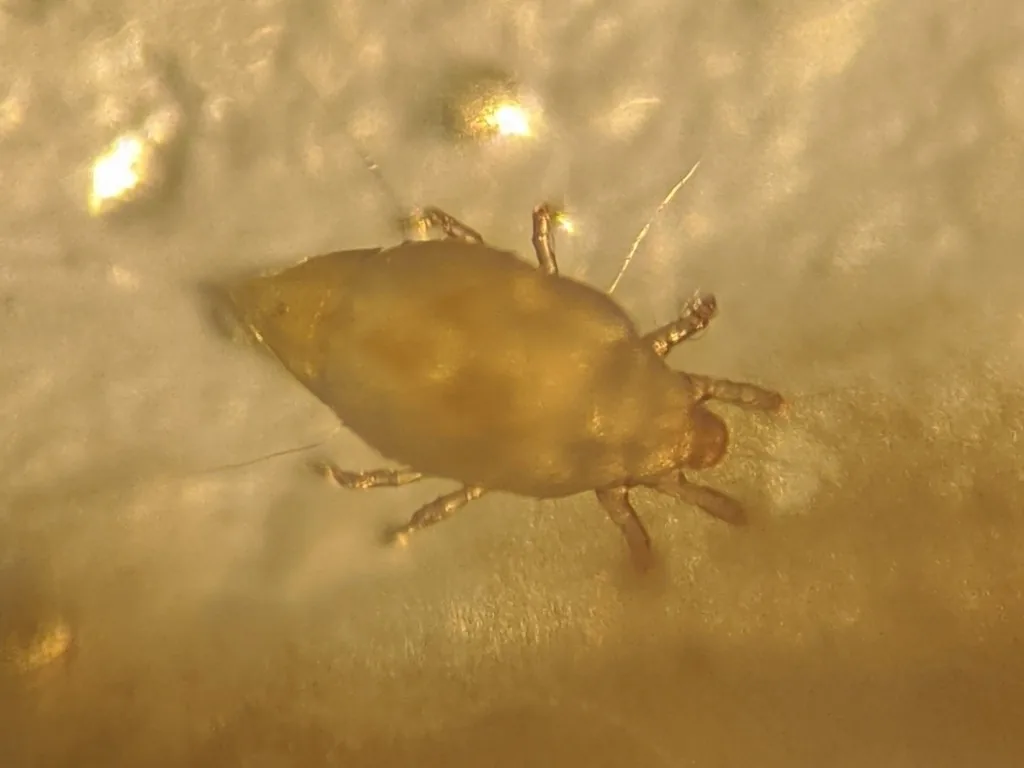
How to identify it
- Extremely small, about 0.3 to 0.4 millimeters long, and translucent, with a more slender body than most other mites.[1]
- Individually they are barely visible without magnification, but large numbers can make the surface of infested food seem to move.[3]
- Heavy infestations leave a pale tan coating of mite dust, made of live and dead mites, shed skins and droppings, under and around the food.[3][2]
- Several similar species, such as the cheese mite, flour mite and grain mite, look alike and are hard to tell apart; they range from off-white and light yellow to brown.[4]
Look-alikes
| Look-alike | How to tell them apart |
|---|---|
| Booklice | Booklice are pale insects about 1 to 2 millimeters long, several times bigger than mold mites; they also feed on mold and thrive in humid rooms.[5][1] |
| Plaster beetles | Mildew-feeding beetles such as the minute brown scavenger beetle are about 2 millimeters long, roughly five times the length of a mold mite.[5][1] |
Where it lives
Found worldwide in stored products, bird and small mammal nests, bee nests and mushrooms, wherever humidity is high.[1][2]
Biology and life cycle
They develop only where there is moisture or high humidity, because they feed on molds and fungal spores; they are not predators or parasites.[1][2][4]
Under ideal warmth and humidity, the life cycle can take as little as two to three weeks.[1]
Tyrophagus putrescentiae favors foods rich in fat and protein, such as seeds, nuts, cheese, ham and dried meats.[2][1]
Infestations have also been reported in wallpaper, furniture, straw and bulbs, always where humidity is high.[4]
Damage and signs
- They infest flour, cereals, baking mixes, dried fruit, grain, bird seed and dry pet food, and can cause heavy losses when numbers build up.[3][2][1]
- Usually they go unnoticed or are just a nuisance; Iowa State notes they don't harm furniture, house structures or clothing.[4][1]
- In barns they infest moldy hay and stored grain; the mold itself may produce toxins that sicken animals eating the feed.[3]
Health risk
Handling infested material can cause an itchy skin rash called grocer's itch, and some people develop allergic or respiratory problems.[3][2][1]
Control
Prevention
Fix the dampness first: lowering humidity and moisture where food is stored matters more than any other step.[2][4]
Buy susceptible foods in small amounts, store them in sealed containers with tight lids, and improve air circulation to keep mold from growing.[3]
Sanitation
Throw out infested food and check what's left. Vacuum shelves and cracks, wipe them with hot soapy water, and let them dry completely before restocking.[3][2]
Seal the vacuumed debris in a plastic bag and dispose of it right away, and keep dry pet food in tight containers away from the pantry.[2][3]
Traps and physical control
Food you suspect may be infested can be cleaned by freezing it for a week or heating it to 120 degrees Fahrenheit for 20 minutes.[2]
Pesticides
Pesticides are not recommended in or near food storage areas, and foods should never be sprayed. Sprays give only temporary relief unless the moisture is corrected.[3][4]
When to call a professional
If a severe infestation persists after cleanup, call a pest management professional.[3]
Mold mites, booklice and plaster beetles share one cause
Mold mites, booklice and mildew-feeding beetles all feed on mold, so finding any of them points to a humidity problem.[5][4]
Texas A&M recommends sanitation, moisture reduction and better ventilation for mildew-feeding insects, noting that pesticides generally provide little control.[5]
In new homes with central heating or air conditioning, several weeks of drying out may be needed before a mildew-feeder infestation runs its course.[5]
Booklice can usually be controlled by bringing relative humidity below 58 percent, and Iowa State likewise puts removing humidity first against mold mites.[5][4]
Common questions
- What is the brown dust under my flour or pet food?
- It may be mite dust, a tan layer of living and dead mites and their waste that builds up under heavily infested food.[3][2]
- Can I save food that might have mold mites?
- Throw out anything visibly infested. Food that only might be infested can be frozen for a week or heated to 120 degrees Fahrenheit for 20 minutes.[3][2]
- Do mold mites bite?
- They aren't parasites, but prolonged contact with infested material can cause an itchy rash known as grocer's itch.[2][3]
Sources
- University of Florida, Department of Entomology and Nematology, “Mold mite, Tyrophagus putrescentiae (Stored Product Pests image gallery).” entnemdept.ufl.edu/projex/gallery/dl/Stored_Product_Pests/text/mold_mite.htm (accessed 2026-10-06)
- Bohart Museum of Entomology, University of California, Davis, “Mold Mites (Information No. 042).” bohart.ucdavis.edu/sites/g/files/dgvnsk4616/files/media/documents/note_39_mold_mites.pdf (accessed 2026-10-06)
- Washington State University Extension, PestSense, “Mites in stored foods (PestSense fact sheet, reviewed December 30, 2025).” pestsense.cahnrs.wsu.edu/fact-sheet/mites-in-stored-foods/ (accessed 2026-10-06)
- Iowa State University Extension and Outreach, “Mold Mites (Yard and Garden encyclopedia).” yardandgarden.extension.iastate.edu/encyclopedia/mold-mites (accessed 2026-10-06)
- Texas A&M AgriLife Extension Service, “Mildew-Feeding Insects in the Home (Insects in the City).” citybugs.tamu.edu/factsheets/household/misc-house/ent-2010/ (accessed 2026-10-06)
- iNaturalist, “Tyrophagus putrescentiae taxon page (order and family).” www.inaturalist.org/taxa/337065 (accessed 2026-10-06)