On this page
How to identify it
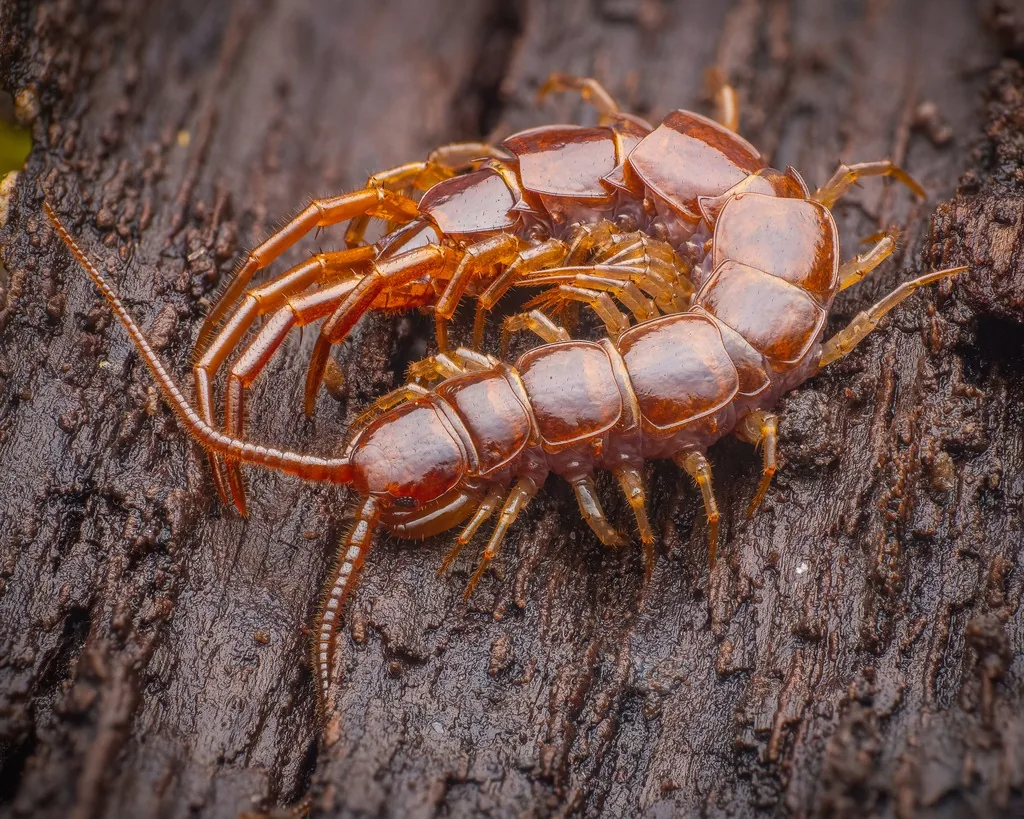
- Centipedes are flattened, usually reddish-brown animals with many body segments, most carrying a single pair of legs. They have a distinct head with long antennae, and the first pair of legs is turned forward around the mouth as fang-like pincers (forcipules) that seize prey and inject venom.[1][3]
- Despite the name, most have far fewer than 100 legs; UC IPM says the number in most species is closer to 30. Kentucky's centipedes mostly have 15 to 30 pairs, and Ohio State counts 15 pairs on adult stone centipedes, 29 or more on soil centipedes and 21 to 23 on the large centipedes.[4][1][3]
- Stone centipedes (order Lithobiomorpha) are the common ones under rocks. They have lost their compound eyes or have none at all. Kentucky's photo of a brown centipede, Lithobius forficatus, shows one about an inch long.[3][1]
- Soil centipedes (order Geophilomorpha) are very slender and completely blind, and people usually find them while digging.[3]
- Sizes differ by source and region. Most Kentucky centipedes are half an inch to an inch long, and the largest there, the eastern bark centipede (Hemiscolopendra marginata), reaches up to 3 inches; Ohio State notes a couple of Ohio species that can top 3 inches, while UC IPM says adult centipedes are usually brownish and more than 1 inch long.[1][3][4]
- Unlike millipedes, centipedes never coil up when disturbed.[4]
Look-alikes
| Look-alike | How to tell them apart |
|---|---|
| House centipede | The house centipede is unusual for its very long, banded legs (up to 15 pairs), three dark stripes down a yellowish-gray to brownish body and well-developed eyes, and it is the only centipede that can live indoors year-round. The stone and soil centipedes that wander in die quickly in dry buildings.[1][3] |
| Millipedes | Millipedes have two pairs of legs on most body segments, with the legs underneath the body, plus short elbowed antennae and, in most species, a rounded body. They move slowly, often curl up when disturbed and feed on decaying plant material, while centipedes run fast and hunt.[1][3] |
| Garden symphylan | Sometimes called a garden centipede, but not a true centipede: it is white, less than 1/4 inch long and has 12 pairs of legs as an adult. It lives in damp soil rich in organic matter and can feed on underground plant parts.[4] |
Where it lives
Centipedes live outdoors in soil, leaf litter and mulch, under rocks and in dead wood, rotting logs and loose bark. Ohio State calls stone centipedes very common in Ohio and the large centipedes relatively rare there, found mainly in southern Ohio forests; in Kentucky the largest species is the eastern bark centipede. GBIF holds about 3,700 U.S. records of stone centipedes since 1990, the most from Texas and Illinois, though most of the world's records come from Europe.[3][2][1][5][6]
Biology and life cycle
Centipedes are generalist predators of insects, spiders, earthworms and other small invertebrates, which they grab and subdue with venom from their fangs. They are mostly active at night and hide in cracks or under objects by day.[1][3][2]
Unlike most arthropods, centipedes lack the waxy coating on the outer skeleton that helps hold water in. They need moist places, which is why they gather in damp spots near foundations and why most die soon after wandering into a dry house.[3][1]
Centipedes are long-lived, but sources give different spans. Ohio State says most can survive three to seven years, UC IPM says they need 2 to 3 years to mature and have been known to live 6 years, and Kentucky says a year or more. Adults overwinter in sheltered, moist places and lay eggs in spring and summer.[3][4][2]
Centipedes do not copulate. The female picks up a sperm packet the male leaves, often after a courtship display, then lays up to 60 eggs in a moist, hidden spot and often curls around them to guard them. The eggs can take up to three months to hatch.[3]
Young centipedes look like small adults. Ohio State says they often hatch with fewer pairs of legs and add more as they molt through five or more immature stages, while UC IPM notes that some species are born with a full set.[3][1][4]
Outdoor centipedes come indoors mostly after the spring warm-up and in fall. They get in under doors and through expansion cracks, floor drains and gaps around pipes and wires, then hide under cardboard, along baseboards and in damp, quiet areas such as basements, crawl spaces, bathrooms and garages.[3][2]
Damage and signs
- Outdoors, centipedes are beneficial predators. Indoors they are nuisance pests: unsettling to find, but they usually turn up only in small numbers.[1][3]
- Problems often coincide with very wet weather, and Kentucky notes that patience and drier conditions often fix them. Large numbers indoors may mean there is plenty of other arthropod prey inside.[2][3]
- They never damage plants or household items.[4]
Health risk
Centipedes can bite with their fang-like front legs when handled or pressed against skin, but extension sources call bites rare, and centipedes are not aggressive unless provoked. Medical reviews describe centipede bites (often called stings) as intensely painful with moderate local inflammation that clears on its own; large tropical centipedes such as Scolopendra can also cause redness, hardening and tissue damage, and deaths are uncommon, resulting from secondary infection or anaphylaxis.[3][7][8][9]
Control
Prevention
Cutting moisture around the foundation is the most effective long-term step. Keep gutters, downspouts and splash blocks carrying water away from the house, fix leaking faucets, pipes and air conditioning units, adjust sprinklers to avoid puddles, and improve drainage where water collects.[2][1]
Dry out basements and crawl spaces with ventilation, a dehumidifier, sump pumps or plastic soil covers.[3][2]
Control the insects and other small arthropods indoors that centipedes feed on.[3]
Keep them out
Seal cracks and openings in the foundation, gaps where pipes and wires enter, and expansion joints where patios and sidewalks meet the house. Fit tight door sweeps or thresholds and weather stripping on exterior doors, and caulk around thresholds and lower windows.[2][1][3]
Sanitation
Clear hiding places from beside the foundation: leaves, grass clippings, heavy mulch, boards, stones, rotting wood, compost and woodpiles. Where practical, Ohio State suggests keeping a strip about 3 feet wide around the house free of litter, and Kentucky suggests raising off the ground anything that can't be moved.[2][3][1]
Traps and physical control
Sweep up or vacuum the occasional centipede indoors. Most that wander inside soon die from lack of moisture, so indoor insecticide treatment is rarely needed. Sticky traps can show which pests are getting in and how many.[2][1][3]
Wear gloves when moving firewood, rocks and debris where centipedes hide, and use tongs or a covered jar to carry one outdoors rather than handling it.[10]
Pesticides
If centipedes keep coming in after you find and seal their entry points, an outdoor treatment can help. Ohio State describes a band of insecticide 18 to 36 inches wide around the foundation, noting that granules often last longer than sprays, and Kentucky adds door thresholds, crawl space entrances, foundation vents and utility openings; rake back heavy mulch and leaf litter first. Total-release foggers (bug bombs) do not work against centipedes because they leave no residue and rarely reach the cracks where centipedes hide. Read and follow the label.[3][2][1]
If you are bitten
For bites and stings in general, MedlinePlus advises washing the site with soap and water, applying ice wrapped in a cloth for 10 minutes on and 10 minutes off, and watching over the next several days for signs of infection such as increasing redness, swelling or pain.[11]
A 2025 medical review says centipede envenomation resolves on its own but can be eased with pain relievers and cold compresses, with antibiotics only if a secondary infection develops, and a Hawaii review describes care for large-centipede bites as supportive: wound care, pain control and antihistamine or anti-inflammatory medicines. MedlinePlus's general bite-and-sting advice is more cautious about medicine, saying not to give aspirin or other pain medicine unless a health care provider prescribes it, so check with a provider first.[8][9][11]
Call 911 or your local emergency number if someone has trouble breathing, swelling of the face or mouth, or other signs of a severe allergic reaction. Emergency-medicine reviews list anaphylaxis among the possible reactions to arthropod bites and stings in North America.[11][12]
Common questions
- Why do I keep finding dead centipedes in the basement?
- Stone and soil centipedes wander in through cracks, drains and gaps, but they lose water easily and most die quickly in a dry building. Only the house centipede lives indoors year-round.[3][1]
- Do centipedes bite people?
- Rarely, and usually only when handled. Medical reviews describe the bite as intensely painful with moderate local inflammation that clears on its own; bites from large tropical species can be more serious.[3][7][8][9]
- Should I get rid of centipedes in the garden?
- Outdoors they are useful predators. Ohio State calls centipedes essential predators that feed on many other arthropods, and both fact sheets treat them as pests only when they come into the house.[3][1]
Sources
- University of Kentucky Entomology Extension, “Centipedes and Millipedes in and Around the Home, ENTFACT-645 (J. Gordon, J.L. Larson, Z. DeVries; revised March 2026).” entomology.ca.uky.edu/ef645 (accessed 2026-11-11)
- University of Kentucky Entomology Extension, “Centipedes and Pseudoscorpions, ENTFACT-647 (L. Townsend, M. Potter).” entomology.ca.uky.edu/ef647 (accessed 2026-11-11)
- Ohio State University Extension (Ohioline), “Centipedes, ENT-50 (2015).” ohioline.osu.edu/factsheet/ENT-50 (accessed 2026-11-11)
- University of California Statewide IPM Program, “Pest Notes: Centipedes and Millipedes (UC ANR Publication 7472).” ipm.ucanr.edu/PMG/PESTNOTES/pn7472.html (accessed 2026-11-11)
- Global Biodiversity Information Facility (GBIF), “Lithobiomorpha (stone centipedes): U.S. occurrence records since 1990 by state (GBIF occurrence search).” api.gbif.org/v1/occurrence/search?taxonKey=807&country=US&hasGeospatialIssue=false&occurrenceStatus=PRESENT&year=1990%2C2026&facet=stateProvince&facetLimit=400&limit=0 (accessed 2026-11-11). Exact count at access: 3,702 U.S. records since 1990 (Texas 906; Illinois 837; Alaska 284).
- Global Biodiversity Information Facility (GBIF), “Lithobiomorpha (stone centipedes): occurrence records since 1990 by country (GBIF occurrence search).” api.gbif.org/v1/occurrence/search?taxonKey=807&hasGeospatialIssue=false&occurrenceStatus=PRESENT&year=1990%2C2026&facet=country&limit=0 (accessed 2026-11-11). Exact counts at access: 68,660 records since 1990; Germany 13,919, France 11,090, United Kingdom 7,523, Poland 4,821, Sweden 4,663, Australia 4,300, United States 3,702.
- University of Wisconsin-Madison Extension (Wisconsin Horticulture), “Centipedes (XHT1113, P. Pellitteri).” hort.extension.wisc.edu/articles/centipedes/ (accessed 2026-11-11)
- Revista da Sociedade Brasileira de Medicina Tropical, via PubMed, “Myriapods (Diplopoda and Chilopoda): medical aspects of envenomations (Haddad Junior et al. 2025; full text PMC12169687).” pubmed.ncbi.nlm.nih.gov/40531675/ (accessed 2026-11-11)
- Hawai'i Journal of Medicine and Public Health, via PubMed, “Centipede envenomation: bringing the pain to Hawai'i and Pacific Islands (Fenderson 2014; full text PMC4244901).” pubmed.ncbi.nlm.nih.gov/25478303/ (accessed 2026-11-11)
- University of Arizona Cooperative Extension, “Backyard Gardener #53: Centipedes (January 15, 2023).” extension.arizona.edu/sites/extension.arizona.edu/files/barnesm/Centipedes.pdf (accessed 2026-11-11)
- MedlinePlus, U.S. National Library of Medicine, “Insect bites and stings (Medical Encyclopedia).” medlineplus.gov/ency/article/000033.htm (accessed 2026-11-11)
- Emergency Medicine Clinics of North America, via PubMed, “Arthropod envenomation in North America (Erickson and Cheema 2017).” pubmed.ncbi.nlm.nih.gov/28411932/ (accessed 2026-11-11)
- iNaturalist, “Lithobius forficatus taxon page (order and family).” www.inaturalist.org/taxa/122234 (accessed 2026-11-08)