The short answer
- Confirm it's slugs or snails: look for silvery slime trails near holes with smooth, irregular edges, or go out after dark with a flashlight. Earwigs and caterpillars make similar holes.[1][2][3]
- Take away their daytime shelter (boards, stones, flowerpots, weeds, dense ground covers such as ivy) and water in the morning, ideally with drip lines, so the soil surface is dry by evening.[1][2][4]
- Handpick at night and trap under boards raised on 1-inch runners, scraping off what collects every morning. Beer or yeast-water traps work, but each one draws slugs from only a few feet away, so you need several.[1][4][3]
- Put copper barriers around raised beds and containers. If you use a bait, choose iron phosphate or ferric sodium EDTA over metaldehyde where dogs, cats or children can reach it; metaldehyde baits are particularly poisonous to dogs and cats, and the pellets can attract dogs.[1][2][4]
- If a dog eats any snail bait, call a veterinarian right away and bring the package. In US poison-center reports from 2001 to 2011, metaldehyde exposures were linked to 35 dog deaths and iron phosphate exposures to none.[3][7]
Related profiles
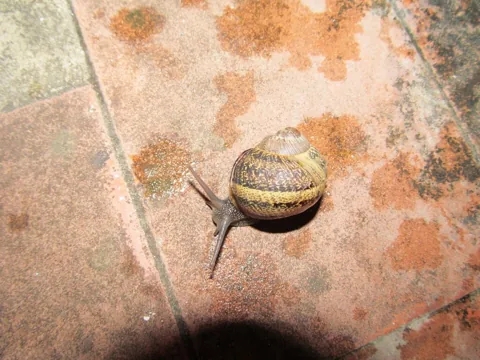 Snails and Slugs
Cornu aspersum (brown garden snail), Deroceras reticulatum (gray garden slug) and related species
Snails and slugs are garden mollusks that hide by day and feed at night, chewing holes in leaves, flowers and low fruit. Slugs are built and behave like snails, just without the external spiral shell, so this page covers both.
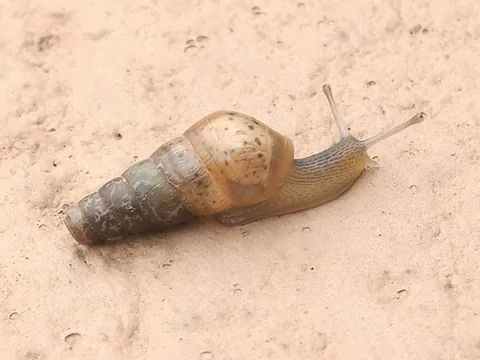 Decollate Snail
Rumina decollata
The decollate snail eats brown garden snails and slugs. It can be released only in certain Central and Southern California counties to protect native snails.
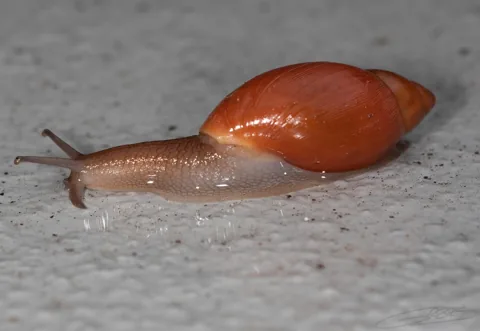 Rosy Wolf Snail
Euglandina rosea
The rosy wolf snail is a large land snail that hunts and eats other snails, and sometimes slugs. In southeastern gardens it needs no control; on islands where people released it, it has wiped out native snails.
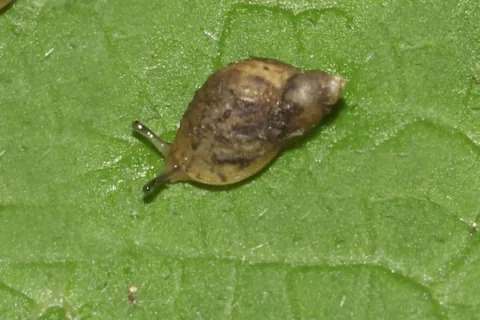 Amber snails
Succineidae (amber snails, e.g. Succinea and Oxyloma species)
Amber snails (family Succineidae) are small air-breathing land snails with very thin, translucent, often amber-colored shells. They live near water and feed on plants, bacteria, fungi, algae and diatoms, and are ordinarily not considered plant pests.
Is it slugs or snails? Damage and signs
Snails and slugs are mollusks, not insects; they are more closely related to clams and mussels. A snail carries an external spiral shell and a slug does not, but they live and feed the same way and are controlled the same way. Both glide on a muscular foot that secretes mucus, which dries into the silvery trail that gives them away.[1][3][4]
Slugs range from 1/4 inch to two inches or longer in Minnesota's description; UMass gives 1/4 inch to over 4 inches depending on age and species. They are usually brownish or grayish with two pairs of feelers: the upper, longer pair carries the eyes and the lower pair is for smelling.[2][5]
Common garden pests in California include the brown garden snail (Cornu aspersum, formerly Helix aspersa), introduced from France in the 1850s as food, and slugs such as the gray garden slug (Deroceras reticulatum), banded slug, three-band garden slug, tawny slug and greenhouse slug. UMass lists the gray garden slug and banded slug among pest species in New England.[1][5]
The damage is irregular holes with smooth edges in leaves and flowers, made by scraping with a rasp-like tongue (the radula). Small leaves may disappear entirely, and seedlings can be clipped off. Ripening fruit near the ground, such as strawberries and tomatoes, gets shallow holes, and the wounds let rot organisms in.[1][2][4][5]
Caterpillars, earwigs and other chewing insects cause similar holes, so look for slime trails before you treat. UMass adds one difference: slugs eat large parts of a leaf outright, while caterpillars tend to avoid leaf veins and stems.[1][3][5]
Plants they hit hardest include basil, beans, cabbage, lettuce, strawberries, dahlia, delphinium, hosta and marigolds; Minnesota adds bellflower, daylily and lungwort. Low to moderate feeding mostly hurts appearance; heavy feeding injures or kills seedlings and reduces harvests.[1][2][3]
Why they keep coming back
All land slugs and snails are hermaphrodites, so every adult can lay eggs after mating. Brown garden snails lay an average of 80 pearly white eggs at a time in a hole in the soil, up to 6 times a year, and take about 2 years to mature. Slugs mature in about 3 to 6 months and lay batches of 3 to 40 translucent eggs under leaves, in soil cracks and in other protected spots.[1][5]
They are most active at night and on cloudy or foggy days. In cold weather they hibernate in the topsoil, and in hot, dry spells snails seal themselves off with a papery membrane, often stuck to tree trunks, fences or walls. In Minnesota slugs usually spend the winter as eggs in soil or under debris, mulch and boards, hatching in spring and early summer.[1][2]
Utah State recommends keeping up control in fall: damage is lighter then, but each slug or snail removed eliminates 300 possible offspring for the next year. In Colorado the most common slugs often have two generations a year, one in spring and one in fall.[3][4]
Checking at night
Because they hide in the day, you may not see them at all until you look after dark or early in the morning. Go out with a flashlight in the evening and check leaf surfaces and undersides, the soil under shady, cool plants, and under rocks and debris.[1][2]
Watering the area in the late afternoon draws them out, which makes a night search more productive. Risk of feeding is higher during cloudy, rainy stretches.[1][3][2]
A daytime alternative is to lay flat objects such as stones or shingles where you suspect slugs; UMass suggests placing them over 6"-deep holes. Lift them during the day to see what has taken shelter underneath. There are no established thresholds for when to treat.[5]
Handpicking
Handpicking can be very effective if you do it thoroughly and regularly. Search daily at first, including fence ledges, the undersides of decks and water meter boxes; once numbers have clearly dropped, weekly handpicking can be enough.[1][3]
Wear rubber or latex gloves. Drop slugs and snails into a bucket of soapy water or diluted household ammonia (5 to 10% solution), or seal them in a plastic bag for the trash.[1][5][2]
Sources disagree on crushing. UC IPM says you can crush captured snails and leave them in the garden, and Minnesota lists crushing as an option; Utah State advises against crushing them in the garden because eggs in the body can still hatch. Utah State also notes that tossing them over the fence doesn't work, since they find their way back.[1][2][3]
Don't use salt. Salt does kill slugs on contact, but it raises soil salinity and damages plants.[1][3][4]
Wear gloves for another reason too. CDC says people can get rat lungworm, a parasite that can cause a rare type of meningitis, by eating raw or undercooked snails or slugs, including a small slug or part of one hidden in raw produce such as lettuce. CDC advises wearing gloves when handling them, washing your hands afterward and washing produce thoroughly.[6]
Board traps
Slugs and snails crawl under anything that stays cool and damp. UC IPM's design is a board about 12 by 15 inches raised on 1-inch runners so they can crawl underneath; Utah State uses a 12" x 12" board with one inch strips of lumber nailed on two sides. Flower pots, inverted melon rinds, shingles and damp newspapers work too.[1][3][2]
Check the traps every morning and destroy what you find. Minnesota says to repeat nightly until damage stops.[1][2][4]
Boards also help you target baits. Utah State suggests putting a small amount of bait under a board trap as a simple bait station, which keeps it moist, out of rain and sun, and harder for pets to reach.[3]
Beer traps: what to expect
Slugs are drawn to the smell of fermentation, not to alcohol. That's why beer works and why a sugar-water and yeast mix works as well; Minnesota's recipe is one teaspoon of yeast to three ounces of warm water.[1][4][3][2]
Bury the container so its rim is level with the soil. Use one with deep vertical sides so slugs can't crawl back out, and a cover with holes cut in it to slow evaporation and keep rain from diluting the bait. Utah State says covered, deeper containers are more effective than shallow pans. Minnesota says to keep the liquid about one inch below the top.[1][3][2]
The catch area is small. UC IPM and Colorado State both say a trap attracts slugs and snails from only a few feet, so a garden needs several traps. Refill every few days to keep the liquid deep enough to drown them; UMass says to check, clean and refill every 2-3 days.[1][4][5][2]
Beer traps are a population-reduction tool for small areas, not a cure. Use them alongside habitat changes and handpicking.[1][3]
Copper barriers
Copper flashing and screen are the easiest barriers to maintain. The copper is thought to react with slime and give slugs and snails something like an electric shock, so they avoid crossing it.[1][2][5]
Size matters. UC IPM suggests a band 4 to 6 inches wide, buried an inch below the soil or attached around the edge of a raised bed, and vertical copper screen at least 2 inches tall with part of it buried 1 to 2 inches so slugs can't go underneath; Utah State uses mesh copper screen or sheeting 8 inches wide. Minnesota warns that not all copper tape sold for slugs is wide enough to span a whole slug, and that sharp edges on some products can cut, a concern around young children.[1][3][2]
Clear the protected area first. Copper keeps slugs out but doesn't kill them, so any already inside a banded planter will stay; handpick until the box is clean before planting. Tarnished copper loses its effect and can be cleaned with a vinegar solution.[1][3]
Barriers aren't foolproof. UMass says they aren't always effective and are most practical at small scales where plants can be fully enclosed, and Utah State notes they divert slugs to nearby plants rather than killing them.[5][3]
For tree trunks, UC IPM wraps copper foil around the trunk with an 8-inch overlap, fastened with one staple and large paper clips so the band can slide as the trunk grows.[1]
Watering timing, mulch and hiding places
Moisture drives slug numbers. Switch from sprinklers to drip irrigation or soaker hoses where you can, water the root zone instead of the leaves, and water in the morning so foliage and soil dry before the pests come out at night.[1][2][4]
Remove places they hide during the day: boards, stones, debris, flowerpots and pavers, weeds, leafy branches touching the ground and dense ground covers such as ivy. Survivors crowd into the shelters that remain, where they are easier to find.[1][2][3]
Go easy on organic mulch. Colorado State advises avoiding straw and grass clippings around susceptible plants, and Minnesota says chopped leaves make good mulch but too much creates slug habitat, so remove and compost the extra in spring.[4][2]
Let in light and air. Prune low branches, thin or divide crowded plants, stake plants and remove lower leaves to lift them off the soil, and use trellises and wider spacing. Minnesota suggests narrow rows 12 to 18 inches wide and better drainage for constantly damp soil.[2][4]
If you find snail eggs in a bed, shallow cultivation brings them to the surface to dry out, and soil solarization under clear plastic kills eggs in raised beds.[1]
Choose plants slugs and snails dislike where they are dense: plants with highly scented or stiff foliage such as lavender, rosemary and sage, along with ferns, hydrangea, California poppy, nasturtium and lantana. Most trees, shrubs and ornamental grasses aren't seriously damaged.[1][3][2]
Remedies that don't hold up
Crushed eggshells and coffee grounds have not been shown to be effective deterrents, according to UC IPM.[1]
Diatomaceous earth scratches slugs but has little effect once it gets damp, which is most of the time slugs are active. Minnesota calls it generally not an effective slug deterrent; UC IPM says a dry band 1 inch high and 3 inches wide can work but is hard to maintain. Wood ashes have the same moisture problem.[2][1][4][5]
Household ammonia diluted to 5 to 10% kills slugs on contact but only when sprayed directly on them, so it suits an overcast evening when slugs are out, not as a barrier. Most insecticides don't poison slugs.[4]
Natural enemies and decollate snails
Ground beetles, rove beetles, firefly larvae, toads, snakes, turtles, shrews and birds eat slugs and snails. On their own they rarely give satisfactory control in a garden, but avoid broad-spectrum insecticides that kill the beetles.[1][2][5]
Penned ducks, geese or chickens can noticeably cut snail problems, but they will eat seedlings too, so protect young plants.[1][3]
The predatory decollate snail (Rumina decollata) eats young brown garden snails and is used in Southern California citrus groves, gardens and landscapes. It also feeds on seedlings, small plants and flowers, though it is less of a problem than the brown garden snail, and snail baits kill it, so don't bait where decollates are working.[1][3]
Because decollate snails could harm endangered native mollusks, California law allows their release only in Fresno, Imperial, Kern, Los Angeles, Madera, Orange, Riverside, Santa Barbara, San Bernardino, San Diego, Ventura and Tulare counties, and even there they shouldn't be put in or near natural areas. Utah State does not recommend them for gardens and notes it is illegal to import exotic snails into Utah without a permit.[1][3]
Snail and slug baits: iron phosphate vs metaldehyde
Baits (molluscicides) help only as part of a program. Used alone they won't control slugs and snails in the long term, especially where shelter, food and moisture are plentiful, and they kill all snails, including decollate snails and native species.[1][3]
Iron phosphate (Sluggo, Slug Magic, Escar-Go and others) is what UC IPM calls a good choice for a home garden IPM program. Slugs stop feeding after eating it and die over several days to a week, usually hidden under plants, so you won't see dead slugs scattered around. Some formulations are approved for organic growing. Minnesota says it stays effective for two weeks even when wet.[1][2][3]
How well it works: Colorado State says data suggest iron phosphate is generally comparable to metaldehyde, and Utah State says it works better than metaldehyde under moist conditions. Iron phosphate can be used around edible crops, according to Colorado State, though UMass says neither bait should go on the edible parts of plants.[4][3][5]
Ferric sodium EDTA products work like iron phosphate but faster, killing snails in about three days instead of seven, and aren't labeled for organic use. Some iron phosphate products add spinosad to also control earwigs and cutworms.[1][2]
Metaldehyde makes slugs secrete large amounts of mucus and die of water loss, usually within a day. It works best in warm, dry weather; in cool, wet weather slugs can recover from a sublethal dose, and some formulations break down quickly in sunlight and after rain or irrigation. UC IPM says 4% products are more effective than 2% ones. Utah State warns that relying on it continuously can select for resistant populations.[4][1][3]
Sources differ on metaldehyde near food crops: Colorado State says current products don't allow direct application among vegetables, while Utah State says the baits can be used around food plants if the edible parts don't touch the bait. Follow the label on the package you buy.[4][3]
Skip baits that combine metaldehyde with carbaryl. Carbaryl kills earthworms and ground beetles, and Utah State says the combination raises toxicity to pets and wildlife.[1][3]
Dogs, cats and snail bait poisoning
Metaldehyde baits are particularly poisonous to dogs and cats, and the pellets can attract dogs. UC IPM and Minnesota both advise against using them anywhere pets or children could get to them; UC IPM's summary adds birds.[1][2][4]
Poison-center records show the difference. A review of 1,500 animal exposure reports to the National Pesticide Information Center from 2001 to 2011 (1,285 involving metaldehyde, 215 iron phosphate) found 35 dog deaths associated with metaldehyde and none with iron phosphate. Metaldehyde reports fell each year from 2006, when a change in metaldehyde product labeling began, to 2011, while iron phosphate reports rose; the authors did not test those trends statistically.[7]
Iron baits are safer, not harmless. The same review describes dogs with signs consistent with iron toxicosis after eating iron phosphate bait. In an Australian case series, five dogs that ate large amounts of an iron EDTA bait developed abdominal pain and bloody gastroenteritis 6 to 24 hours later; all five survived with treatment.[7][8]
Signs of metaldehyde poisoning include tremors, weakness, excitability, a fast heart rate and rising body temperature, which can progress to convulsions and death. In a French study of 26 poisoned dogs the most common signs were wobbliness (ataxia), convulsions, drooling and tremors, and 81% survived.[3][9]
If you suspect a pet ate snail bait, call a veterinarian immediately and bring the container or note the brand so they know the active ingredients. Utah State says treatment can last several days up to a week, and recovery is likely good when caught early.[3]
Prevention: use iron-based baits where pets roam, put bait in covered bait stations, keep pets out of treated areas while bait is still visible, and store the package where pets can't reach it. Colorado State specifically says not to let dogs get into metaldehyde packages.[1][3][4]
How to apply bait so it works
Water lightly first, then apply bait in the late afternoon or evening on a warm day when slugs will be active. Don't water heavily after baiting: the pellets mold and lose their appeal, and Utah State says water dilutes bait.[1][2][3]
Scatter, never pile. Sprinkle bait on soil where slugs travel, near but not on the plants you're protecting, along walls and fences and around sprinkler and meter boxes. Piles attract pets and children, clump when wet and work worse. Colorado State's guide for metaldehyde is 10 or more pieces per square yard.[1][4]
Rebait the same spots, since slugs return to feeding sites, and avoid very hot, very dry or cold periods when they aren't active.[1]
Common questions
- What kills slugs and snails fastest?
- Metaldehyde baits usually kill within a day, and ferric sodium EDTA baits in about three days, compared with up to a week for iron phosphate. Metaldehyde is far more hazardous to dogs and cats, so for most gardens with pets an iron-based bait plus handpicking is the better trade.[1][2]
- Is Sluggo safe for dogs?
- Iron phosphate baits such as Sluggo are much safer than metaldehyde: in poison-center reports from 2001 to 2011 they were linked to no dog deaths, against 35 for metaldehyde. Dogs that eat a lot of iron bait can still get sick, so store it securely and call a vet if a dog gets into it.[7][1][2]
- Do beer traps work for slugs?
- Yes, within limits. Slugs come to the fermentation smell and drown, but each trap only draws from a few feet away, so you need several traps, deep containers and fresh beer or yeast water every few days.[1][4][5]
- Does copper tape keep slugs away?
- Copper repels slugs and snails, but only if the strip is wide enough to span a whole slug, is kept clean of tarnish, and fully encloses a bed or container that is already slug-free. Narrow tapes sold for slugs may not be wide enough.[1][2][5]
- Do eggshells or coffee grounds stop slugs?
- They haven't been shown to work, according to UC IPM. Diatomaceous earth and wood ash work only while dry, so they fail in the damp conditions slugs prefer.[1][2][4]
- Should I pour salt on slugs?
- No. Salt kills slugs, but it builds up in the soil and damages plants.[1][3][4]
- When is the best time to water to reduce slugs?
- Morning. Watering early lets leaves and soil dry before slugs come out at night; evening watering leaves the garden wet just when they feed.[1][2][4]
Photo credits
- Snails and Slugs: (c) zebedeugalinha, some rights reserved (CC BY) — via iNaturalist, CC BY 4.0
- Decollate Snail: (c) Rodolfo Salinas Villarreal, some rights reserved (CC BY) — via iNaturalist, CC BY 4.0
- Rosy Wolf Snail: (c) Tedd Greenwald, some rights reserved (CC BY) — via iNaturalist, CC BY 4.0
- Amber snails: Liubov Ilminska, public domain (CC0), via iNaturalist
Sources
- UC Statewide IPM Program, “Pest Notes: Snails and Slugs (UC ANR Publication 7427; C.A. Wilen, M.L. Flint).” ipm.ucanr.edu/home-and-landscape/snails-and-slugs/ (accessed 2026-11-10)
- University of Minnesota Extension, “Slugs in home gardens (J. Weisenhorn, J. Hahn; reviewed 2024).” extension.umn.edu/yard-and-garden-insects/slugs (accessed 2026-11-10)
- Utah State University Extension, “Controlling Slugs and Snails in Utah (L.A. Sagers, K. Rood).” extension.usu.edu/planthealth/research/slugs-snails (accessed 2026-11-10)
- Colorado State University Extension, “Slugs.” extension.colostate.edu/resource/slugs/ (accessed 2026-11-10)
- UMass Amherst Center for Agriculture, Food, and the Environment, “Slugs (Vegetable fact sheet).” www.umass.edu/agriculture-food-environment/vegetable/fact-sheets/slugs (accessed 2026-11-10)
- Centers for Disease Control and Prevention, “About Rat Lungworm Disease.” www.cdc.gov/angiostrongylus/about/index.html (accessed 2026-11-10)
- Journal of the American Veterinary Medical Association, via PubMed, “Buhl, Berman and Stone (2013), Reports of metaldehyde and iron phosphate exposures in animals and characterization of suspected iron toxicosis in dogs, J Am Vet Med Assoc.” pubmed.ncbi.nlm.nih.gov/23600781/ (accessed 2026-11-10)
- Australian Veterinary Journal, via PubMed, “Haldane and Davis (2009), Acute toxicity in five dogs after ingestion of a commercial snail and slug bait containing iron EDTA, Aust Vet J.” pubmed.ncbi.nlm.nih.gov/19573155/ (accessed 2026-11-10)
- Open Veterinary Journal, via PubMed, “Dutil and Berny (2023), A prospective study on clinical signs, management, outcomes, and delayed neurologic sequelae due to metaldehyde poisoning in 26 dogs, Open Vet J.” pubmed.ncbi.nlm.nih.gov/37304610/ (accessed 2026-11-10)