On this page
How to identify it
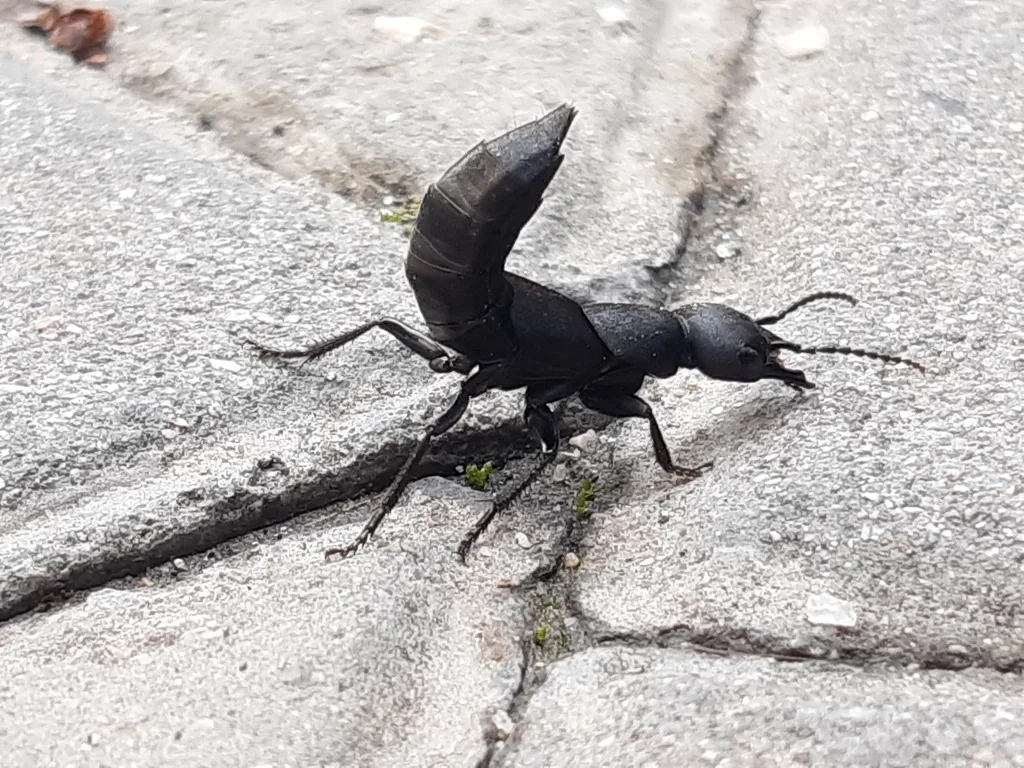
- A large, all-black rove beetle, reaching about 32 mm (1 1/4 inches) and one of the largest members of its family worldwide. The body is long and robust, with a large head and massive mandibles toothed along the inner edge.[1][2]
- When agitated it raises its abdomen and opens its mandibles in a threat posture.[1]
Where it lives
Widespread and generally common across the Palearctic, including North Africa, and introduced to North America and Australasia. It lives in many habitats, especially damp woodland, grassland, brownfield sites and gardens.[1]
Biology and life cycle
It is largely nocturnal and spends the day under leaf litter, logs and stones. Larvae and adults are both generalist predators of a wide range of invertebrates, and they also eat carrion.[1]
Adults can be found all year and spend the winter as adults. Mating takes place in late summer or autumn, eggs are laid two to three weeks later, and adults can live up to two years.[1]
It is a known snail predator. In laboratory trials, adults killed adult garden snails (Cornu aspersum) 30 to 35 mm across, starting with repeated bites to the snail's extended head. Larvae used the same attack with much more difficulty: they never killed snails that large and most often took snails of 18 to 22 mm.[2]
Adults and larvae also fed on snails about 12 hours after the snails died, drawn by the smell of decay. On Sardinia it is among the predators that cause the most trouble on snail farms.[2]
Biological control workers have imported various rove beetles into Italy, Hawaii, the mainland United States and Easter Island, and Ocypus is among the genera that have been moved, but those introductions brought no evident success.[3]
It has been associated with evil and the devil in folklore since the Middle Ages.[1]
Damage and signs
Health risk
It can give a painful bite to people, and it readily releases defensive secretions from its mouth and the tip of its abdomen.[1]
Control
Prevention
No control is needed in a garden: it is a generalist predator of snails and other invertebrates. Don't pick one up bare-handed, because it can bite painfully.[1][2]
Common questions
- Can the devil's coach horse beetle bite?
- Yes. It can give a painful bite to people, and it also releases defensive secretions from its mouth and abdomen tip.[1]
- Why does it raise its tail?
- Raising the abdomen and opening the mandibles is its threat posture when it is agitated.[1]
- Is it good to have in a garden?
- It is a predator of many invertebrates, snails among them; in laboratory trials, adults killed full-grown garden snails.[1][2]
Sources
- Wellcome Open Research (Wellcome Trust), full text in PubMed Central (PMC9069170), “Crowley et al. (Darwin Tree of Life Consortium). The genome sequence of the devil's coach horse beetle, Ocypus olens (Muller, 1764). Wellcome Open Research (2021), doi:10.12688/wellcomeopenres.17342.2.” doi.org/10.12688/wellcomeopenres.17342.2 (accessed 2026-11-09)
- Insects (MDPI), full text in PubMed Central (PMC11594771), “Murgia, Coroneo, Zuddas, Pani and Cogoni. Garden Snail Predatory Insects' Modus Operandi Under Laboratory Conditions. Insects 15: 865 (2024), doi:10.3390/insects15110865.” doi.org/10.3390/insects15110865 (accessed 2026-11-09)
- University of Florida IFAS Extension (Featured Creatures), “Rove Beetles of the World, Staphylinidae (Insecta: Coleoptera: Staphylinidae), EENY-114 (J. H. Frank and M. C. Thomas; September 1999).” journals.flvc.org/edis/article/view/108401 (accessed 2026-11-09)
- iNaturalist, “Ocypus olens taxon page (order and family).” www.inaturalist.org/taxa/53869 (accessed 2026-11-09)