On this page
How to identify it
- The mite itself is microscopic, so scabies is recognized by what it does to the skin: a pimple-like rash, severe itching and tiny burrows. MedlinePlus describes a burrow as looking like a pencil mark.[1][2][4]
- The itching is usually worst at night. Wisconsin's health department and the CDC list the webs and sides of the fingers, the skin folds of the wrists, elbows, knees and armpits, the waist, thighs, abdomen, genitals, nipples, buttocks and shoulder blades.[2][1]
- Babies and very young children are more likely to have the rash on the head, face and neck and on the palms and soles. MedlinePlus notes that scabies doesn't affect the face except in babies and in people with crusted scabies.[1][2][4]
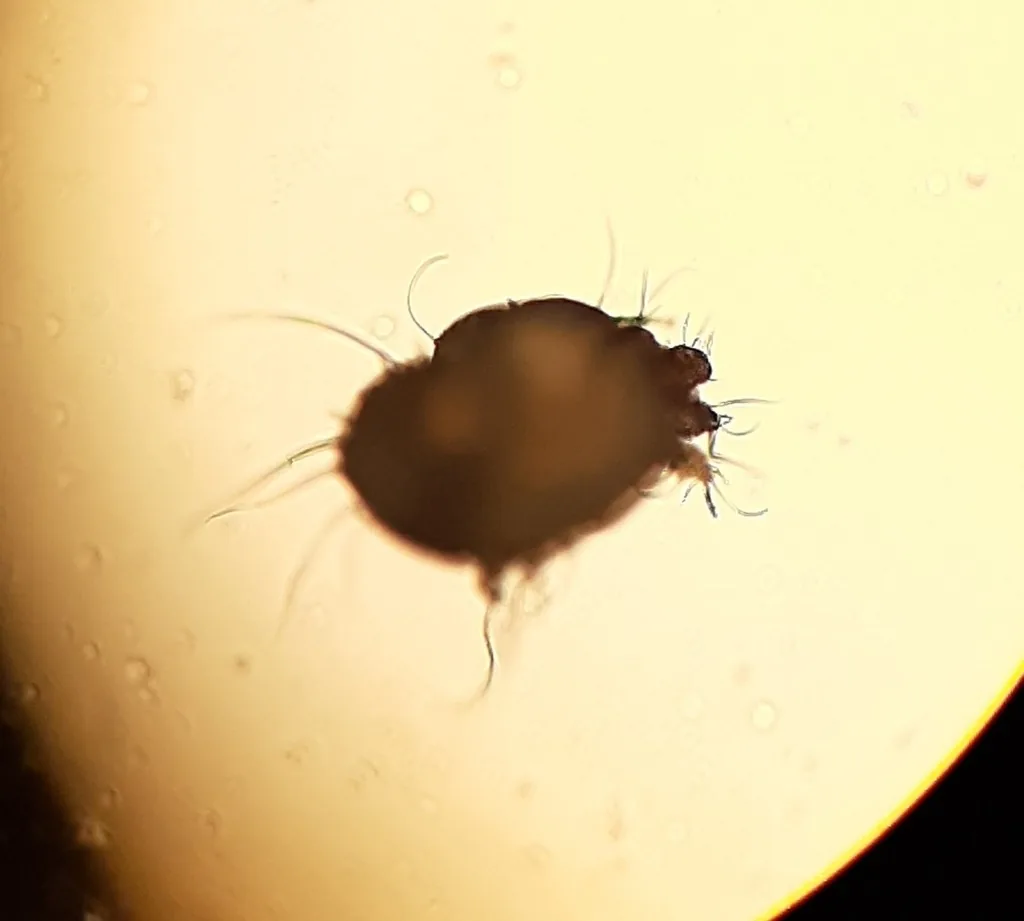
- Under a microscope the mite has an oval, tortoise-like body, flat underneath and domed on top, with spines on its back and short, stubby legs.[3]
- A person with ordinary scabies carries surprisingly few adult mites: fewer than 15, with an average of about 11, in a study of some 900 adult patients. The CDC likewise says an otherwise healthy person may carry fewer than 10 to 15. People with crusted (Norwegian) scabies and animals with advanced infestations carry thousands.[3][1]
- A clinician usually confirms scabies by scraping the skin, or lifting a mite from the end of its burrow with a needle tip, and finding mites, eggs or mite droppings under a microscope. A person can still have scabies even when none are found.[1][2][4]
Look-alikes
| Look-alike | How to tell them apart |
|---|---|
| Guinea pig mite (Trixacarus caviae) | A related mite that looks much like the scabies mite but is much smaller. It lives on guinea pigs and can cause itchy dermatitis in people who hold or handle infested guinea pigs.[3] |
Where it lives
Scabies is found worldwide in people of every age and group, whatever their standard of personal hygiene. Outbreaks are more common in nursing homes and other extended care facilities, child care centers, jails and prisons and college dorms, and the same mite species infests many wild and domestic mammals, including dogs, foxes, coyotes, deer, goats and rabbits.[1][4][2][3]
Biology and life cycle
Scabies mites live in burrows they dig in the outer, nonliving layer of the skin, where females lay their eggs. They appear to feed on fluid that seeps into the burrow from the living skin cells just below and leave their droppings behind them as they go.[3][1]
The life cycle runs from egg to larva, through two nymphal stages, to adult. Published estimates for mites from people range from about 7 to 21 days for the full cycle, and older literature credits a female with 40 to 50 or more eggs over a life of 26 to 40 days.[3]
All stages sometimes leave their burrows and wander over the skin. Mites placed on skin dig in quickly: in laboratory tests with mites from dogs, females began burrowing within about 20 minutes and males, nymphs and larvae within 5 minutes.[3]
Mites pass from person to person mostly through direct, extended skin-to-skin contact, which is why whole families are often affected. Less commonly they spread through shared clothing, towels or bedding; Wisconsin's health department says that outside severe cases, clothing, bedding and furniture do not spread scabies.[1][4][2]
Away from a person, the CDC says scabies mites generally don't survive more than two to three days. In laboratory tests, females from dogs lived a week or more at 59 degrees F and relative humidity above 75 percent but only 1 to 2 days at 77 degrees F, and the review's authors estimate that in dry air (below 50 percent relative humidity) the mites likely survive and stay infective for less than 36 hours.[1][5][3]
Damage and signs
- The burrowing mites cause a pimple-like rash and severe itching. The itch is an allergic reaction to the mites and their droppings, and intense scratching can lead to a bacterial skin infection such as impetigo.[1][4][2]
- Symptoms are slow to appear the first time: two to six weeks after exposure according to Wisconsin's health department, four to eight weeks according to the CDC. A person can pass scabies on during that time, before any itching starts. Someone who has had scabies before can react within one to four days of being re-exposed.[2][1]
- Because an early infestation involves very few mites and causes few or no symptoms for many weeks, ordinary scabies is hard to diagnose early.[3]
- In animals the same mite causes sarcoptic mange. Dogs, foxes, coyotes, deer, goats, rabbits and other mammals with advanced infestations carry thousands of mites.[3]
Health risk
Scabies is an infectious skin disease. A person can pass it on until the mites and eggs are killed, usually by one treatment with an effective prescription medication; the CDC says children and adults can return to child care, school or work the day after treatment. Crusted scabies is a severe, very contagious form with very large numbers of mites that mostly affects people with weakened immune systems, and a delayed diagnosis often causes outbreaks.[2][6][1][4]
Control
Prevention
Treat all household members and close contacts at the same time, even if they have no symptoms, so the mites aren't passed back. The CDC also advises telling anyone you had skin-to-skin contact with in the previous two months.[1][6][4][2]
Don't spray the house. The CDC says not to use insecticide sprays or fumigants to treat scabies or crusted scabies, and Wisconsin's health department says environmental pesticides should be avoided.[5][2]
Avoid skin-to-skin contact with an infested person until treatment is finished, and don't share their clothing, towels or bedding.[1][6][2]
Sanitation
Machine-wash bedding, clothing and towels used next to the skin in the three days before treatment in hot water and dry them on a hot cycle; the CDC says temperatures above 122 degrees F for 10 minutes kill mites and eggs. Dry-clean items that can't be washed, or seal them in a plastic bag for at least 72 hours to a week.[1][6][5]
MedlinePlus also advises vacuuming carpets and upholstered furniture.[4]
Pesticides
Itching can last for weeks after the mites are dead and doesn't by itself mean treatment failed. The CDC says retreatment may be needed if itching continues more than 2 to 4 weeks after treatment or new burrows or rash appear; Wisconsin's health department warns against over-treating.[5][1][2][4]
When to call a professional
See a healthcare provider. Scabies is treated with a prescription cream or lotion (a scabicide) or, in some cases, a pill; over-the-counter products have not been tested and approved for it. MedlinePlus names permethrin 5% as the medicine most often used, with ivermectin pills for hard-to-treat cases.[5][1][4][2]
Scabicide is applied to the whole body from the neck down to the feet and toes; children need it on the head and neck too, and infants should get only the product their pediatrician recommends. MedlinePlus notes the treatment is typically repeated in a week.[1][5][4]
Pets get a different form of the mite, which causes mange. Those mites can get under human skin and cause temporary itching but cannot survive or reproduce on people, so the CDC advises treating any animal with mange.[6]
Crusted (Norwegian) scabies
Crusted scabies is a severe infestation with very large numbers of mites, mostly in people with weakened immune systems; a severe case with heavy scaling or crusting may itself be a sign of a weakened immune system.[4]
It is very contagious, and the CDC says it should be treated aggressively, because a delayed diagnosis often sets off outbreaks that are hard to control in institutions such as nursing homes.[1][6]
People with crusted scabies, like animals with advanced mange, carry thousands of mites that are easy to find in a skin scraping.[3]
Where sources disagree
Time to first symptoms: Wisconsin's health department gives two to six weeks after a first exposure, the CDC four to eight weeks.[2][1]
What to launder: the CDC says to wash everything used next to the skin in the three days before treatment and to bag unwashable items for at least 72 hours to a week, while Wisconsin's health department limits laundering to severe cases, covers the 48 hours before treatment and suggests bagging for 5 to 7 days. The CDC gives 122 degrees F for 10 minutes as killing mites and eggs; MedlinePlus says to dry at 140 degrees F or higher.[1][6][2][4]
How long itching lasts after treatment: one to two weeks according to Wisconsin's health department, two weeks or more according to MedlinePlus, and several weeks according to the CDC.[2][4][5]
Animals: the CDC says animals do not spread human scabies, but the Parasites & Vectors review reports that genetic studies disagree, with work in northern Australia finding separate mite populations on people and dogs and a study in China concluding people could be infected with mites from dogs.[6][3]
Common questions
- Can I catch scabies from my dog?
- Usually not with human scabies. The CDC says animals don't spread human scabies; dogs get a different form of the mite that can cause temporary itching on people but can't reproduce on them. Researchers still disagree on how separate the forms are: a study in China concluded people could be infected with mites from dogs, while work in northern Australia found separate transmission cycles in people and dogs even in the same household.[6][3]
- Do I need to spray my house for scabies?
- No. The CDC says not to use insecticide sprays or fumigants for scabies, and Wisconsin's health department says environmental pesticides should be avoided. Treat the people, wash bedding, clothing and towels used in the days before treatment in hot water, and bag what can't be washed.[5][2][1]
- Why do I still itch after treatment?
- The itch is an allergic reaction to the mites and their droppings, so it can continue for weeks after every mite is dead. If it lasts more than 2 to 4 weeks after treatment, or new burrows or rash appear, see your provider about retreatment.[5][1]
- How long can scabies mites live off the body?
- The CDC says generally no more than two to three days. Laboratory work on mites from dogs found survival is shortest in warm, dry air, and the Parasites & Vectors review estimates that leaving bedding and clothing isolated for 48 hours at room temperature should kill them.[1][3]
Sources
- Centers for Disease Control and Prevention, “About Scabies (September 9, 2024).” www.cdc.gov/scabies/about/index.html (accessed 2026-11-11)
- Wisconsin Department of Health Services, Division of Public Health, “Scabies, Disease Fact Sheet Series P-42089 (rev. May 2004).” www.dhs.wisconsin.gov/publications/p4/p42089.pdf (accessed 2026-11-11)
- Parasites & Vectors (BioMed Central), “A review of Sarcoptes scabiei: past, present and future (L. G. Arlian and M. S. Morgan), Parasites & Vectors 10:297 (2017).” pmc.ncbi.nlm.nih.gov/articles/PMC5477759/ (accessed 2026-11-11)
- MedlinePlus, U.S. National Library of Medicine, “Scabies (Medical Encyclopedia).” medlineplus.gov/ency/article/000830.htm (accessed 2026-11-11)
- Centers for Disease Control and Prevention, “Treatment of Scabies (January 12, 2024).” www.cdc.gov/scabies/treatment/index.html (accessed 2026-11-11)
- Centers for Disease Control and Prevention, “Preventing Scabies (December 18, 2023).” www.cdc.gov/scabies/prevention/index.html (accessed 2026-11-11)
- iNaturalist, “Sarcoptes scabiei taxon page (order and family).” www.inaturalist.org/taxa/262979 (accessed 2026-11-08)