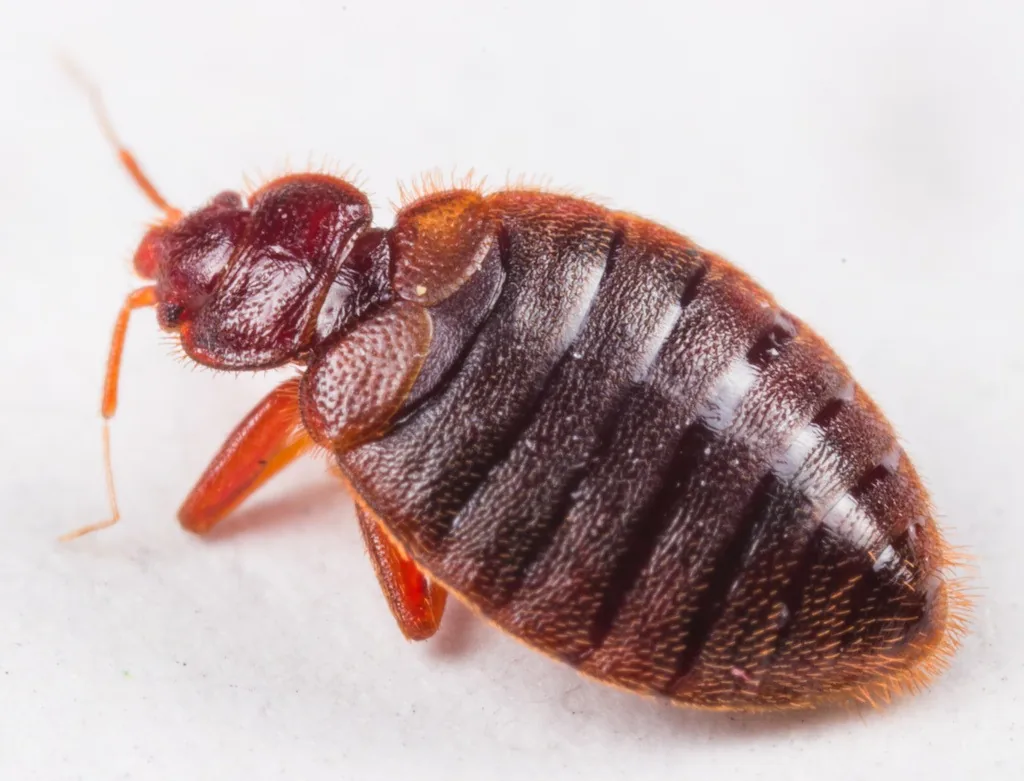
How to identify it
- It looks so much like the common bed bug that most people couldn't tell them apart without a microscope.[1]
- Specialists measure the plate behind the head: it is less than 2.5 times as wide as long in the tropical bed bug, and wider than that in the common bed bug.[1]
- The side edges of that plate are less upturned than on the common bed bug.[1]
Look-alikes
| Look-alike | How to tell them apart |
|---|---|
| Common bed bug | The common bed bug has a relatively wider plate behind the head with more upturned edges, and it dominates in temperate climates rather than the tropics.[1][3] |
| Bat bug | Bat bugs have hairs on the plate behind the head longer than the eye is wide; on bed bugs those hairs are shorter. Seeing this takes a hand lens or microscope.[3] |
Where it lives
Found mainly in tropical and subtropical areas within about 30 degrees of the equator. In the U.S., published records come from Florida: several counties in the 1930s and 1940s, an Orlando hotel in 1989, and a Brevard County home in 2015.[1]
Biology and life cycle
Biologically and behaviorally it is similar to the common bed bug and feeds on human blood.[1][2]
Earlier research suggests it may develop faster than the common bed bug, though the two haven't been compared directly under the same conditions.[2]
Little is known about its ecology, biology and insecticide resistance compared with the common bed bug.[1]
Bed bugs in general hide in cracks and crevices near where people sleep and spread on clothing, bedding, furniture and luggage.[3]
Damage and signs
- Bed bugs leave odors and reddish-brown to black fecal spots on sheets and around their hiding places.[3]
Health risk
A severe infestation can cause anxiety, sleeplessness and itchy, blistering reactions in some people, as with common bed bugs. Bed bugs have never been shown to transmit human disease.[2][3]
Control
Sanitation
Reducing clutter is the first step toward controlling the spread of bed bugs.[2]
Traps and physical control
For bed bugs generally, combine vacuuming, washing bedding at high temperature, steam or heat treatment and sealing hiding places with any insecticide treatment.[3]
When to call a professional
Because bed bugs are so hard to control, UF researchers advise people with an infestation to hire a professional pest control service.[2]
Get the species identified first; UF/IFAS asked for suspected samples, sealed in a small container or folded plastic bag, to help track where this species occurs.[2]
Common questions
- Is the tropical bed bug harder to get rid of?
- Not known yet. It should respond to the same methods as the common bed bug, but researchers note it may need different strategies, and identifying the species helps explain control failures.[2][1]
- How do I know which bed bug I have?
- You can't tell by eye. A lab measures the shape of the plate behind the head, so send a sample to an extension or university identification lab.[1][2]
Sources
- Florida Entomological Society (Campbell, Koehler, Buss and Baldwin, University of Florida), “Recent Documentation of the Tropical Bed Bug (Hemiptera: Cimicidae) in Florida Since the Common Bed Bug Resurgence, Florida Entomologist 99(3): 549-551 (2016).” doi.org/10.1653/024.099.0333 (accessed 2026-10-06)
- UF/IFAS Communications, “Tropical bed bug reappears after 60-year absence (November 9, 2016).” blogs.ifas.ufl.edu/news/2016/11/09/tropical-bed-bug-reappears-after-60-year-absence/ (accessed 2026-10-06)
- University of California Statewide IPM Program, “Pest Notes: Bed Bugs, Publication 7454 (May 2013).” ipm.ucanr.edu/legacy_assets/PDF/PESTNOTES/pnbedbugs.pdf (accessed 2026-10-06)
- iNaturalist, “Cimex hemipterus taxon page (order and family).” www.inaturalist.org/taxa/936185 (accessed 2026-10-06)