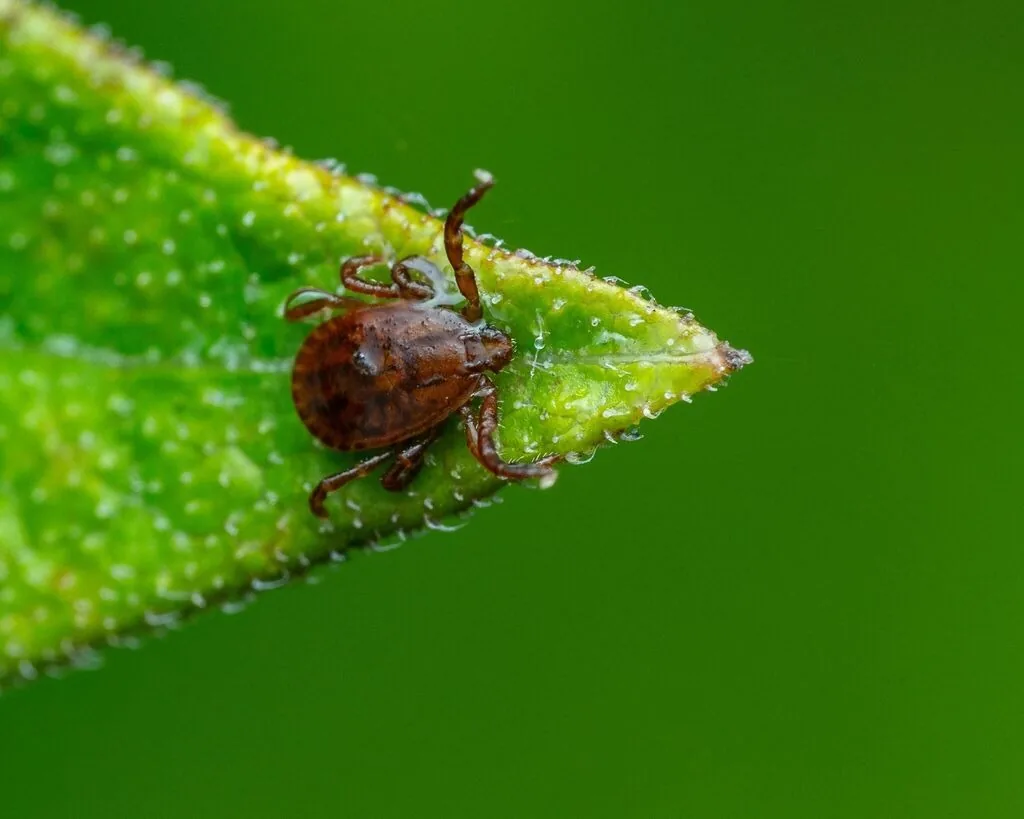
How to identify it
- Adults are small, about 0.1 inch long, and plain brown with no markings or distinct colors on the back.[1]
- Larvae and nymphs are tiny and easy to miss, but they may show up in unusually large numbers on one animal.[1]
- On animals, look on the ears, brisket, back of the neck, shoulders, inner flanks, groin, armpits and around the anus.[1]
- A small Haemaphysalis tick found on cattle, deer or other large hosts is very likely this species, since the two native Haemaphysalis ticks feed almost only on rabbits or birds.[1]
Look-alikes
| Look-alike | How to tell them apart |
|---|---|
| Lone star tick (immature) | Nymphs of the two species look alike, but their mouthparts differ; send specimens to a lab rather than relying on a photo.[1] |
| Rabbit tick and bird tick | These native Haemaphysalis ticks are similar but feed almost entirely on rabbits or birds, not on livestock, deer or pets.[1] |
Where it lives
Native to East and Central Asia. As of April 2024 the CDC listed 20 eastern and central states with finds, from Massachusetts and New York south to Georgia and west to Missouri and Arkansas.[1][2]
Biology and life cycle
U.S. populations are entirely female and reproduce without mating, a trait called parthenogenesis, so a single tick can start a large infestation.[1][3][2]
It has three life stages, larva, nymph and adult, and each one feeds on a different host before dropping off.[1]
After her blood meal, an adult female drops off and lays up to 2,000 eggs over two to three weeks.[1]
Hosts include cattle, horses, sheep, goats, deer, dogs, cats, opossums, raccoons, foxes and groundhogs; it has also been found on people.[1][3][2]
Thousands of ticks may be found at one time in grass, in shrubs or on a single animal.[2]
Damage and signs
- Large numbers feeding on one animal can cause anemia, and the tick spreads bovine theileriosis, which can cut dairy production and occasionally kills calves.[1]
- In Australia and New Zealand, where it is also invasive, it can reduce dairy cattle production by about 25 percent.[3]
- It has been confirmed to spread Babesia parasites that infect animals.[1]
Health risk
It seems less attracted to people than native ticks. In other countries it spreads germs that can seriously sicken people, but whether U.S. ticks pass pathogens to people, and how often, is still being studied.[2][3]
Control
Prevention
Check pets and livestock regularly and do personal tick checks after time in tick habitat; Penn State calls this the most straightforward way to prevent disease.[1]
Use permethrin-treated clothing and a repellent containing DEET, picaridin or IR3535 when you are in tick habitat.[1]
Sanitation
Keep grass short, control weeds and brush, cut back tall growth along fence lines and remove woody debris from lawn and pasture edges.[1]
Keep about a 9-foot gap between lawn or pasture and wooded edges to reduce tick contact.[1]
Traps and physical control
Remove ticks from pets or livestock with fine-point tweezers close to the skin, pulling back slowly and gently until the tick lets go.[1]
Pesticides
Perimeter treatments with a fungal biopesticide or pyrethroid or carbamate insecticides are an option in tick areas; follow the label, and note some products require a licensed applicator.[1]
When to call a professional
Ask your veterinarian about whole-animal treatments for livestock and fipronil-based or similar products for dogs and cats.[1]
Common questions
- Why are there so many Asian longhorned ticks on one animal?
- Females in the United States lay eggs without mating, so one tick can produce a whole population and cause massive infestations on a host.[3][1][2]
- Does the Asian longhorned tick spread Lyme disease?
- A CDC-cited experimental study found it is unlikely to help spread Lyme disease bacteria in the U.S. A lab study showed it can carry Rocky Mountain spotted fever bacteria, which have not been found in wild ticks.[2]
- What should I do if I think I found one?
- Collect a few ticks from the animal, put them in 70 percent alcohol or freeze them, note the place, host and date, and send them to an identification lab. Photos are not accepted in place of specimens.[1]
Sources
- Penn State Extension, “Asian Longhorned Tick, Haemaphysalis longicornis (updated May 21, 2026).” extension.psu.edu/asian-longhorned-tick (accessed 2026-10-06)
- Centers for Disease Control and Prevention, “Where Ticks Live.” www.cdc.gov/ticks/about/where-ticks-live.html (accessed 2026-10-06)
- Centers for Disease Control and Prevention, “Multistate Infestation with the Exotic Disease-Vector Tick Haemaphysalis longicornis, United States, August 2017-September 2018 (MMWR 67(47)).” www.cdc.gov/mmwr/volumes/67/wr/mm6747a3.htm (accessed 2026-10-06)
- iNaturalist, “Haemaphysalis longicornis taxon page (order and family).” www.inaturalist.org/taxa/485044 (accessed 2026-10-06)