How to identify it
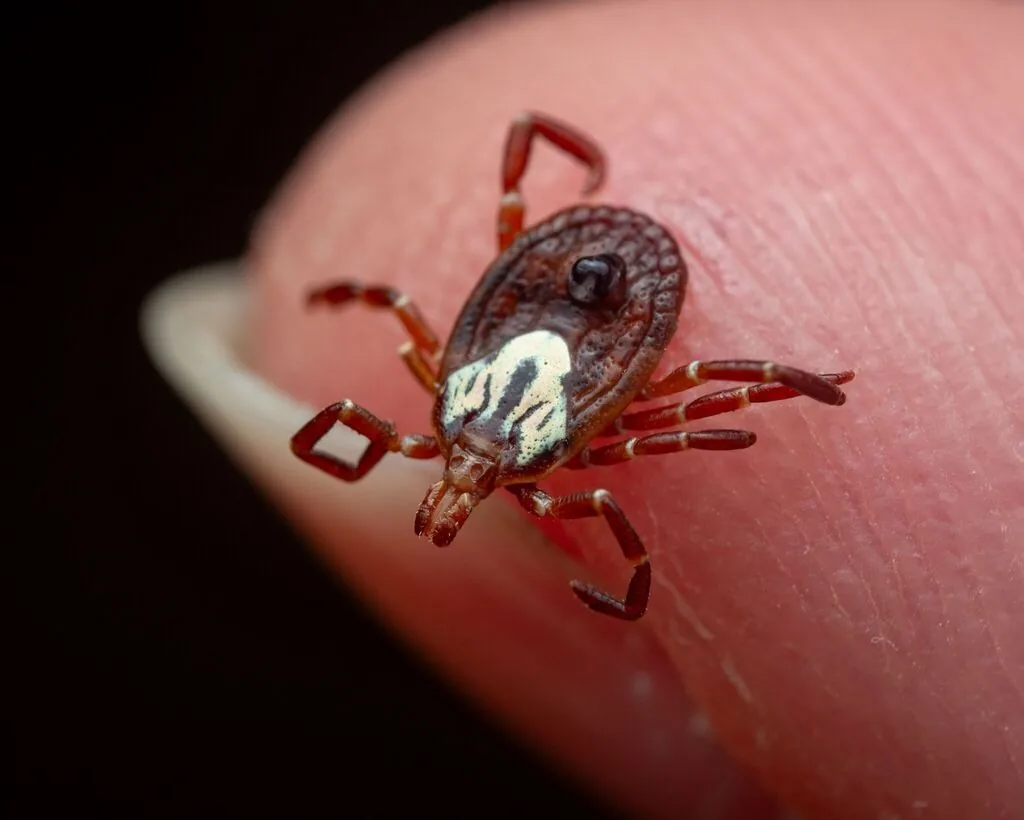
- Unfed adults are about 1/4 inch long, roughly the width of a pencil, with eight legs.[1][2]
- Females have a small dark brown shield behind the head with silvery-white stripes; on males, the shield covers the whole back in a network of silvery lines.[1]
- The mouthparts are long and narrow, which helps separate it from the American dog tick.[1][2]
- Larvae, called seed ticks, are tiny and six-legged; nymphs are about 1/16 inch long and eight-legged.[1]
Look-alikes
| Look-alike | How to tell them apart |
|---|---|
| American dog tick | American dog ticks have short, stout, pyramid-shaped mouthparts, while Gulf Coast ticks have long, rectangular ones.[1][2] |
| Lone star tick | On male lone star ticks the silvery marks are small separate spots along the edges of the back, not a connected pattern covering most of it.[1] |
Where it lives
Found mainly in the southeastern U.S., with established pockets in the Northeast, Midwest and Southwest. Its range has grown a lot over the past 70 years, helped in part by migrating grassland birds.[3][4][2]
Biology and life cycle
It is a three-host tick: larvae and nymphs feed on birds, rodents and rabbits, while adults feed on deer, cattle, horses, dogs, coyotes and people.[1][2]
Adults prefer to attach on and around the outer ears of their animal hosts.[1]
A fed female drops off to lay a single clutch that averages about 10,000 eggs.[1]
It favors fairly dry habitats and can quest on grass for long periods in hot weather while waiting for a host.[1]
Activity seasons vary by region; in northern Florida ticks are active from February to September.[1]
Damage and signs
Health risk
The CDC links adult Gulf Coast ticks to Rickettsia parkeri rickettsiosis, which typically causes a dark scab at the bite site followed by fever, headache and rash. Doxycycline is the recommended treatment. Rarely, an attached tick causes tick paralysis.[3][4][2]
Control
Prevention
In tick habitat such as knee-high grass, wear long sleeves and pants, tuck pants into socks and use an EPA-registered repellent; permethrin is for clothing only.[1][2]
After being outdoors, check people and pets, especially hair, ears, armpits, groin and behind the knees, and dry clothes on high heat to kill ticks.[2][1]
Ask your veterinarian about tick protection for dogs and cats, and inspect pets and livestock routinely.[1]
Sanitation
Keep lawns under about 3 inches, trim overhanging shrubs, and keep a gravel or wood-chip strip between lawn and natural areas.[2]
Traps and physical control
Remove an attached tick with fine-tipped tweezers close to the skin, pulling straight up steadily without twisting, then clean the bite.[1][2]
Pesticides
Acaricides can be used on animals or in tick habitat; follow the product label exactly and ask your Extension office or veterinarian.[1]
Common questions
- What is Rickettsia parkeri rickettsiosis?
- A spotted fever infection spread by Gulf Coast ticks. It usually starts with a dark, scabbed sore at the bite, followed by fever, headache and a sparse rash, and tends to be milder than Rocky Mountain spotted fever.[4][2]
- Is the Gulf Coast tick only found along the Gulf Coast?
- No. It is most common in the Southeast, but it now has populations in Oklahoma, Kansas and parts of the mid-Atlantic and Northeast.[1][3][2]
Sources
- University of Florida IFAS Extension, Featured Creatures, “Gulf Coast Tick, Amblyomma maculatum Koch (IN1062).” edis.ifas.ufl.edu/publication/IN1062 (accessed 2026-10-06)
- North Central IPM Center, Public Tick IPM Working Group, “Gulf Coast Tick (Pest Alert, July 2026).” www.ncipmc.org/communications/pest-alerts/gulf-coast-tick/ (accessed 2026-10-06)
- Centers for Disease Control and Prevention, “Where Ticks Live.” www.cdc.gov/ticks/about/where-ticks-live.html (accessed 2026-10-06)
- Centers for Disease Control and Prevention, “Notes from the Field: Rickettsia parkeri Rickettsiosis, Georgia, 2012-2014 (MMWR 65:718-719, 2016).” www.cdc.gov/mmwr/volumes/65/wr/mm6528a3.htm (accessed 2026-10-06)
- iNaturalist, “Amblyomma maculatum taxon page (order and family).” www.inaturalist.org/taxa/180017 (accessed 2026-10-06)