On this page
How to identify it
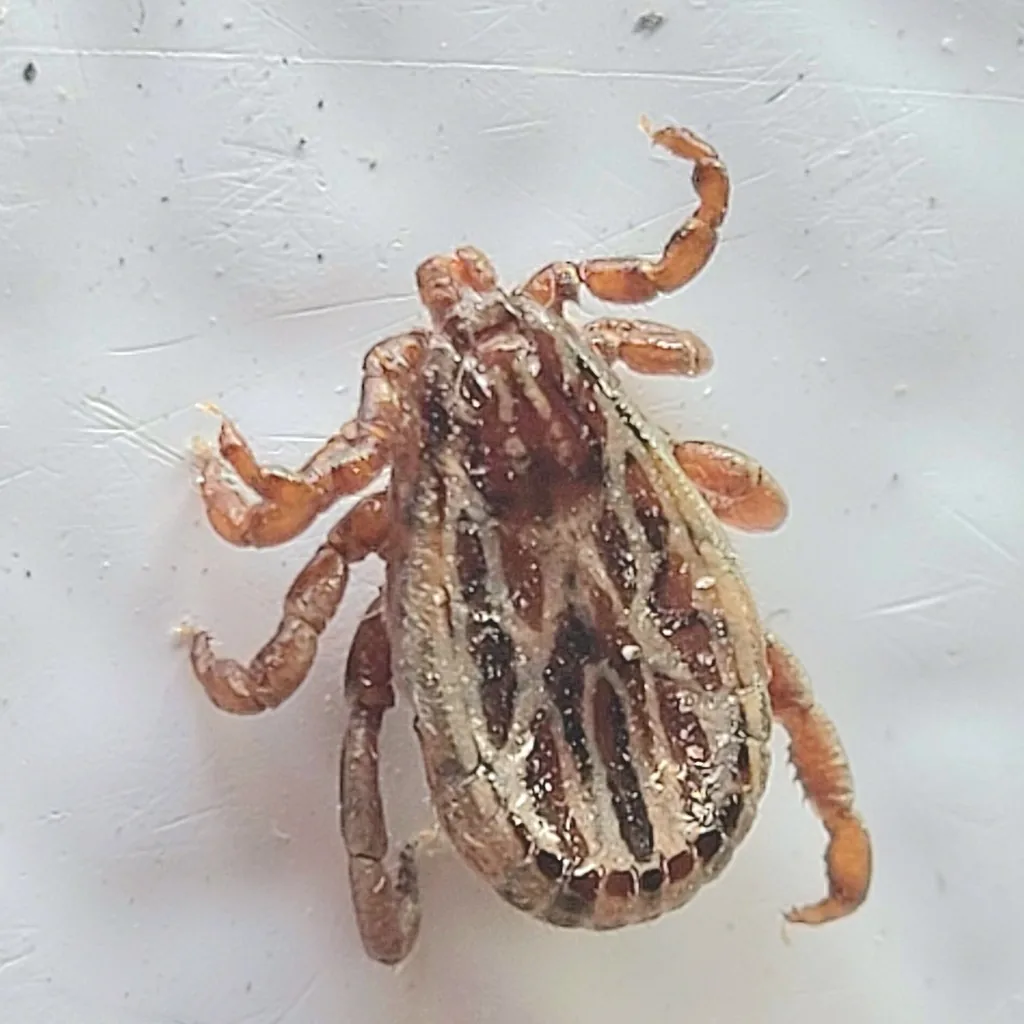
- Unfed adults are about 1/4 inch long or a little less; engorged females swell to about 3/4 inch.[2][4][1]
- Males are brown to dark reddish brown with white or cream markings on the back; females are reddish brown with a pale, patterned shield behind the head.[3][4]
- Larvae and nymphs are small, brown and nondescript. On a moose in fall they are about 2 mm long, clinging to the hair between meals.[4][1]
Look-alikes
| Look-alike | How to tell them apart |
|---|---|
| American dog tick | Patterned winter tick adults can be confused with the American dog tick, but the American dog tick is not often found in large numbers on hooved animals.[4] |
| Asian longhorned tick | In some areas winter tick males lack the usual markings and can be confused with the Asian longhorned tick or the brown dog tick.[4] |
Where it lives
The winter tick is found throughout North America, across the entire United States and into Canada and Mexico.[4]
Biology and life cycle
It is a one-host tick: larva, nymph and adult all feed on the same animal, and only engorged females drop off, in late winter or spring, to lay eggs. There is one generation a year.[1][2][4]
Eggs hatch in late summer and early fall, and the larvae climb low vegetation, sometimes in clumps of more than 1,000, to wait for a moose, deer or other large animal to brush past. Questing slows below freezing and stops once snow covers the ground.[1][4][2]
Once aboard, the ticks feed as larvae, molt to nymphs in fall and early winter, and turn into adults later in winter; in Alberta, the first adults appear in late January and engorged females in late March or April.[1][4]
Each engorged female lays up to 3,000 eggs in the leaf litter near where she dropped; females that land on snow survive poorly.[1]
Big tick years follow early spring snowmelt, summers without drought, and mild falls with little snow, and Penn State notes that warmer winters may raise numbers and speed up the life cycle.[1][4]
Damage and signs
- Heavily infested moose rub against trees and groom the heavily infested spots with teeth and hooves, breaking guard hairs and losing large patches of hair starting at the shoulders, so the coat looks pale gray or tan. They lose blood and fat reserves at the hardest time of year.[1]
- Calves carry the heaviest loads for their size, and most tick-related moose deaths happen in April; Alberta researchers counted more than 150,000 ticks on one moose. Deer, by contrast, groom the ticks off early.[1]
- On horses, cattle and other animals, large numbers cause anemia, hair loss, poor appetite and abdominal swelling, and severe untreated cases can be fatal.[2][3]
Health risk
Winter ticks will bite people and pets given the chance, and New Hampshire deer hunters have found larvae on their clothing. Because the tick stays on one host, disease spread is less likely: South Dakota State does not consider it a human health concern, and Penn State notes only weak evidence that it might carry Rickettsia rickettsii or Anaplasma marginale.[1][2][4]
Control
Keep them out
Where pastures meet woods, moving the fence line 10 feet in from the woods' edge and keeping that strip mowed short and clear of debris helps keep ticks away from animals. Open, sunny pasture rarely needs an acaricide, but wooded edges can be treated.[4]
Traps and physical control
Brushing and washing remove ticks from horses and other infested animals.[2][3]
Pesticides
Insecticide sprays and pour-ons labeled for ticks can treat infested animals; follow the label, and ask a veterinarian for specific recommendations.[2][3]
When to call a professional
No products are labeled for ticks on captive deer and other cervids, so deer farms work with a veterinarian on off-label treatments; four-poster feeders that roll permethrin onto a deer's head and neck are another option.[4]
Common questions
- Why am I finding ticks on my horse in the middle of winter?
- They may be winter ticks, which feed through fall and winter when most ticks are inactive. South Dakota State has reports of them on horses, and New Hampshire horse owners have sent in ticks biting their animals in late fall and winter.[3][1]
- Can winter ticks bite people?
- Yes, if given the chance. Because they stay on one host, they are less likely to spread disease, and South Dakota State does not consider them a human health concern.[1][4][2]
- Why do moose look pale and patchy in late winter?
- Heavy winter tick loads make moose rub and groom away their guard hairs, starting at the shoulders, so the coat turns pale gray or tan.[1]
Sources
- University of New Hampshire Cooperative Extension, “Winter Tick (Dermacentor albipictus) (A. T. Eaton and D. Bergeron).” extension.unh.edu/resources/files/Resource001955_Rep2885.pdf (accessed 2026-11-08)
- South Dakota State University Extension, “Winter Ticks in South Dakota.” extension.sdstate.edu/winter-ticks-south-dakota (accessed 2026-11-08)
- South Dakota State University Extension, “Winter Ticks Showing Up on Horses.” extension.sdstate.edu/winter-ticks-showing-horses (accessed 2026-11-08)
- Penn State Extension, “Managing Winter Tick, Dermacentor albipictus, on White-tailed Deer Farms and Hunting Preserves.” extension.psu.edu/managing-winter-tick-dermacentor-albipictus-on-white-tailed-deer-farms-and-hunting-preserves (accessed 2026-11-08)
- iNaturalist, “Dermacentor albipictus taxon page (order and family).” www.inaturalist.org/taxa/262660 (accessed 2026-11-08)