On this page
How to identify it
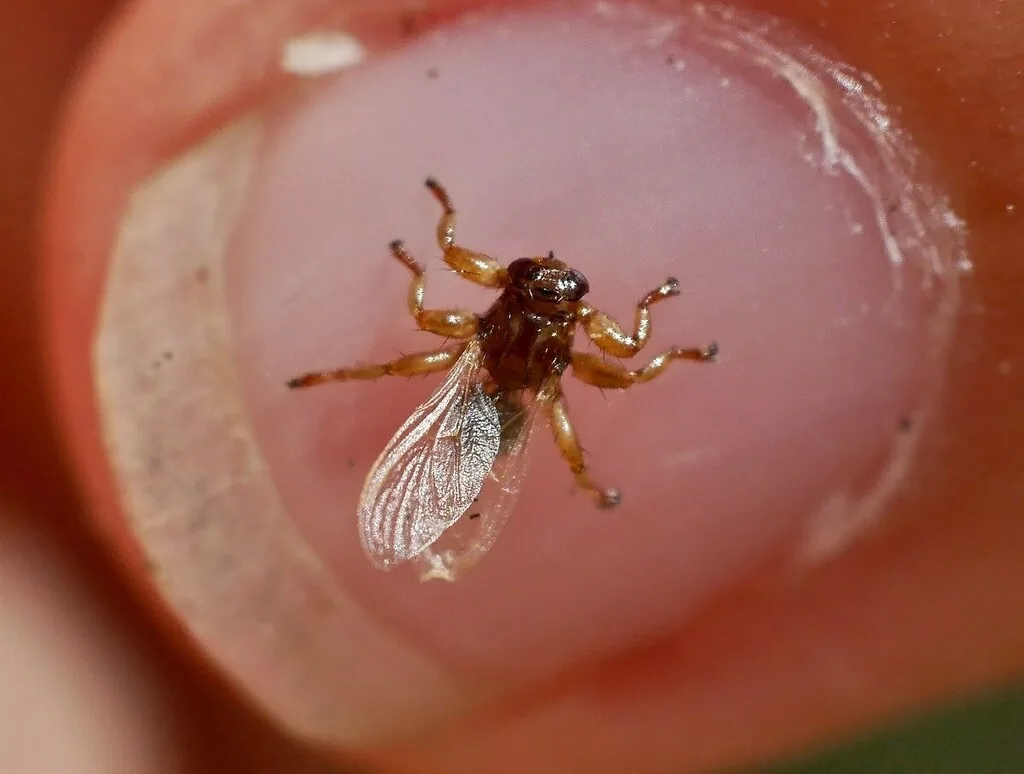
- Deer keds are brown, flattened flies; newly emerged adults have wings and fly to a host, then shed them, leaving small wing stubs on the thorax.[1]
- Wingless keds climb quickly through hair and are often mistaken for ticks, but they have six legs and their bellies swell much less than an engorged tick's.[1][3]
- They find hosts by movement rather than by smell, so they fly to large moving objects, including people, often without the person feeling the first bite.[1][4]
Look-alikes
| Look-alike | How to tell them apart |
|---|---|
| Blacklegged (deer) tick | Ticks have eight legs and swell greatly when engorged; deer keds are wingless flies with six legs that move quickly through hair.[1][3] |
Where it lives
Four species occur in North America: the European deer ked in the Northeast and adjacent Canada (first found in New Hampshire and Pennsylvania in 1907 and since spread west into Ohio and south into Virginia), the Neotropical deer ked in the Southeast, and the western and Pacific deer keds in the West.[1][2][3]
Biology and life cycle
Larvae develop inside the mother on a special secretion; when mature they are deposited and pupate at once, resting in soil and leaf litter for up to 11 months, so pupae pile up where deer bed down.[1][3]
Adult European deer keds emerge on warm fall days, en masse over about four to six weeks in the Northeast, fly to a host and can live for at least a year on it; they stay mostly in wooded areas but may fly up to 50 yards into fields and lawns.[1][4]
Damage and signs
- Most deer carry modest numbers without obvious harm; research on Neotropical deer keds in South Carolina found more grooming but no effect on overall deer health.[1]
Health risk
Keds bite people and pets. Penn State researchers found Anaplasma phagocytophilum in 8.8 percent of keds tested and Bartonella schoenbuchensis in most, but it is unclear whether keds can pass these to people; treat a ked bite like a tick bite and see a doctor if flu-like symptoms follow in the weeks after.[1][2]
Control
Prevention
Wear permethrin-treated clothing: in a Penn State study every deer ked died within 20 minutes of exposure to permethrin, while DEET, picaridin and IR3535 repellents had no effect on them.[1][4]
Light-colored clothing may also help, since European studies found keds more attracted to dark colors; hunters and processors handling deer should expect keds to crawl onto them.[1]
Common questions
- What is the flat, tick-like bug that crawled on me after handling a deer?
- A flat, brown, six-legged insect that scurries quickly through hair after you handle a deer is likely a deer ked, a wingless louse fly.[1][3]
- Does bug spray keep deer keds away?
- Common repellents such as DEET, picaridin and IR3535 didn't affect keds in testing, but permethrin-treated clothing killed them within 20 minutes.[1][4]
Sources
- Penn State Extension, “Deer Keds.” extension.psu.edu/deer-keds (accessed 2026-10-17)
- Penn State News, “New records show spread of parasitic deer flies across US (May 30, 2019).” news.psu.edu/story/576201/2019/05/30/research/new-records-show-spread-parasitic-deer-flies-across-us (accessed 2026-10-17)
- UF/IFAS Extension (EDIS), “Neotropical Deer Ked or Neotropical Deer Louse Fly, Lipoptena mazamae (EENY-308).” edis.ifas.ufl.edu/publication/IN585 (accessed 2026-10-17)
- Entomology Today (Entomological Society of America), “Meet the Deer Ked: The Fly That Makes Life Tough for Hunters and Hikers.” entomologytoday.org/deer/ (accessed 2026-10-17)
- iNaturalist, “Lipoptena cervi taxon page (order and family).” www.inaturalist.org/taxa/130393 (accessed 2026-10-06)