On this page
How to identify it
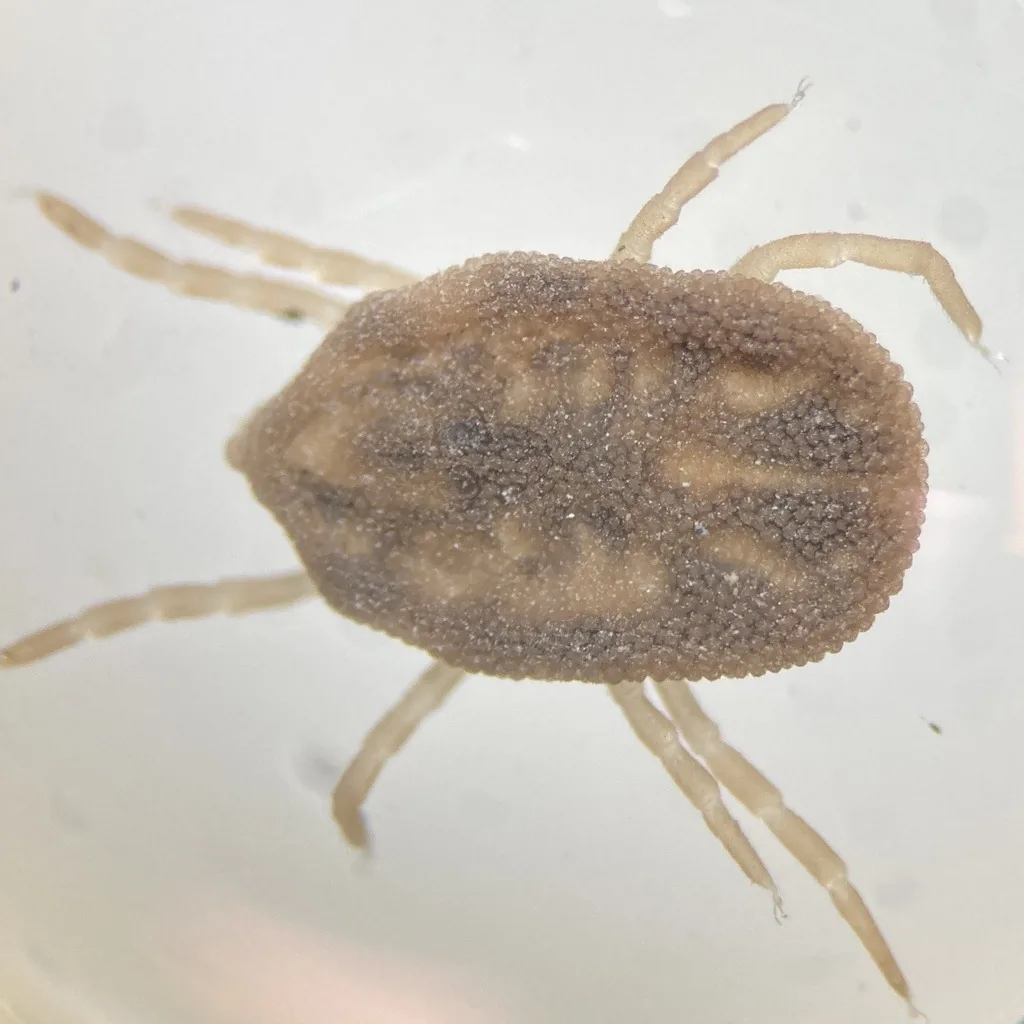
- A soft tick, it looks unlike the familiar hard ticks of lawns and woods, and most people would not recognize it as a tick at all. Its mouthparts sit under the body and can't be seen from above.[1]
- It ranges from about 1/7 to 3/8 inch long depending on life stage, and is dark to dirty gray or light black.[1]
- Context is the best clue: these ticks turn up in homes and buildings where bats roost, such as attics, and are usually noticed after the bats are gone.[1][2][4]
Look-alikes
| Look-alike | How to tell them apart |
|---|---|
| Hard ticks (deer tick, dog ticks) | The bat tick is a soft tick and does not look like the familiar hard ticks: its mouthparts are hidden beneath the body, and it lives in bat roosts in buildings.[1] |
Where it lives
Thought to be widespread in North America, it is known from at least 29 of the 48 contiguous states and is widespread and common in Iowa. Recent first state records include New Jersey and Vermont, and reports are rising across the Northeast.[4][1][5]
Biology and life cycle
The tick feeds almost entirely on bats in nature. It hides in cracks and crevices in roosting areas and feeds on the bats while they roost, usually staying close to them.[2][1]
Soft ticks feed intermittently, taking small blood meals every few days, typically at night, and feeding only briefly.[1]
They prefer dry places and can survive months and even years without feeding.[1]
When bats abandon a roost, are removed or decline, the ticks get hungry and wander in search of other hosts, including people and pets. A Vermont tick collected in a home with big brown bats roosting in the attic had fed on a domestic dog.[1][6][5]
Damage and signs
- Bat ticks have been found in massive numbers in homes with bat colonies in eastern Iowa, and 25 live ticks were collected from one Kansas home with a history of bats.[2][6]
- Iowa State describes the bite as usually benign and unnoticed because the tick feeds briefly. Researchers in Iowa, though, recorded residents' complaints of night-time bites while asleep that may have caused red, swollen, hive-like welts and whole-body symptoms, and confirmed human blood in a tick from such a home.[1][2]
Health risk
The bat tick seldom bites people, but it will when bats are not available, and it can carry bacteria that cause disease in people. Studies have found spotted fever group Rickettsia in most ticks tested from buildings in Iowa, Rickettsia in ticks from a Kansas home, and occasional relapsing-fever-type Borrelia and Bartonella. Iowa State notes that soft ticks are not believed to transmit the bacteria that cause Lyme disease.[6][3][5][4][1]
Control
Prevention
Plan for the ticks when bats are evicted. Researchers recommend that bat removal include monitoring for ticks afterward, since the ticks start searching for new hosts once the bats are gone.[5][6]
Don't count on spraying alone or on starving the ticks out. Spraying without removing the bats gives only short-term relief, and the ticks can survive months to years without a meal.[1]
Keep them out
Get the bats out of the building. Seal the cracks and holes they use to get in; Iowa State says late summer and fall is the best time to seal bats out, and there are no pesticides for controlling bats in attics.[1]
Pesticides
Ticks may still need direct treatment. Iowa State suggests residual insecticides like those used for cockroaches, applied to cracks and crevices in bat roosting areas and wherever ticks are seen.[1]
Common questions
- Why am I finding ticks indoors after the bats were removed?
- Bat ticks live in the roost and normally feed on the bats. Once the bats leave or are removed, the hungry ticks wander through the building looking for other hosts, which is usually when people notice them.[1][6]
- Can bat ticks spread disease?
- Researchers have found Rickettsia, a Borrelia related to relapsing fever agents, and Bartonella in bat ticks from buildings, and pathogens able to infect people, pets and livestock have been isolated from this species. Its public health importance is still unclear, but Iowa State notes soft ticks are not believed to transmit Lyme disease bacteria.[3][5][4][2][1]
- Will the ticks die off once the bats are gone?
- Not quickly. Soft ticks can survive months and even years without feeding, so Iowa State advises treating cracks and crevices where the ticks hide rather than waiting for them to starve.[1]
Sources
- Iowa State University Extension and Outreach, “Bat Tick, Yard and Garden encyclopedia (December 2021).” yardandgarden.extension.iastate.edu/encyclopedia/bat-tick (accessed 2026-11-08)
- Journal of Medical Entomology, “Detection of human blood in the bat tick Carios (Ornithodoros) kelleyi in Iowa (J. S. Gill and others), Journal of Medical Entomology 41(6):1179-1181 (2004), abstract.” pubmed.ncbi.nlm.nih.gov/15605658/ (accessed 2026-11-08)
- Journal of Medical Entomology, “Detection of Rickettsia, Borrelia, and Bartonella in Carios kelleyi (A. D. Loftis and others), Journal of Medical Entomology 42(3):473-480 (2005), abstract.” pubmed.ncbi.nlm.nih.gov/15962801/ (accessed 2026-11-08)
- Journal of Medical Entomology, “First Record of Carios kelleyi in New Jersey, United States and Implications for Public Health (J. L. Occi and others), Journal of Medical Entomology 58(2):939-942 (2021), abstract.” pubmed.ncbi.nlm.nih.gov/32901802/ (accessed 2026-11-08)
- Journal of Medical Entomology, “First Report of the Bat Tick Carios kelleyi From Vermont, United States (C. F. Sullivan and others), Journal of Medical Entomology 59(2):784-787 (2022), abstract.” pubmed.ncbi.nlm.nih.gov/35041004/ (accessed 2026-11-08)
- Journal of Medical Entomology, “Carios kelleyi Infected With Rickettsial Agents Documented Infesting Housing in Kansas, United States (R. M. Nadolny and others), Journal of Medical Entomology 58(6):2398-2405 (2021), abstract.” pubmed.ncbi.nlm.nih.gov/34007993/ (accessed 2026-11-08)
- iNaturalist, “Alectorobius kelleyi taxon page (order and family).” www.inaturalist.org/taxa/1624657 (accessed 2026-11-08)