The short answer
- Remove the tick as soon as you find it. Don't wait to have a healthcare provider do it, because delay can raise the risk of a tickborne disease.[1]
- Grasp the tick as close to the skin as you can with clean fine-tipped tweezers and pull it away with steady, even pressure. Don't twist or jerk it.[1][14]
- Don't use petroleum jelly, heat, nail polish or anything else to make the tick let go.[1]
- Clean the bite and your hands with soap and water, rubbing alcohol or hand sanitizer, then check your body for other ticks.[1]
- Put the tick in a sealed container or bag, or in rubbing alcohol, rather than crushing it. Keeping it lets a doctor or expert see what kind of tick it was and how much it had fed.[1][2][17][16]
- CDC does not generally recommend sending the tick off for disease testing.[1]
- See a doctor if you get a rash or fever within several weeks of the bite, and tell them when and where you were bitten.[1][14]
Ticks that bite people
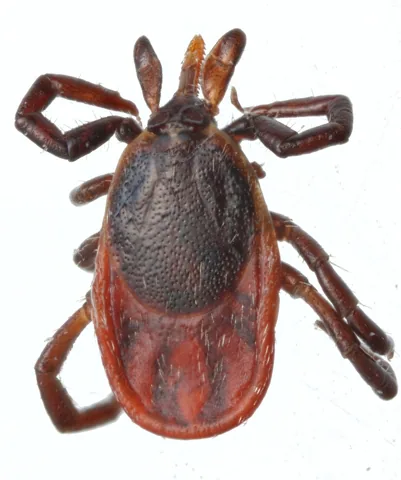 Blacklegged Tick
Ixodes scapularis
The blacklegged tick, often called the deer tick, is widely distributed across the eastern United States and transmits the bacteria that cause Lyme disease along with several other diseases.
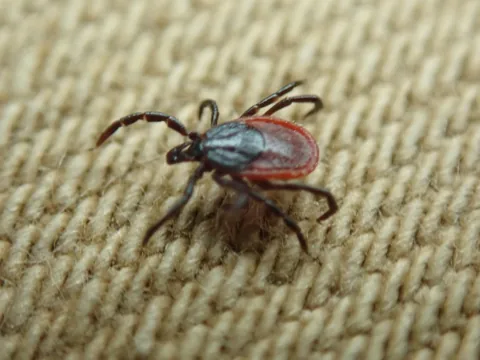 Western Blacklegged Tick
Ixodes pacificus
The western blacklegged tick is the West Coast relative of the eastern deer tick and the only tick that spreads Lyme disease bacteria to people in California. It bites people more often than any other tick in the state.
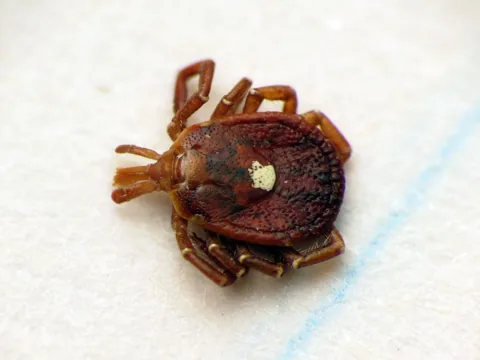 Lone Star Tick
Amblyomma americanum
The lone star tick is a very aggressive tick that readily bites people and pets across the Northeast, South and Midwest; its bite is linked to alpha-gal syndrome, a red meat allergy.
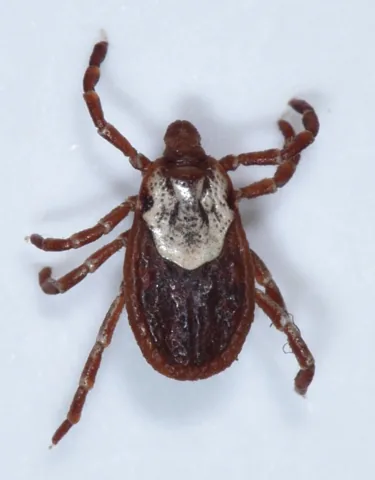 American Dog Tick
Dermacentor variabilis
The American dog tick, also called the wood tick, is widely distributed east of the Rocky Mountains. Adult females are the stage most likely to bite people, especially in spring and summer, and adults commonly climb to the crown of the head.
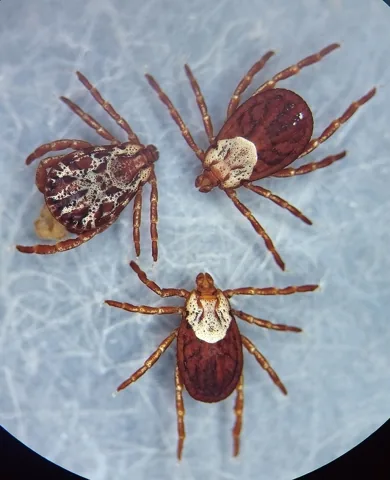 Rocky Mountain Wood Tick
Dermacentor andersoni
The Rocky Mountain wood tick is the tick most often found on people and pets in Colorado and Utah. It is most active in spring, then goes dormant as the weather turns hot and dry, and it is the vector of Colorado tick fever.
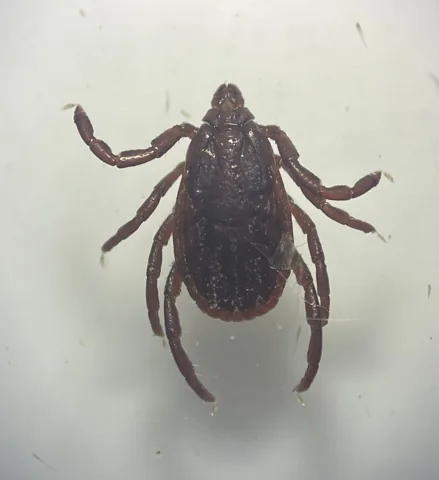 Brown Dog Tick
Rhipicephalus sanguineus
The brown dog tick is unusual: unlike most ticks, it can complete its entire life cycle indoors. It occurs across the United States, is met more often in the southern states, and can build up to high numbers on dogs and in homes and kennels.
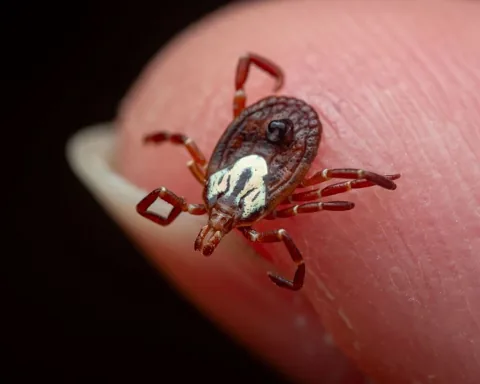 Gulf Coast Tick
Amblyomma maculatum
The Gulf Coast tick is a hard tick of grass prairies, coastal uplands and shrubby, recently disturbed ground with little or no tree cover. Adults bite people, and it is the principal carrier of Rickettsia parkeri, which causes a form of spotted fever, and of the parasite behind American canine hepatozoonosis in dogs.
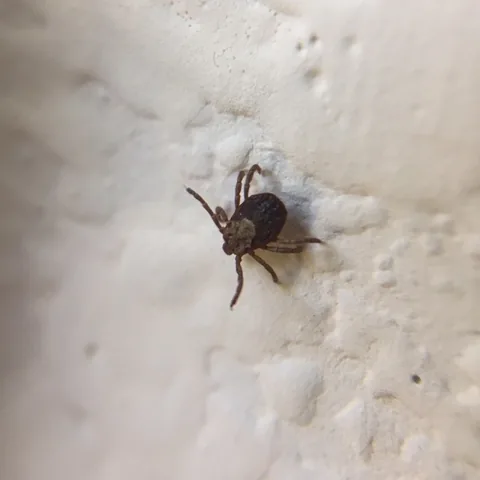 Pacific Coast Tick
Dermacentor occidentalis
The Pacific Coast tick is one of the most widespread ticks in California and one of a handful that regularly bite people. It is the only tick known to spread Pacific Coast tick fever, and it can also carry spotted fever and tularemia.
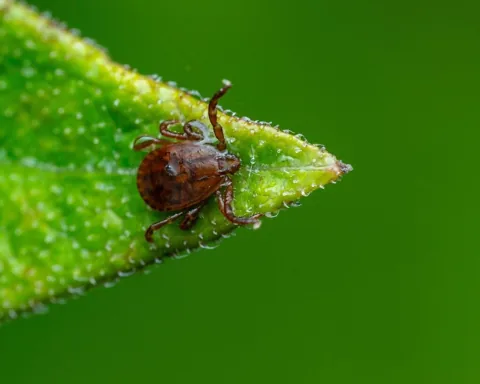 Asian Longhorned Tick
Haemaphysalis longicornis
The Asian longhorned tick is an invasive tick first reported in the United States in 2017. U.S. females lay eggs without mating, which APHIS describes as essentially cloning themselves, so huge numbers can build up on livestock, pets and wildlife and in grass.
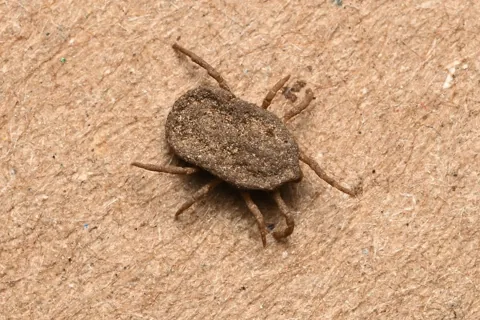 Soft Ticks (relapsing fever ticks)
Ornithodoros species (mainly O. hermsi and O. turicata in the U.S.)
Soft ticks live in rodent nests, often inside the walls and floors of rustic cabins, and come out at night to feed briefly on sleeping people. In the U.S., infected Ornithodoros soft ticks spread soft tick relapsing fever.
How to remove a tick
A plain set of tweezers works very well, according to CDC, even though many tick removal devices are sold. MedlinePlus, from the National Library of Medicine, says either a removal device or fine-tipped tweezers will do.[1][14]
Get the tick out as soon as you find it. CDC warns that waiting to have a healthcare provider remove it could increase your risk of getting a disease spread by the bite.[1]
- Grasp: hold the tick with clean fine-tipped tweezers as close to the skin's surface as possible. If you don't have fine-tipped tweezers, use regular tweezers or your fingers, but avoid squeezing the tick's body.[1]
- Pull: draw the tick away from the skin with steady, even pressure. Twisting or jerking can break the mouthparts off in the skin.[1][15]
- If the mouthparts stay in: try to lift them out with the tweezers. If they don't come out easily, leave them alone. CDC says your body will push them out over time as the skin heals.[1][14]
- Clean up: wash the bite area and your hands with soap and water, rubbing alcohol or hand sanitizer. Kentucky's fact sheet also lists iodine soap.[1][15]
- Check again: if one tick was attached, others may be on you too. Do a careful tick check and remove any others promptly.[1]
What not to do
CDC says not to use petroleum jelly, heat, nail polish or other substances to try to make a tick back out. Doing so may agitate the tick and force infected fluid from it into the skin.[1]
Don't crush a tick with your fingers. CDC lists four ways to get rid of a live tick instead: put it in a sealed container, wrap it tightly in tape, flush it down the toilet, or drop it in alcohol.[1]
If you want the tick identified, don't flush it. Seal it in a container or bag, or put it in rubbing alcohol, so you still have it.[2][17]
Saving and identifying the tick
CDC's guidance for clinicians says to save the tick so its species and how engorged it was can be identified, which matters when a doctor decides whether Lyme disease prophylaxis makes sense. Ohio State University Extension suggests keeping the tick in a container and bringing it with you if you see a healthcare professional.[2][17]
Identifying ticks is hard. University of Minnesota Extension says size, sex, life stage and feeding all change how a tick looks, and engorged ticks are especially difficult because their size and color change so much. If there is any doubt, send it to an expert.[16]
- Minnesota: you can fill out a form and send the tick to the state health department for identification, which also helps the state track where ticks are active.[16]
- Ohio: ticks can be submitted for identification to the C. Wayne Ellett Plant and Pest Diagnostic Clinic at Ohio State, or ask your county Extension office how to submit one.[17]
- Elsewhere: ask your county Extension office or state health department how to get a tick identified. Our tick profiles below show the main species and their markings.[17][16][15]
Should you get the tick tested?
Some commercial labs will test a tick for disease germs, but CDC says this is not generally recommended, and that tick test results should not be used for treatment decisions. Ohio State Extension agrees that treatment should not depend on tick testing.[1][17]
- Labs that test ticks don't have to meet the quality control standards that clinical diagnostic labs follow.[1]
- A positive result means the tick carried the germ, not that you were infected.[1]
- A negative result can give false reassurance, because a different, infected tick may have bitten you without your noticing.[1]
- If you were infected, you will probably have symptoms before the test results come back. If you get sick, CDC says not to wait for tick test results before starting treatment.[1]
How long the tick was attached matters
Ticks need time to pass on most infections. CDC says that in general an infected tick must be attached for more than 24 hours to transmit Lyme disease bacteria, and removing a tick within 24 hours greatly reduces your chances of getting Lyme disease.[6]
University of Minnesota Extension gives 24 to 48 hours of attachment for Lyme disease and 12 to 24 hours for human anaplasmosis, and notes that a blacklegged tick can't transmit disease by just crawling on a person.[16]
How full the tick is gives a clue. CDC's prophylaxis guidance says a flat, unfed tick is unlikely to have transmitted the Lyme disease bacterium, while an engorged tick means a higher risk.[3]
- Nymphs are the hardest to spot. CDC says blacklegged tick nymphs are about the size of a poppy seed and adults about the size of a sesame seed, and that Lyme disease patients often never noticed a tick bite.[6]
- Many people with ehrlichiosis or anaplasmosis don't remember being bitten either, because tick bites can be painless.[9][10]
- MedlinePlus notes a tick can stay attached for several days, and that catching it before it has filled up on blood makes infection less likely.[14]
What a normal tick bite looks like
A small bump or redness that shows up right away at the bite and looks like a mosquito bite is common. CDC says this irritation usually goes away in 1-2 days and is not a sign of Lyme disease.[5]
A rash that appears days later and keeps growing is different. Lyme disease's erythema migrans rash begins at the bite site after a delay of 3 to 30 days and expands over several days, and other tickborne illnesses cause their own kinds of rash.[5]
Symptoms to watch for, by disease
Many tickborne diseases look alike at first. MedlinePlus lists fever, chills, aches and pains, and rash as the most common signs, and CDC's clinician guidance says to watch for fever, rash or flu-like illness in the weeks after a bite. Which diseases are likely depends on where the bite happened.[14][2]
- Lyme disease (blacklegged and western blacklegged ticks): early symptoms start 3 to 30 days after the bite and include fever, chills, headache, fatigue, muscle and joint aches and swollen lymph nodes. The erythema migrans rash shows up in about 70 to 80 percent of infected people, about 7 days after the bite on average, and can reach 12 inches (30 cm) or more across. It is rarely itchy or painful and doesn't always look like a bull's-eye.[5]
- Lyme disease, later signs (days to months after the bite): severe headaches and neck stiffness, more rashes elsewhere on the body, drooping on one or both sides of the face, arthritis with severe pain and swelling in the knees and other large joints, heart palpitations or an irregular heartbeat, dizziness or shortness of breath, and shooting pains, numbness or tingling in the hands or feet.[5]
- Rocky Mountain spotted fever (American dog tick, Rocky Mountain wood tick, and the brown dog tick in parts of the Southwest): symptoms begin 3 to 12 days after the bite, usually with sudden fever and headache, and can include nausea or vomiting, stomach pain, muscle pain and loss of appetite. The rash usually develops 2 to 4 days after the fever starts and can look like red splotches or pinpoint dots. RMSF can be deadly if not treated early.[8][7]
- Ehrlichiosis: symptoms typically begin within 1-2 weeks of the bite and can include fever, chills, severe headache, muscle aches, nausea, vomiting, diarrhea, loss of appetite and confusion. Up to 1 in 3 people get a rash, more often children, usually about 5 days after fever begins.[9]
- Anaplasmosis (blacklegged and western blacklegged ticks): symptoms typically begin within 1–2 weeks of the bite, with fever, chills, severe headache, muscle aches, nausea, vomiting, diarrhea and loss of appetite.[10]
- Babesiosis (mostly blacklegged ticks; most cases occur in the Northeast and upper Midwest): many people never feel sick. Others get flu-like symptoms such as fever, chills, sweats, headache, body aches, nausea and fatigue. Symptoms may start around a week after infection but usually develop over a few weeks or months, or longer.[11]
- Alpha-gal syndrome (mostly the lone star tick, less often blacklegged or western blacklegged ticks): an allergy to a molecule in red meat and other mammal products. It can take weeks to months after the bite before reactions start, and they usually come 2–6 hours after eating red meat or dairy: hives or itchy rash, stomach pain, vomiting, diarrhea, trouble breathing, swelling of the lips, throat or tongue, or anaphylaxis.[12][13]
Who is more at risk of severe illness
Delayed treatment is the main risk with the bacterial diseases. CDC says delayed antibiotics can lead to severe ehrlichiosis and anaplasmosis, and that early treatment with doxycycline can prevent death and severe illness from RMSF.[9][10][7]
- Ehrlichiosis: children younger than 5, adults older than 65, and people with weakened immune systems.[9]
- Anaplasmosis: people 65 or older and people with weakened immune systems.[10]
- Babesiosis: people without a spleen, people with weak immune systems from cancer, lymphoma or HIV, people with serious liver or kidney disease, and adults older than 50.[11]
When to see a doctor
CDC says to see your doctor if you develop a rash or fever within several weeks of removing a tick. MedlinePlus says to contact your provider if you get fever, chills, aches and pains, or a rash in that time.[1][14]
If you become ill after a tick bite, or after time in woods or high brush where ticks live, CDC advises seeing your healthcare provider, even if you don't remember a bite.[7][10][9]
- Tell the doctor about the tick bite, when it happened, and where you most likely picked up the tick.[1][17]
- Bring the tick if you saved it.[17][2]
- Don't wait for lab results. CDC tells clinicians to start treatment for suspected early Lyme disease or Rocky Mountain spotted fever as soon as possible, because early lab tests can miss these infections.[2][7]
- Get emergency care right away for a severe allergic reaction or anaphylaxis.[13]
Antibiotics after a tick bite: a decision for your doctor
CDC says that in certain circumstances a single dose of doxycycline after a tick bite in an area where Lyme disease is common may lower the risk of Lyme disease, and to ask your healthcare provider whether it is right for you.[4]
CDC's guidance for clinicians lays out when that single dose may help. The doctor weighs all of these together, and the decision is theirs.[2][3]
- The bite happened in a state where Lyme disease is common, or in an area where more than 20% of ticks carry the Lyme bacterium.[2]
- The tick can be identified as an adult or nymphal blacklegged tick. CDC notes identification is hard, and a doctor can still consider prophylaxis when the tick isn't available.[2][3]
- The tick was attached an estimated 36 hours or more, judged by how engorged it was or when you were likely exposed.[2]
- It can be started within 72 hours of removing the tick. CDC explains that Lyme disease takes at least three days to incubate.[2][3]
- Doxycycline is safe for the patient. CDC says the single dose is safe for people of all ages, including young children, and lists doxycycline allergy, pregnancy and breastfeeding among the things a doctor checks first.[3]
- It only applies to Lyme disease. CDC says antibiotic prophylaxis has not been shown to prevent other tickborne diseases and is not recommended against anaplasmosis, babesiosis, ehrlichiosis or Rocky Mountain spotted fever.[2]
Preventing the next bite
CDC's RMSF and anaplasmosis pages give the same advice: prevent tick bites on yourself, on your pets and in your yard. There is no vaccine for RMSF or anaplasmosis, and preventing tick bites is the best protection against alpha-gal syndrome.[7][10][12]
CDC's babesiosis page lists tick repellents, socks, long-sleeved shirts and pants, and checking yourself and pets for ticks before going inside. Our guides on repellents, permethrin-treated clothing and tick control in the yard cover each step.[11]
Common questions
- What is the best way to remove a tick?
- Grasp it as close to the skin as possible with clean fine-tipped tweezers and pull it away with steady, even pressure, without twisting or jerking. Then clean the bite and your hands.[1][14]
- Should I put Vaseline, a match or nail polish on a tick?
- No. CDC says petroleum jelly, heat, nail polish and other substances may agitate the tick and force infected fluid into the skin. Pull it out with tweezers instead.[1]
- What if the tick's head stays in my skin?
- Try to remove the mouthparts with tweezers. If they don't come out easily, leave them; CDC says the skin will push them out as it heals.[1][14]
- Should I get the tick tested for Lyme disease?
- CDC doesn't generally recommend it. A positive tick doesn't mean you're infected, a negative one can give false reassurance, and symptoms usually appear before results come back.[1]
- How long does a tick have to be attached to give you Lyme disease?
- In most cases more than 24 hours, according to CDC, and removing a tick within 24 hours greatly reduces the chance. Minnesota Extension gives 24 to 48 hours for Lyme disease and 12 to 24 hours for anaplasmosis.[6][16]
- Is a red bump after a tick bite a sign of Lyme disease?
- Not by itself. A small red bump that appears right away is common and usually fades in 1-2 days. The Lyme rash appears 3 to 30 days later and keeps expanding.[5]
- Do I need antibiotics after a tick bite?
- Usually that's a doctor's call. A single dose of doxycycline may be offered after a high-risk blacklegged tick bite in an area where Lyme disease is common, if it can be started within 72 hours of removing the tick. It doesn't prevent other tickborne diseases.[4][2][3]
- How long after a tick bite can symptoms appear?
- It depends on the disease: 3 to 30 days for early Lyme disease, 3 to 12 days for Rocky Mountain spotted fever, 1-2 weeks for ehrlichiosis and anaplasmosis, a week to months for babesiosis, and weeks to months before alpha-gal reactions begin.[5][8][9][10][11][13]
Photo credits
- Blacklegged Tick: (c) Christian Back, some rights reserved (CC BY) — via iNaturalist, CC BY 4.0
- Western Blacklegged Tick: Randal, public domain (CC0), via iNaturalist
- Lone Star Tick: (c) Katja Schulz, some rights reserved (CC BY) — via iNaturalist, CC BY 4.0
- American Dog Tick: (c) Don Loarie, some rights reserved (CC BY) — via iNaturalist, CC BY 4.0
- Rocky Mountain Wood Tick: (c) Toby, some rights reserved (CC BY) — via iNaturalist, CC BY 4.0
- Brown Dog Tick: (c) NoahM, some rights reserved (CC BY) — via iNaturalist, CC BY 4.0
- Gulf Coast Tick: (c) Zachary Dankowicz, some rights reserved (CC BY) — via iNaturalist, CC BY 4.0
- Pacific Coast Tick: Stanley, public domain (CC0), via iNaturalist
- Asian Longhorned Tick: (c) Zachary Dankowicz, some rights reserved (CC BY) — via iNaturalist, CC BY 4.0
- Soft Ticks (relapsing fever ticks): (c) Trevor Van Loon, some rights reserved (CC BY) — via iNaturalist, CC BY 4.0
Sources
- Centers for Disease Control and Prevention, “What to Do After a Tick Bite.” www.cdc.gov/ticks/after-a-tick-bite/index.html (accessed 2026-11-10)
- Centers for Disease Control and Prevention, “Caring for Patients after a Tick Bite (guidance for clinicians).” www.cdc.gov/lyme/media/pdfs/Caring-for-Patients-after-a-Tick-Bite.pdf (accessed 2026-11-10)
- Centers for Disease Control and Prevention, “Lyme Disease Prophylaxis After Tick Bite (clinician flowchart).” www.cdc.gov/lyme/media/pdfs/Lyme-Disease-Prophylaxis-After-Tick-Bite-Poster.pdf (accessed 2026-11-10)
- Centers for Disease Control and Prevention, “Treatment and Intervention for Lyme Disease.” www.cdc.gov/lyme/treatment/index.html (accessed 2026-11-10)
- Centers for Disease Control and Prevention, “Signs and Symptoms of Untreated Lyme Disease.” www.cdc.gov/lyme/signs-symptoms/index.html (accessed 2026-11-10)
- Centers for Disease Control and Prevention, “How Lyme Disease Spreads.” www.cdc.gov/lyme/causes/index.html (accessed 2026-11-10)
- Centers for Disease Control and Prevention, “About Rocky Mountain Spotted Fever.” www.cdc.gov/rocky-mountain-spotted-fever/about/index.html (accessed 2026-11-10)
- Centers for Disease Control and Prevention, “Rocky Mountain Spotted Fever: Clinical Signs and Symptoms.” www.cdc.gov/rocky-mountain-spotted-fever/hcp/signs-symptoms/index.html (accessed 2026-11-10)
- Centers for Disease Control and Prevention, “Signs and Symptoms of Ehrlichiosis.” www.cdc.gov/ehrlichiosis/signs-symptoms/index.html (accessed 2026-11-10)
- Centers for Disease Control and Prevention, “About Anaplasmosis.” www.cdc.gov/anaplasmosis/about/index.html (accessed 2026-11-10)
- Centers for Disease Control and Prevention, “About Babesiosis.” www.cdc.gov/babesiosis/about/index.html (accessed 2026-11-10)
- Centers for Disease Control and Prevention, “About Alpha-gal Syndrome.” www.cdc.gov/alpha-gal-syndrome/about/index.html (accessed 2026-11-10)
- Centers for Disease Control and Prevention, “Symptoms of Alpha-gal Syndrome.” www.cdc.gov/alpha-gal-syndrome/signs-symptoms/index.html (accessed 2026-11-10)
- MedlinePlus, U.S. National Library of Medicine (NIH), “Tick Bites (MedlinePlus health topic).” medlineplus.gov/tickbites.html (accessed 2026-11-10)
- University of Kentucky Entomology, “Ticks and Disease in Kentucky (ENTFACT-618).” entomology.mgcafe.uky.edu/ef618 (accessed 2026-11-10)
- University of Minnesota Extension, “Ticks.” extension.umn.edu/garden-and-home/yard-and-garden/yard-and-garden-insects/ticks (accessed 2026-11-10)
- Ohio State University Extension (Ohioline), “Ticks and Tick-Borne Diseases (HYG-2073).” ohioline.osu.edu/factsheet/HYG-2073 (accessed 2026-11-10)
- Minnesota Department of Health, “Tickborne Diseases.” www.health.state.mn.us/diseases/tickborne/index.html (accessed 2026-11-10)