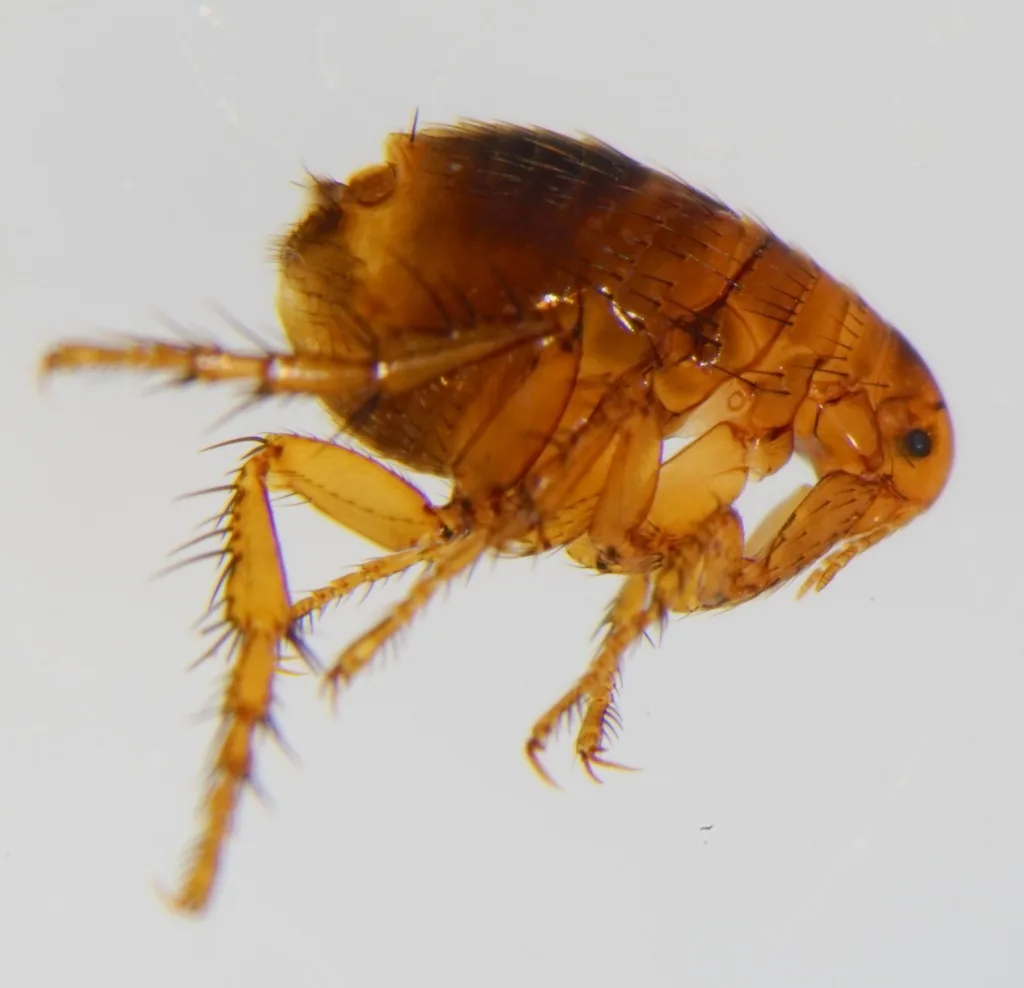
How to identify it
Look-alikes
| Look-alike | How to tell them apart |
|---|---|
| Oriental rat flea | It lacks a hardened ridge over the second pair of legs that the oriental rat flea has.[1] |
| Cat flea | Cat fleas have bristle combs on the head; the human flea has none.[1] |
Where it lives
It's reported worldwide but isn't known to be established in Florida, where it's often confused with a close relative, Pulex simulans.[1]
Biology and life cycle
Development from egg to adult averages 63 to 77 days.[1]
Hosts include dogs, cats, rodents, pigs, carnivores and people.[1]
Health risk
Bites cause red bumps and dermatitis; it's a potential vector of plague and murine typhus bacteria and a tapeworm.[1]
Control
Sanitation
Vacuum carpets and clean bedding and furniture, treating cracks and crevices where fleas develop.[1]
Traps and physical control
Where small mammal pests are the source, trapping them removes hosts.[1]
Pesticides
Make sure pet dogs and cats are treated to reduce their flea burden.[1]
Common questions
Sources
- University of Florida IFAS Extension (Featured Creatures), “Human Flea, Pulex irritans (EENY-798).” edis.ifas.ufl.edu/publication/IN1383 (accessed 2026-10-06)
- iNaturalist, “Pulex irritans taxon page (order and family).” www.inaturalist.org/taxa/308321 (accessed 2026-10-06)