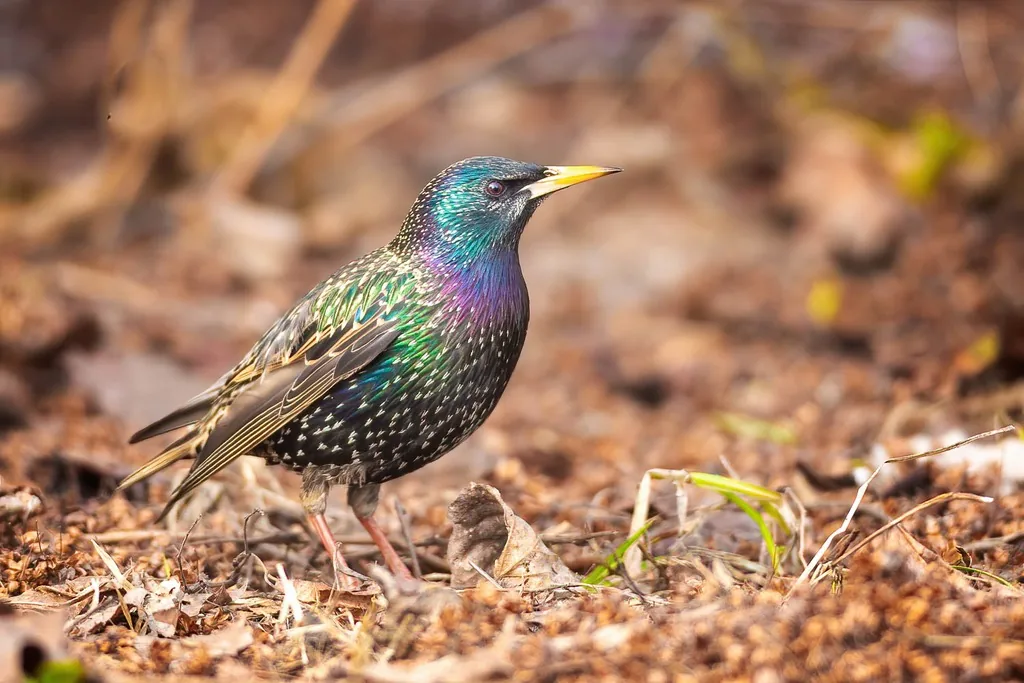
How to identify it
- A robin-sized, short-tailed bird about 8 inches long and about 3 ounces, with a long, slender, pointed bill.[3][2]
- Looks black from a distance; up close, summer plumage is glossy purplish-green and winter plumage is brownish with white spots.[2][3]
- The bill turns light brownish yellow in the breeding season, and both sexes have pinkish-red legs.[3]
- A varied song that often mimics other birds, and fall flocks that swirl together in coordinated murmurations.[3][2]
- A fan-shaped spray of droppings on the wall below a cavity can mark an active starling nest.[3]
Look-alikes
| Look-alike | How to tell them apart |
|---|---|
| Common grackle, blackbirds and brown-headed cowbird | These native black birds look similar, but the starling has a short tail and long, slender bill; native species are protected, so confirm the identification before any control.[2][3][1] |
| Pigeon | Pigeons are much larger, about 12 inches long, and nest on sheltered ledges; starlings are about 8 inches and nest inside cavities.[3] |
Where it lives
Released in New York City around 1890, starlings spread across nearly all of the United States and Canada and now number over 200 million in North America.[2][1]
Biology and life cycle
From April to August, pairs fill a cavity with a messy mass of plant stems around a neater cup of grass and feathers, usually raising two broods a year.[1][3]
Females lay about four to six eggs per clutch.[3]
They prefer tree cavities but readily nest in nooks of houses, barns, office buildings and traffic lights, and take over bluebird and purple martin boxes.[1][2]
They eat insects, especially during nesting, plus seeds, grain, fruit and berries, livestock feed and bird-feeder seed.[1][3][2]
After nesting they form flocks that can reach tens of thousands, returning to the same winter roosts in buildings and dense trees year after year.[1][2]
Damage and signs
- Nests in vents and wall cavities can block airflow, and the bulky nest material is highly flammable.[2][1]
- Winter roosts leave heavy droppings that corrode structures and foul sidewalks, cars and buildings, along with loud early-morning and evening chatter.[1][2][3]
- Flocks eat and contaminate livestock feed and damage fruit and grain crops.[2][1]
- Starlings compete with native cavity nesters and often destroy bluebird nests, occasionally killing the adults.[3][1]
Health risk
Starlings can carry Salmonella and E. coli, and they carry spores of the fungus that causes histoplasmosis; wear proper protection when cleaning up roost droppings.[2][3]
Control
Prevention
Use bluebird boxes with an entrance hole exactly 1-1/2 inches across, which keeps starlings out.[1][2]
Thinning dense windbreaks or tree stands by about one-third can break up large starling roosts.[1][2]
Keep them out
Screen bathroom and exhaust vents with 1/2-inch mesh, taking care with dryer vents where lint can build up, and cap chimneys with stainless steel screens.[3]
Box out spaces under dormers, eaves and porches and cover rafters with hardware cloth or netting so birds can't nest or roost there.[3][1][2]
Sanitation
Clean up spilled grain and seed, use covered trash containers, and don't feed birds on your property.[1][3]
Traps and physical control
Pull nests and eggs from building cavities and nest boxes every couple of weeks through the nesting season, since starlings rebuild quickly.[1][3]
Decoy traps can catch large numbers of starlings; prebait the area and check traps daily so native birds can be released unharmed.[1][3]
When to call a professional
The avicide sold for starling control and the 4-aminopyridine frightening bait are restricted to certified pesticide applicators.[3]
Scare devices: short-lived help
Noise makers, air cannons, balloons and effigies usually work only briefly because starlings get used to them; vary type, timing and placement.[1][2][3]
Ultrasonic devices have no reliable evidence of working against birds.[3]
Legal status
European starlings are non-native, so they are not protected by the federal Migratory Bird Treaty Act, and states such as Iowa and Nebraska also exempt them.[2][1][3]
Their nests, eggs and young are not protected either, but local ordinances may limit methods such as shooting, so check before acting.[3]
Common questions
- How do I get starlings out of my dryer or bathroom vent?
- Remove the nest material, then cover the vent opening with a mesh guard; check dryer vents often because lint can collect and catch fire.[3][1]
- Is it legal to remove a starling nest?
- Yes. Starlings are not protected under the Migratory Bird Treaty Act, but make sure the nest isn't a protected native bird's.[2][3]
- Why do thousands of starlings roost in the same trees every winter?
- Winter flocks pick warm, sheltered roosts in dense trees and buildings and often return to the same spot in later years.[1]
Sources
- Iowa State University Extension and Outreach, Natural Resource Stewardship, “Nuisance Birds: Damage Management (last reviewed July 1, 2019).” naturalresources.extension.iastate.edu/encyclopedia/nuisance-birds-damage-management (accessed 2026-10-06)
- University of Illinois Extension, “European Starlings (Invasive Species).” extension.illinois.edu/invasives/european-starlings (accessed 2026-10-06)
- University of Nebraska-Lincoln Extension, “G2024: Urban Pest Birds: Controlling Damage.” extensionpubs.unl.edu/publication/g2024/html/view (accessed 2026-10-06)
- iNaturalist, “Sturnus vulgaris taxon page (order and family).” www.inaturalist.org/taxa/14850 (accessed 2026-10-06)