On this page
How to identify it
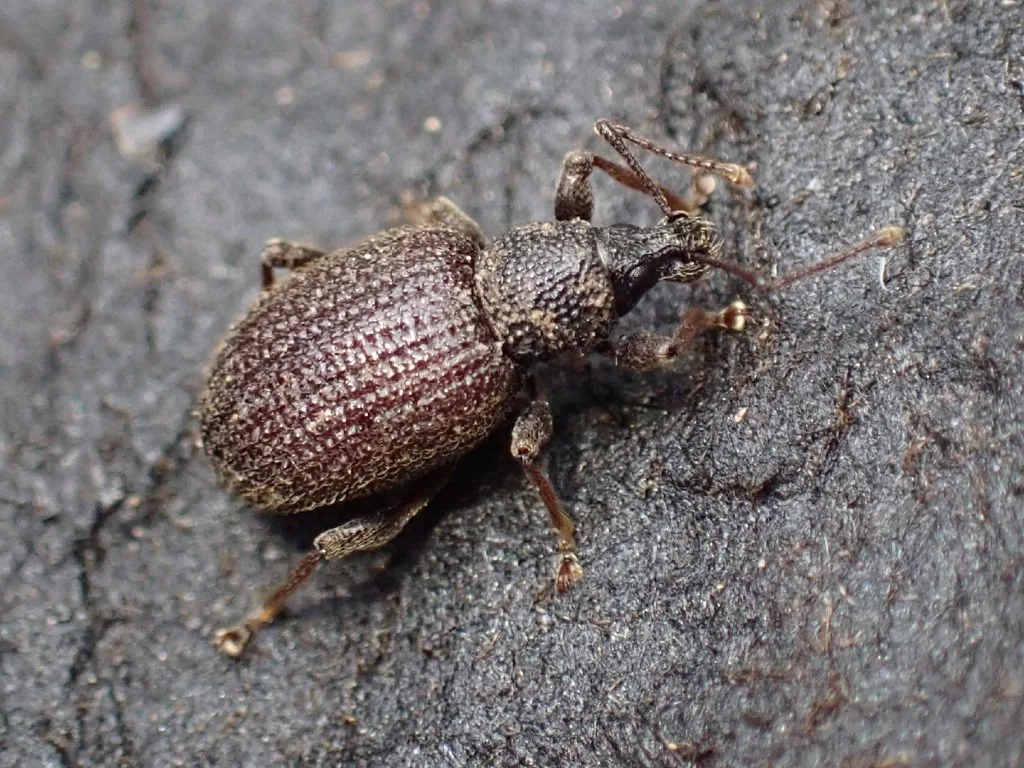
- The adult is a small, dark snout beetle with rows of pits along its back. This species is chocolate brown and about 1/4 inch long, bigger than the strawberry root weevil (about 1/5 inch) and smaller than the black vine weevil (about 2/5 inch).[3]
- It cannot fly. Adults move slowly, walking or getting carried to new places on plants and equipment.[2]
- The grubs are white with a tan head, legless and C-shaped, and grow to about 1/2 inch (12 mm). They are smaller than other soil grubs and have a lighter-colored head.[2][3]
Look-alikes
| Look-alike | How to tell them apart |
|---|---|
| Strawberry root weevil (Otiorhynchus ovatus) | Smaller, about 1/5 inch, and black to light brown. It is the root weevil that most often wanders into homes, usually in hot, dry weather in late June and July.[3][1] |
| Black vine weevil (Otiorhynchus sulcatus) | Larger, about 2/5 inch, and black with small flecks of yellow on its back. The Pacific Northwest handbook calls it probably the most common weevil infesting strawberries.[3][2] |
| Ground beetles | Ground beetles are swift-running predators, while root weevils are slow-moving plant feeders, and the two should not be confused.[2] |
Where it lives
It is one of the most common root weevils in Colorado, and it is covered in strawberry pest guides from the Pacific Northwest and Kentucky.[1][2][3]
Biology and life cycle
It has one generation a year. The grubs spend the winter in the soil and may keep feeding through mild winters, then pupate in spring; adults emerge from about April to June.[2][1][3]
Adults hide by day in the soil or in debris at the base of plants and climb up at night to feed on leaves. In these strawberry root weevils, every adult is a female able to lay eggs.[2]
Eggs are laid in clusters in or on the soil from June to September, and the young grubs wriggle down through the soil to start feeding on roots. Most damage comes from grubs that resume feeding in spring.[2][3]
Adults tend to gather in large groups, so damage in a strawberry field is often confined to a circular patch.[3]
Besides strawberry, its hosts include rose, raspberry, gooseberry and cotoneaster.[1]
Adults sometimes wander into buildings; this species is seen indoors more often in late summer and early autumn. They do not reproduce indoors, and infestations of buildings tend to be short-lived.[1]
Damage and signs
- The grubs tunnel in the roots and crowns of strawberry plants. Damaged plants are stunted and darkened, with leaves bunched close together, and they may be weakened or killed.[3]
- Adults cut angular notches along leaf edges when they feed at night. On strawberries this leaf damage matters little in itself, but notching is the injury you can easily see, and it signals that root weevils are present.[1][3]
Health risk
Root weevils that come indoors cause no injury to people or household furnishings; they are a temporary nuisance.[1]
Control
Keep them out
Indoors, insecticides do not help. Seal openings that let the weevils in, remove host plants next to the house, cut back watering around the foundation, and vacuum up the occasional weevil.[1]
Sanitation
To keep root weevils from spreading to new beds, plow under old strawberry beds as soon as possible. Cultivating the soil in April or May before planting can kill overwintering grubs, and a cereal cover crop helps because small grains are not root weevil hosts.[3][2]
Traps and physical control
Look for adults after dark on warm, still evenings, or by day in the debris at the base of plants. A small piece of cardboard laid next to a strawberry plant makes a hiding place you can check early in the morning, and home gardeners can hand-pick the adults.[2]
Biological control
Insect-parasitic nematodes applied as a soil drench have shown some effectiveness against the grubs, provided they reach the root zone where the grubs feed. Heterorhabditis species are the most effective against root weevil larvae; apply them after most eggs have hatched and the soil is warm, typically mid-July to mid-September.[2][1]
Pesticides
In strawberries, time any spray to the adults: watch for leaf notching in early summer and treat soon after feeding starts but before egg laying, generally within about four weeks. Kentucky recommends post-harvest foliar sprays against adults at bed renovation.[2][3]
On ornamental and landscape plants, Colorado State lists pyrethroids such as permethrin, bifenthrin, cyfluthrin and cyhalothrin for adult root weevils, applied to the lower trunk and around the base of the plant so the weevils contact them as they climb. Do not spray leaves and flowers of plants in bloom.[1]
Common questions
- What is chewing notches along the edges of my strawberry or rose leaves?
- Notches cut along leaf edges at night are the signature of adult root weevils, including the rough strawberry root weevil. Check plants after dark, or look in the debris at their base during the day, to find them.[1][2]
- Which does more damage, the weevils or the grubs?
- The grubs. Leaf notching by adults matters little on strawberries, while grubs tunneling in roots and crowns stunt plants and can kill them; most damage comes from grubs feeding in spring.[3]
- Why are these weevils in my house?
- Root weevils sometimes wander indoors, and this species shows up more often in late summer and early autumn. They cause no harm, will not breed inside and usually die or leave on their own, so vacuuming them up is often the best approach.[1]
Sources
- Colorado State University Extension, “Root Weevils (Fact Sheet 5.551).” extension.colostate.edu/resource/root-weevils/ (accessed 2026-11-09)
- Pacific Northwest Pest Management Handbooks (Oregon State University, Washington State University and University of Idaho Extension), “Strawberry-Root weevil (Pacific Northwest Insect Management Handbook).” pnwhandbooks.org/insect/small-fruit/strawberry/strawberry-root-weevil (accessed 2026-11-09)
- University of Kentucky Entomology Extension, “Some Common Strawberry Pests, ENTFACT-207 (R. Bessin).” entomology.ca.uky.edu/files/ef207.pdf (accessed 2026-11-09)
- iNaturalist, “Otiorhynchus rugosostriatus taxon page (order and family).” www.inaturalist.org/taxa/604471 (accessed 2026-11-09)