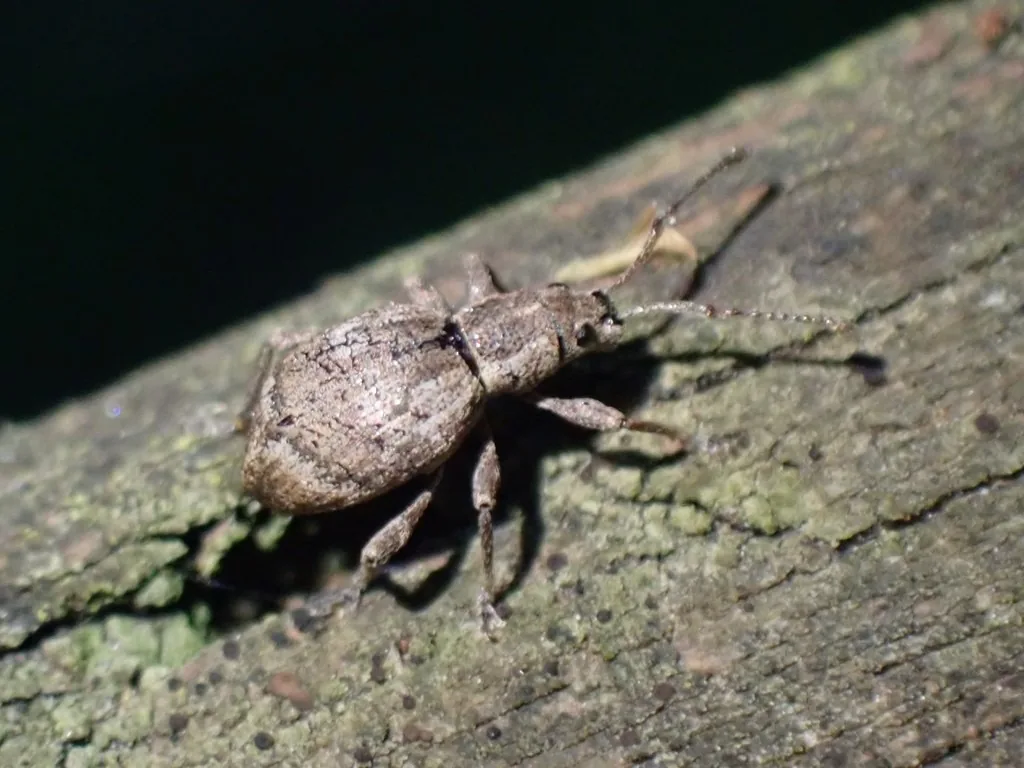
How to identify it
Look-alikes
| Look-alike | How to tell them apart |
|---|---|
| Strawberry root weevil | Their larvae look alike and have similar life cycles; obscure root weevil adults are gray with a wavy brown line across the wing covers.[1] |
Where it lives
The PNW Insect Management Handbook covers it on blueberries and caneberries in the Pacific Northwest.[1]
Biology and life cycle
Larvae overwinter in the soil, pupate from April to June, and adults emerge in late spring.[1]
Adults can't fly; they walk or ride on equipment, and all are females that can lay hundreds of eggs in or on the soil from June to September.[1]
Unlike other blueberry weevils, many stay in the foliage by day and feed at night; there's one generation a year.[1]
Damage and signs
- Larvae feed on roots, while adult leaf notching does little harm.[1]
Health risk
It feeds on plants; the PNW Insect Management Handbook mentions no risk to people.[1]
Control
Prevention
Check foliage on warm, still nights, or wrap trunks with cardboard and check under it in early morning.[1]
Cultivating soil in April and May before planting can kill overwintering larvae.[1]
Biological control
Beneficial nematodes (Heterorhabditis and Steinernema) applied to the root zone as a fall drench have shown some effect on larvae.[1]
Pesticides
No products are registered for home-garden control in the PNW handbook's blueberry listing.[1]
Common questions
Sources
- Pacific Northwest Pest Management Handbooks (OSU, WSU, University of Idaho), “Blueberry: Obscure root weevil (Insect Management Handbook).” pnwhandbooks.org/insect/small-fruit/blueberry/blueberry-obscure-root-weevil (accessed 2026-10-06)
- iNaturalist, “Sciopithes obscurus taxon page (order and family).” www.inaturalist.org/taxa/366563 (accessed 2026-10-06)