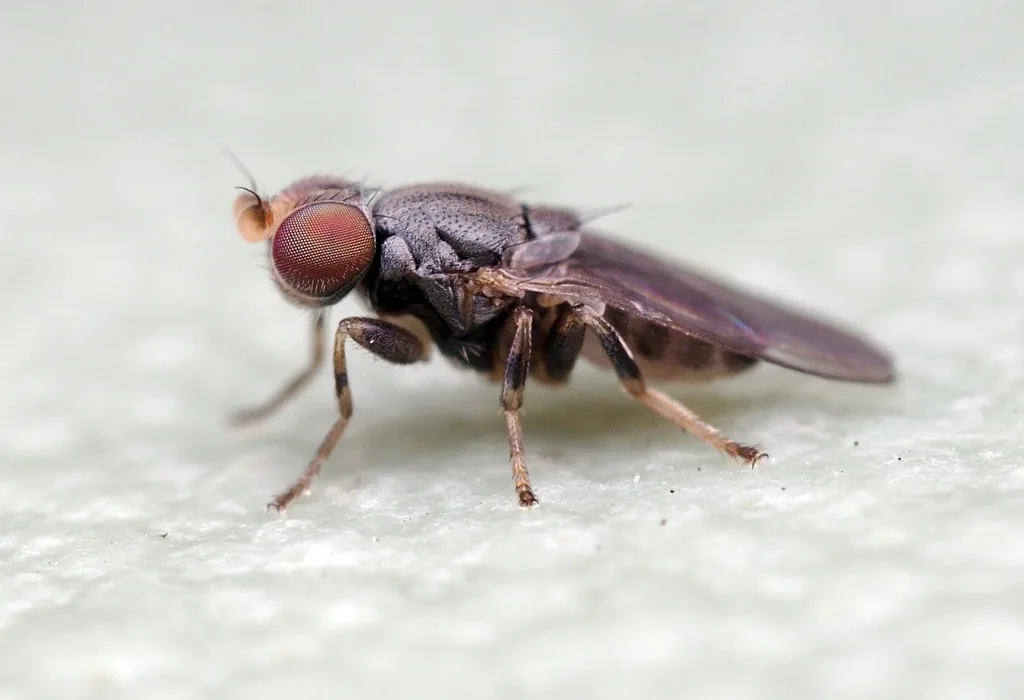
How to identify it
Look-alikes
| Look-alike | How to tell them apart |
|---|---|
| Fungus gnats | Fungus gnats aren't attracted to eyes the way eye gnats are.[1] |
| Biting midges (no-see-ums) | Midges can bite and draw blood; eye gnats can't make wounds.[1] |
| Black flies | Black flies bite; eye gnats only sponge up secretions.[1] |
Where it lives
Liohippelates collusor is the most abundant species in California and also occurs in the Southwest and northern Mexico.[1]
Biology and life cycle
They breed in moist, well-drained sandy soil rich in organic matter, and the wind can carry them miles from breeding sites.[1]
The life cycle averages about 28 days; activity peaks between 70 and 90 degrees F.[1]
Damage and signs
- Swarms can discourage outdoor recreation near farms, schools, parks and golf courses.[1]
Health risk
Eye gnats don't bite, but they feed on secretions at the eyes and wounds and can potentially spread disease-causing organisms.[1]
Control
Prevention
Turn less fresh organic matter into soil and flowerbeds, and reduce surface moisture, which cuts egg laying.[1]
Keep them out
Screen fences about 8 feet high kept out more than 90 percent of eye gnats in research, since they fly low.[1]
Traps and physical control
Egg-baited bottle traps, refreshed at least every 14 days, give some relief when combined with repellents.[1]
Pesticides
For temporary relief, repellents with DEET or picaridin help; insecticides are rarely if ever warranted around homes.[1]
Common questions
Sources
- University of California Statewide IPM Program, “Eye Gnats (Pest Notes).” ipm.ucanr.edu/home-and-landscape/eye-gnats/ (accessed 2026-10-06)
- iNaturalist, “Liohippelates collusor taxon page (order and family).” www.inaturalist.org/taxa/1628486 (accessed 2026-10-06)