On this page
How to identify it
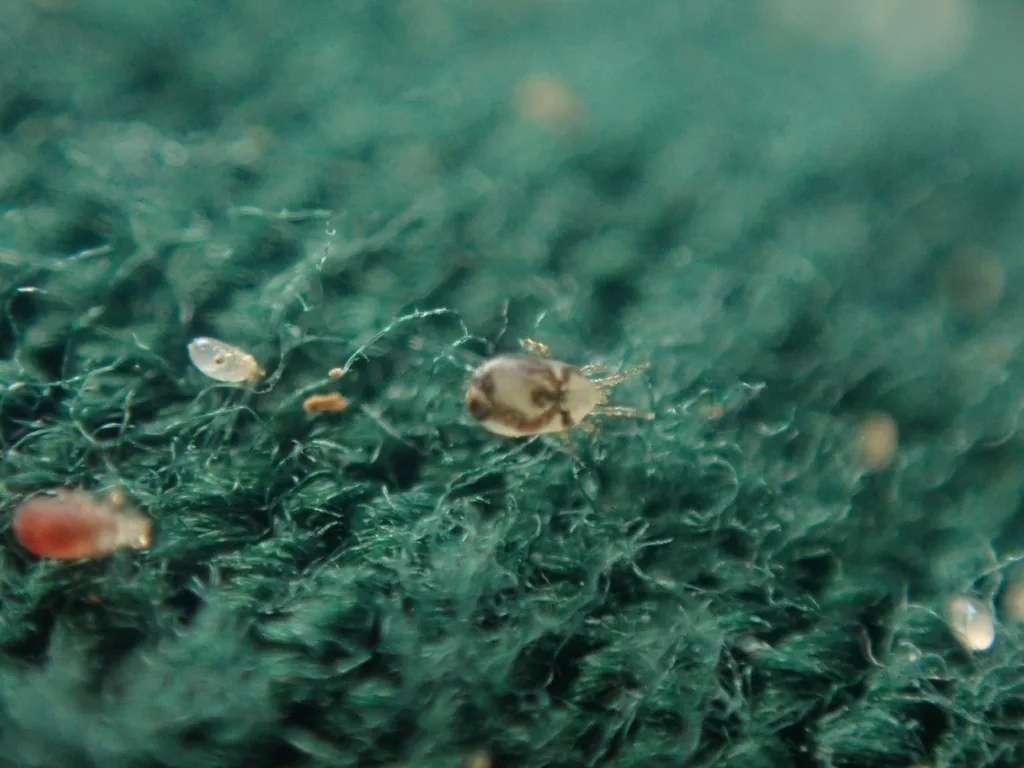
- Adults are about 1/26 inch long, eight-legged and dark red to black, small but visible to the naked eye.[3][2]
- Check the vent area: infested birds have dark, dirty, matted feathers there, blackened by dried blood and mite droppings, and the skin may be crusty or scabby.[1][3][4][2]
- Eggs are laid in masses at the base of the feathers, usually around the vent, and blood stains or mites may show up on the eggs the hens lay.[3][2]
Look-alikes
| Look-alike | How to tell them apart |
|---|---|
| Chicken mite (red mite) | The chicken mite hides in cracks in the coop by day and comes out to feed on birds at night, while the northern fowl mite stays on the bird.[3][1] |
Where it lives
Common on wild birds and rodents, which spread it to flocks, and regarded as the most serious external parasite of poultry in North America.[3][4]
Biology and life cycle
It spends most of its life on the bird, and the life cycle from egg to egg-laying adult takes as little as 5 to 7 days, so numbers rise quickly; a severe infestation can spread through a flock in three to six weeks.[5][3][2]
Mites stay mostly around the vent, though they also turn up on the back and tail.[4]
Damage and signs
Health risk
It lives on birds, but the mites will also bite people, causing itching and skin irritation.[5]
Control
Prevention
Prevention works best: keep wild birds and rodents away from the flock, and check new birds before adding them.[3][1]
Check part of the flock regularly by parting the vent feathers and looking for mites, eggs and dark debris.[1][3]
Pesticides
Use only products labeled for poultry, focus the treatment on the vent area, and follow the label.[1][2]
Common questions
- Why are my hen's vent feathers dark and dirty?
- Dark, matted feathers and scabby skin around the vent, with tiny dark moving specks, are classic signs of northern fowl mites.[1][3]
- How did my backyard flock get northern fowl mites?
- Wild birds and rodents carry them, and they can also arrive with new birds.[3][1]
Sources
- University of Kentucky Cooperative Extension (Entomology), “External Mite and Insect Parasites of Backyard Chickens (ENTFACT-516, L. Townsend).” entomology.ca.uky.edu/files/ef516.pdf (accessed 2026-10-17)
- Virginia Cooperative Extension, “Poultry Parasites: Northern Fowl Mites (APSC-190, 2023).” www.pubs.ext.vt.edu/content/dam/pubs_ext_vt_edu/APSC/apsc-190/APSC-190.pdf (accessed 2026-10-17)
- Mississippi State University Extension, “Northern Fowl Mite Management.” extension.msstate.edu/publications/northern-fowl-mite-management (accessed 2026-10-17)
- UF/IFAS Extension (EDIS), “Northern Fowl Mite (IG141).” web.archive.org/web/20251216135845/edis.ifas.ufl.edu/publication/IG141 (accessed 2026-10-17). Archived copy (Internet Archive, captured 2025-12-16); the original page https://edis.ifas.ufl.edu/publication/IG141 returns 410 Gone (publication retired from EDIS).
- UF/IFAS Extension (EDIS), “External Parasites of Poultry (ENY-290/IG140, P. E. Kaufman; reviewed July 2022).” web.archive.org/web/20251220211336/edis.ifas.ufl.edu/publication/IG140 (accessed 2026-10-17). Archived copy (Internet Archive, captured 2025-12-20); the original page https://edis.ifas.ufl.edu/publication/IG140 returns 410 Gone (publication retired from EDIS).
- iNaturalist, “Ornithonyssus sylviarum taxon page (order and family).” www.inaturalist.org/taxa/263408 (accessed 2026-10-06)