On this page
How to identify it
Where it lives
A parasite of small backyard flocks covered by Kentucky and New Hampshire Extension; chickens kept in wire cages 3 feet or more above the ground rarely get it.[1][2]
Biology and life cycle
It spreads from bird to bird, and birds often pick it up at poultry shows.[1]
Damage and signs
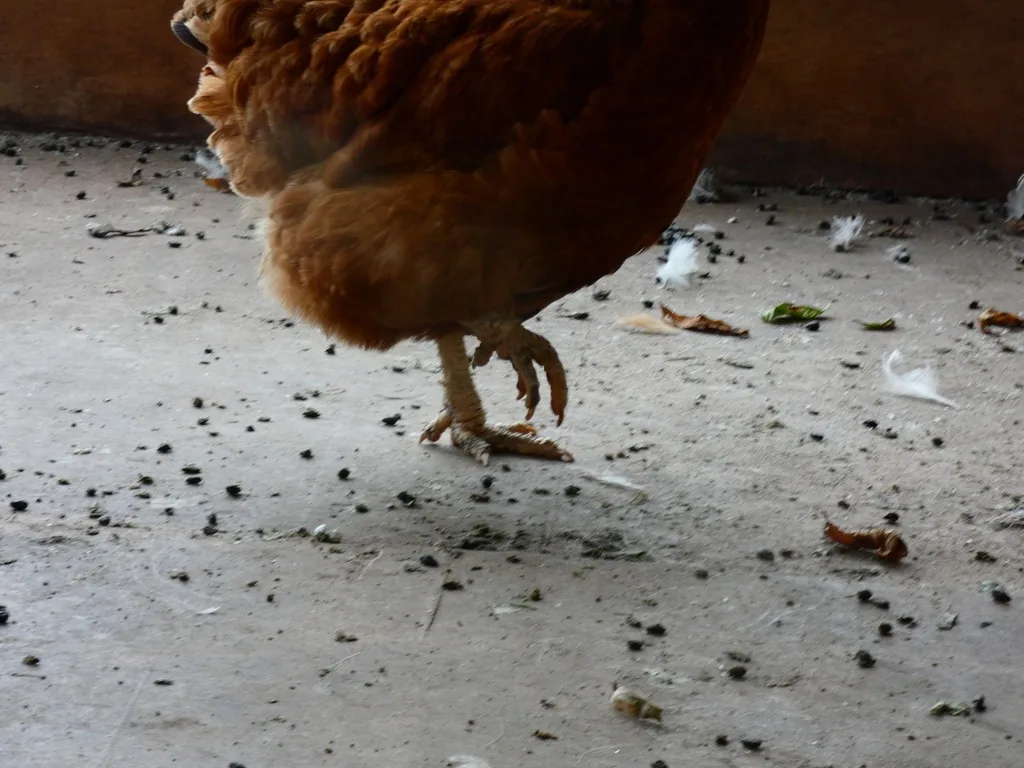
- Burrowing mites lift the scales and deform the feet, and the swollen, deformed look may remain even after the mites are dead.[1]
Health risk
It lives on birds; neither source reports it infesting people.[1][2]
Control
Prevention
Inspect new birds before adding them to the flock, and treat all birds returning from poultry shows; prevention is easier than treatment.[1]
Traps and physical control
Kentucky Extension suggests dipping the legs in linseed oil or petroleum jelly every seven days for three weeks; never use fuel oil, kerosene, motor oil or other liquid petroleum products on chickens.[1]
Common questions
- Why are my chicken's leg scales sticking up?
- Raised, crusty scales and thickened legs are the classic sign of scaly leg mites burrowing under the scales.[1][2]
- Can I show a chicken with scaly leg mites?
- Kentucky Extension advises against it: judges see scaly leg as a sign of poor management, and the mites spread from bird to bird.[1]
Sources
- University of Kentucky Cooperative Extension (Animal and Food Sciences), “Common External Parasites of Poultry (ASC-206, J. Jacob and T. Pescatore; revised September 2017).” web.archive.org/web/20241116021457/afs.ca.uky.edu/sites/afs.ca.uky.edu/files/ASC206.pdf (accessed 2026-10-17). Archived copy (Internet Archive, captured 2024-11-16); the original page https://afs.ca.uky.edu/sites/afs.ca.uky.edu/files/ASC206.pdf returns 404 (file removed).
- UNH Cooperative Extension, “Common External Parasites of Poultry (Small Flock Poultry Management fact sheet, T. Savage; copy hosted by UConn Department of Animal Science).” animalscience-cahnr.media.uconn.edu/wp-content/uploads/sites/3396/2022/06/articlesByFaculty_2_1732435862.pdf (accessed 2026-10-17)
- iNaturalist, “Knemidokoptes mutans taxon page (order and family).” www.inaturalist.org/taxa/391240 (accessed 2026-10-06)