The short answer
- Read the leaves. Puffy blisters on the underside, with orange-yellow maggots inside, mean boxwood leafminer. Tiny pale streaks like scratches mean boxwood mite. Cupped leaves at the branch tips, with white waxy nymphs inside, mean boxwood psyllid. Chewed or skeletonized leaves with webbing and green-black droppings mean box tree moth.[9][14][17][2]
- If you suspect box tree moth, report it before you treat it. Take photos and contact your state department of agriculture, State Plant Regulatory Official or local Extension office. Don't move boxwood clippings or debris out of a quarantined area; APHIS prohibits moving them interstate except for decorative uses.[1][2][3][7][8]
- Timing decides whether control works. Leafminer adults fly for a short window in spring (in May, when weigela blooms, in Pennsylvania); boxwood mites are best treated in spring when they're active; psyllids must be treated as new leaves expand, because sprays after the leaves have opened won't undo that year's cupping.[10][9][14][19]
- Most leafminer, mite and psyllid damage can be tolerated, pruned out or prevented with resistant boxwoods. Kentucky and UMass call psyllid damage mostly aesthetic, and Clemson advises against insecticides for leafminer unless the damage is intolerable.[17][23][21]
Boxwood pest profiles
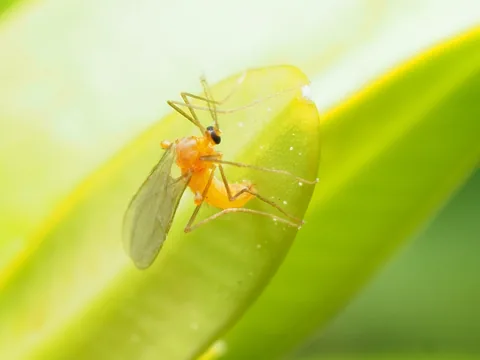 Boxwood Leafminer
Monarthropalpus flavus
Swarms of tiny orange gnatlike flies around boxwoods in spring, and puffy, blistered, yellowing leaves later, point to the boxwood leafminer, the most serious insect pest of boxwood.
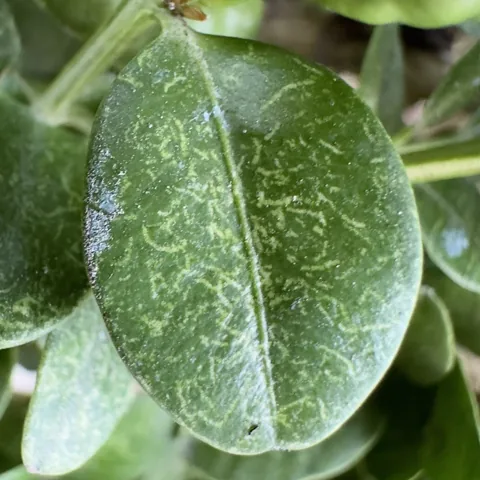 Boxwood Mite
Eurytetranychus buxi
The boxwood mite is a nearly microscopic spider mite that feeds only on boxwood, leaving fine pale stippling or scratch-like lines on the leaves.
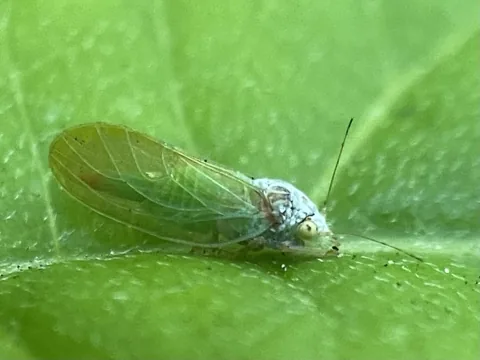 Boxwood psyllid
Psylla buxi
Boxwood psyllids cup and curl new boxwood leaves, but the damage is mostly cosmetic.
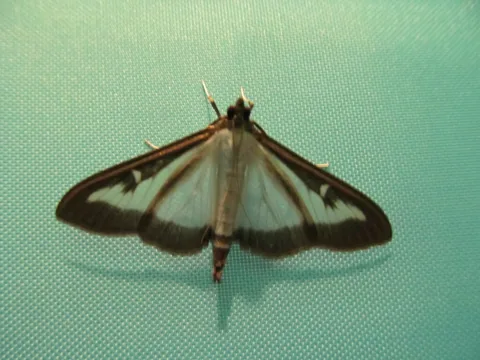 Box Tree Moth
Cydalima perspectalis
The box tree moth is an invasive moth from eastern Asia whose caterpillars feed on boxwood. Heavy infestations can strip a shrub bare, and the caterpillars then chew the bark, which can kill the plant.
Which pest is it? Match the damage
All four pests leave distinct signs on the leaves, so a close look (a hand lens helps for mites) usually tells you which one you have. NC State's boxwood pest key separates the first three; APHIS describes the signs of box tree moth.[22][1]
- Blistered, puffy leaves: boxwood leafminer. The lower leaf surface looks puffy or blistered, and heavily infested plants have distorted, discolored leaves. Breaking a blister open shows 2-6 small orange-yellow maggots.[22][9]
- Scratch-like streaks: boxwood mite. Damage shows as tiny lines or 'hen scratches' on the leaf surface, and the shrub can look off-color. Twospotted spider mites, which also attack boxwood, leave clusters of separate dots instead of lines.[22][14]
- Cupped tips: boxwood psyllid. New growth is distorted and cup-shaped, with pale-green nymphs covered in fluffy white wax inside the cupped leaves, or small green, leafhopper-like adults that jump or fly.[22][17]
- Chewed leaves, webbing and droppings: box tree moth. Look for missing or skeletonized leaves, browned foliage, silk webbing and green-black frass. The lime-green caterpillars have black stripes, white spots and a shiny black head and grow up to 1.5 inches.[1][2][6]
- White waxy blobs on the twigs: Japanese wax scale, found from Florida to Virginia and Maryland. The blobs are up to 6 mm across and are often accompanied by black sooty mold.[22]
Browning that isn't an insect
Not every brown boxwood has a pest. UMass Extension says boxwood is especially prone to winter burn from drying winter winds, which shows as reddish-orange to brown discoloration along the midrib or the whole interior of the leaf, often with green left at the margins. Plants that were drought-stressed in fall are more likely to burn.[23]
Several diseases also brown boxwood. Boxwood blight causes leaf spots, stem cankers and defoliation; Volutella blight browns leaves and kills scattered branches, and its dead leaves stay on the plant for weeks or months, often with salmon-colored spore masses underneath. Clemson describes a broader boxwood decline that involves fungi, cold injury, drought stress, nematodes and poor growing conditions.[23][21]
If you find no insects, mites, mines or webbing, send a sample to your Extension office or a plant diagnostic clinic. Clemson notes that boxwood blight can be confused with other boxwood diseases, so accurate diagnosis matters. Insect and mite damage can also open the door to disease: UMass says damage from leafminer, mite and psyllid, along with shearing wounds, is a main way boxwood pathogens get in.[21][23]
Boxwood leafminer: blistered leaves
The boxwood leafminer (Monarthropalpus flavus) is a tiny gall midge from Europe and is often called the most serious insect pest of boxwood. It now occurs wherever boxwood grows in the United States. NC State says it is a bigger problem in the Mountains and Piedmont than in the Coastal Plain of North Carolina.[11][9][10][21][22]
Adults are delicate, mosquito-like, yellow to orange-red flies about 2.5 mm (1/10 inch) long. They're easiest to spot swarming around boxwoods in spring. The larvae are legless whitish, yellow or orange maggots up to 3 mm (1/8 inch) long that live inside the leaf.[11][10][22][21]
There is one generation a year. Partly grown larvae spend the winter in the leaf, feed again in spring, pupate, and push the pupa out through the underside of the leaf, where the empty pupal skin may hang after the adult leaves. Adults live only a few days, and the female lays about 29 eggs into the current season's leaves, then dies. The eggs hatch in about 2 to 3 weeks (14-21 days by Penn State's count) and the larvae feed slowly through summer.[9][10][11][12][22]
Sources disagree on which side of the leaf gets the eggs. UMass, NC State, Clemson and the Pacific Northwest handbook say the female lays through the upper surface; Penn State, UC IPM and Oregon State say the lower surface. Either way, Penn State notes that eggs in new leaves can be seen by holding a leaf up to the light.[9][22][21][13][10][11][12]
Damage: mines start as pale green or yellow spots on the upper leaf surface, then become yellow to brown blisters on the underside. Infested leaves are smaller and yellower and can drop early. UMass and UC IPM say repeated heavy attacks lead to branch dieback and plants more open to stress and disease, and Clemson says heavy infestations can cause serious leaf loss and possibly plant death.[11][9][21][10]
Controlling boxwood leafminer
Watch for the adults. Emergence lines up with weigela bloom: in May in Pennsylvania, mid-May to early June in Massachusetts, late April through May in the Pacific Northwest, generally April by UC IPM's account, and mid-April to early May in South Carolina. UMass and Oregon State put it at 300 to 650 growing degree days (base 50°F). Shake the shrubs or look for swarms early in the morning, or hang yellow sticky traps.[10][9][12][11][21]
Prune and clean up. If only a few leaves are mined, clip or pick them off. The Pacific Northwest handbook says to pick off infested leaves or shear infested tips before the flies emerge and destroy the clippings. UMass suggests, where practical, cutting back first-year growth by about a third after egg-laying in June. UC IPM also suggests raking up and disposing of fallen boxwood leaves in fall and winter.[11][13][9]
Spraying the adults is hard to time. UMass says adults are only around for 2-3 weeks, and Clemson notes they emerge over about three weeks but each lives only a few days. Contact insecticides labeled for boxwood leafminer go on during adult emergence, after you've confirmed the flies are present.[9][21]
Systemic insecticides reach larvae inside the leaf. UC IPM describes soil drenches of dinotefuran or imidacloprid in late winter and spinosad sprayed on the foliage in spring, where horticultural oil in the mix can help it work and last longer. Clemson says these may take two weeks or more to start working. Because these products are toxic to bees, UC IPM says to wait until the boxwood has finished flowering and to spray spinosad in the evening. Follow the label; Massachusetts restricts neonicotinoid use on shrubs to licensed applicators.[11][21][9]
UMass says there are no known effective natural enemies of boxwood leafminer, and Clemson lists no biological controls.[9][21]
Boxwood mite (boxwood spider mite): scratch-like streaks
The boxwood mite (Eurytetranychus buxi) is a spider mite that feeds only on boxwood. It is about the size of a printed period: Clemson puts it at about 1/64 inch, and the Pacific Northwest handbook at around 0.015 inch. Descriptions of its color vary from gray with pale legs (NC State) to greenish or yellowish-brown (Clemson) and yellow, tan or gray (Rutgers).[14][21][16][15]
Unlike most spider mites, it feeds on both the upper and lower leaf surfaces, and it tends to feed in a line. NC State says the result is tiny pale lines that look like minute scratches under a hand lens. Heavy infestations can give the shrub a dingy, silvery look or cause leaves to drop early. UMass calls the damage often minor.[14][21][16][23]
The mites overwinter as yellowish eggs on the leaves (UMass and Clemson say on the undersides) and hatch in mid-spring. A full life cycle takes 18 to 21 days, giving at least eight generations a year. A female lays 25 to 30 eggs, and the overwintering eggs are laid in September and October.[14][23][21][15]
Most of the injury happens in spring, but NC State says it often isn't noticed until later in the year. Rutgers says the mites are most active in late spring and early summer and can become active again in late summer. UMass says English and common boxwood are most affected and Japanese boxwood is much less susceptible.[14][15][23]
Controlling boxwood mites
Check with the paper tap test. Hold a white sheet of paper under a branch and strike the branch, then watch for moving mites. Clemson says more than 15 mites per strike can mean serious damage.[21]
Start gently. A strong spray of water applied regularly removes mites, and natural predators such as predatory mites and lady beetles often keep them in check. Clemson advises avoiding insecticides unless needed, because they can kill those predators. Kentucky notes that soil-applied neonicotinoids for psyllids have been associated with later mite outbreaks.[21][15][17]
Oils and soaps. NC State recommends two treatments of insecticidal soap, horticultural oil or another labeled miticide, 10 to 14 days apart, in spring when the mites are active; if mites are found later, an oil treatment then and again the next spring. Clemson's oil rate is 1% to 2% (2½ to 5 tablespoons of oil per gallon of water) when temperatures are between 45°F and 85°F. Rutgers suggests 2-3% dormant oil against the overwintering eggs. UMass puts treatment timing at 245 to 600 growing degree days (base 50°F), roughly the beginning of May.[14][21][15][23]
Boxwood psyllid: cupped leaves at the tips
The boxwood psyllid (Psylla buxi, also listed as Cacopsylla buxi) is a small, green, jumping sap-feeder that looks like a tiny cicada. Sources give adult lengths from about 1/16 inch (Kentucky) to 3 mm (Penn State) and up to 1/8 inch (NC State and Clemson). Nymphs are pale green and coated in white, cottony wax.[17][18][19][21][23]
There is one generation a year. The insect spends the winter under the bud scales as a tiny orange egg; NC State and UMass say a first-stage nymph is already formed inside the shell. Nymphs come out as the buds open in spring, and their feeding makes the expanding leaves cup around them. Adults appear in late May and June. NC State says females lay 1 to 7 eggs under each bud scale in July or August; Penn State says egg-laying is in early summer.[19][23][18][17][20]
The damage is mostly cosmetic. Penn State says the psyllid is not as destructive as other boxwood pests, and NC State says plants sometimes outgrow the injury by midsummer, though UMass notes cupped leaves can stay on the plant for up to two years. American boxwood is more likely to be severely infested than English boxwood.[18][19][23][20]
Controlling boxwood psyllid
Usually no treatment is needed. Kentucky says pruning out the cupped tips is often the easiest fix; do it by mid-May, before the nymphs become adults, and destroy the clippings. The Pacific Northwest handbook says lady beetles, lacewings and parasitic wasps are effective controls and that broad-spectrum sprays that disrupt them should be avoided.[17][20]
If you do treat, do it while leaves are expanding. NC State says sprays after the leaves have fully expanded (mid to late May) won't prevent that year's damage, though they may cut numbers for next year. Kentucky lists insecticidal soap or summer-rate horticultural oil on emerging buds, contact insecticides in early to mid-May for nymphs or by early June for egg-laying adults, and soil-applied systemics in April or early May before damage appears. Penn State's timing is early May, when nymphs are present. UMass gives 290 to 440 growing degree days (base 50°F) for foliar sprays.[19][17][18][23]
NC State adds that in dry weather you should water boxwoods well before spraying to avoid injuring them.[19]
Box tree moth: chewed leaves, webbing and dead shrubs
Box tree moth (Cydalima perspectalis) is native to East Asia. It reached Europe in 2007, Ontario in 2018 and Niagara County, New York, in 2021. APHIS says it has since been confirmed in Delaware, Kentucky, Maryland, Massachusetts, Michigan, Ohio, Pennsylvania, Virginia and West Virginia. Long-distance spread in Europe came mainly through moving infested boxwood plants.[1][2][8]
Unlike the other boxwood pests, it can kill the plant. The caterpillars can strip a boxwood of leaves, then feed on the bark, girdling branches or the whole shrub. Pennsylvania notes that about 150 boxwood cultivars are available to homeowners and all are susceptible.[1][2][7][8]
Eggs are pale yellow, laid in flat clusters of about 5 to 20 on the underside of the leaves, and hatch in about 3 days. Young caterpillars are green to yellow with black heads; older ones develop white, yellow and black stripes with black dots and reach about 1.5 to 1.6 inches. Pupae are 0.6 to 0.8 inch long in silk cocoons.[2][6][7][1]
Adults usually have white, slightly iridescent wings with a thick, irregular brown border. Pennsylvania gives the wingspan as 1.5 to 1.8 inches; APHIS and UMass give 1.6 to 1.8. Some are almost entirely brown with a small white streak or comma mark on each forewing. They are active at night. Pennsylvania lists the melonworm moth and pickleworm moth as look-alikes; neither has the white comma mark.[2][6][7][1]
The caterpillars overwinter in webbed shelters among the leaves and start feeding in March in warm areas or late May to early June in cooler ones. Adults from the overwintering generation fly from April to July, and later generations from June to October. UMass expects 1-5 overlapping generations a year in Massachusetts. Young caterpillars hide among twigs and leaves, so damage may not be obvious early on; they tend to feed low in the plant but can be found throughout.[2][6]
Box tree moth quarantine and how to report it
APHIS regulates the interstate movement of boxwood from quarantined areas. Under Federal Order DA-2026-24, boxwood plants can leave a quarantined area across state lines only from a business operating under a compliance agreement, with a state-issued certificate. All other boxwood material (plant parts, cuttings, clippings, debris, alive or dead) is prohibited from interstate movement except for decorative uses such as wreaths, garlands and floral arrangements. States can add their own rules.[3][4]
As of APHIS's list updated October 1, 2026, the quarantined areas were all of Delaware, Massachusetts and West Virginia, plus listed counties in Maryland, Michigan, New Jersey, New York, Ohio, Pennsylvania and Virginia (including the independent city of Winchester). The list changes as the moth is found in new places; APHIS added New Jersey's Cumberland and Atlantic Counties in October 2026 and four Maryland counties and Franklin County, Pennsylvania, in August 2026. Check the APHIS box tree moth page or its quarantine boundary viewer for the current map.[5][4][3][1]
Report suspected box tree moth. APHIS asks people to report damage and to contact their State Plant Regulatory Official, State Plant Health Director or local Extension office to get the specimen identified. Pennsylvania takes reports at badbug@pa.gov or 1-888-253-7189 and asks for the life stage, whether there was damage, and photos. New York takes reports online at agriculture.ny.gov/reportBTM, except from counties where the moth is already established. UMass directs Massachusetts reports to massnrc.org/pests/report.aspx.[1][2][7][8][6]
Let officials in. APHIS asks property owners to allow state or federal agricultural officials to inspect boxwoods and place detection traps.[1]
What to do about box tree moth on your boxwood
Cut out infested branches. APHIS says to remove infested branches, and for heavy infestations to cut the boxwood off at its base, since it should grow back from the roots. Double-bag all boxwood debris in plastic and put it in the trash. New York gives the same advice for counties where the moth is established. UMass adds that on small or lightly infested plants, caterpillars can be hand-picked and dropped into soapy water.[1][8][6]
Insecticides. UMass lists active ingredients tested for efficacy against box tree moth, including Bacillus thuringiensis kurstaki (Bt), spinosad, chlorantraniliprole, cyantraniliprole, methoxyfenozide, bifenthrin and lambda-cyhalothrin. Contact sprays only work with thorough coverage of the inside of the shrub and through the caterpillars' webbing. Spray after bloom to protect pollinators. UMass says treatment is unnecessary in parts of Massachusetts where the moth hasn't been confirmed, and Pennsylvania and APHIS direct people to their Extension office for treatment options.[6][1][7]
Natural enemies aren't a solution yet. UMass says their effectiveness in the United States is unknown, and classical biological control (importing parasitoids or predators from Asia) isn't available. In lab studies, the beneficial nematodes Steinernema carpocapsae and Heterorhabditis bacteriophora killed many box tree moth larvae.[6]
Consider replacing boxwood in infested areas. UMass suggests replanting with other shrubs, such as bayberry, dwarf hinoki cypress, inkberry holly, Japanese holly or plum yew, depending on the site.[6]
A boxwood pest calendar
Exact dates shift with region and weather, so use plant cues and degree days where the sources give them. A rough season, based mostly on eastern sources:[10][9][23]
- Late winter: soil-applied systemics for leafminer go on now if you use them (UC IPM).[11]
- Bud break into early May: psyllid nymphs hatch and cup the new leaves; treat as leaves expand or prune out cupped tips by mid-May (NC State, Kentucky). Boxwood mite eggs hatch in mid-spring; treat mites in spring, around the beginning of May at 245 to 600 degree days (NC State, UMass).[19][17][14][23]
- May into early June, when weigela blooms: leafminer adults swarm and lay eggs (Penn State, UMass). Late May and June: psyllid adults appear.[10][9][19][20]
- June: after leafminer egg-laying, UMass suggests pruning back first-year growth where practical; check new leaves for egg-laying pinholes in late June.[9]
- Summer: leafminer larvae grow slowly in the leaves; boxwood mite generations keep cycling every 18 to 21 days; box tree moth generations fly from June to October where the moth is present.[9][14][2]
- September and October: boxwood mites lay their overwintering eggs (NC State). Fall and winter: rake up fallen boxwood leaves (UC IPM).[14][11]
Resistant boxwoods and replacements
Leafminer resistance varies by cultivar. UC IPM and UMass list Buxus microphylla 'Green Pillow' and 'Grace Hendrick Phillips' and Buxus sempervirens 'Argenteo-variegata', 'Handworthiensis', 'Justin Brouwers', 'Pendula', 'Pyramidalis', 'Suffruticosa' and 'Vardar Valley' as more resistant. UMass says English boxwood ('Suffruticosa') is rarely attacked. Clemson's fact sheet disagrees, saying no leafminer-resistant varieties are available and that American, English and Japanese boxwood are all susceptible.[11][9][21]
For the other pests: UMass says Japanese boxwood is much less susceptible to boxwood mite, and both UMass and NC State say American boxwood is more heavily infested by psyllids than English boxwood. Clemson knows of no resistant varieties for either. No boxwood resists box tree moth; Pennsylvania says all of the roughly 150 cultivars sold to homeowners are susceptible.[23][19][21][7]
Healthy plants handle pests better. UC IPM and UMass both stress good cultural care, especially adequate soil moisture in dry weather, so boxwoods stay vigorous and tolerate damage.[11][9]
Common questions
- What is eating my boxwood?
- If leaves are chewed, skeletonized or missing and you see webbing and green-black droppings, suspect box tree moth and report it. Blistered leaves point to boxwood leafminer, scratch-like streaks to boxwood mite, and cupped tips to boxwood psyllid.[1][2][22]
- Do I have to report box tree moth?
- Report it if you find it outside an area where it's already established. APHIS asks people to report signs of the moth to their State Plant Regulatory Official or Extension office, and Pennsylvania and New York have their own reporting lines. New York says residents of counties where it's established don't need to report it.[1][7][8]
- Can I move boxwood clippings out of a quarantined area?
- Not across state lines. APHIS prohibits interstate movement of boxwood plant parts, cuttings, clippings and debris from quarantined areas, except for decorative uses. Double-bag infested debris and put it in the trash.[3][4][1]
- When should I spray boxwood for leafminer?
- Contact sprays target the adult flies as they emerge, when weigela is in bloom (May in Pennsylvania, mid-May to early June in Massachusetts). Because adults live only a few days, confirm them first. Systemic soil drenches go on in late winter.[10][9][21][11]
- Is boxwood psyllid damage serious?
- Usually not. The cupping is mostly cosmetic, plants often outgrow it, and pruning out cupped tips by mid-May is often all that's needed.[17][19][23]
- How do I get rid of boxwood mites?
- Confirm them with a paper tap test, hose them off and let predators work. If needed, NC State recommends two sprays of insecticidal soap, horticultural oil or a labeled miticide 10 to 14 days apart in spring.[21][14]
Photo credits
- Boxwood Leafminer: (c) Katja Schulz, some rights reserved (CC BY) — via iNaturalist, CC BY 4.0
- Boxwood Mite: wilderbombyx, public domain (CC0), via iNaturalist
- Boxwood psyllid: (c) fuzzyspider, some rights reserved (CC BY) — via iNaturalist, CC BY 4.0
- Box Tree Moth: (c) zebedeugalinha, some rights reserved (CC BY) — via iNaturalist, CC BY 4.0
Sources
- USDA Animal and Plant Health Inspection Service, “Box Tree Moth (last modified October 7, 2026).” www.aphis.usda.gov/plant-pests-diseases/box-tree-moth (accessed 2026-11-10)
- USDA Animal and Plant Health Inspection Service, “Pest Alert: Box Tree Moth (Cydalima perspectalis), APHIS 81-35-040, revised February 2025.” www.aphis.usda.gov/sites/default/files/alert-box-tree-moth.pdf (accessed 2026-11-10)
- USDA Animal and Plant Health Inspection Service, “Federal Order DA-2026-24: APHIS Establishes a Box Tree Moth Quarantine in Maryland and Pennsylvania (August 4, 2026).” www.aphis.usda.gov/sites/default/files/da-2026-24.pdf (accessed 2026-11-10)
- USDA Animal and Plant Health Inspection Service, “DA-2026-44: APHIS Expands Box Tree Moth Quarantine in New Jersey (October 1, 2026).” www.aphis.usda.gov/sites/default/files/da-2026-44.pdf (accessed 2026-11-10)
- USDA Animal and Plant Health Inspection Service, “Box Tree Moth Regulated Areas (last updated October 1, 2026).” www.aphis.usda.gov/sites/default/files/btm-regulated-areas.pdf (accessed 2026-11-10)
- UMass Amherst Center for Agriculture, Food, and the Environment, “Cydalima perspectalis (Box Tree Moth), Insect & Mite Guide.” www.umass.edu/agriculture-food-environment/landscape/publications-resources/insect-mite-guide/cydalima-perspectalis (accessed 2026-11-10)
- Pennsylvania Department of Agriculture, “Box Tree Moth.” www.pa.gov/agencies/pda/plants-land-water/plant-industry/plant-protection/box-tree-moth.html (accessed 2026-11-10)
- New York State Department of Agriculture and Markets, “Box Tree Moth.” agriculture.ny.gov/plant-industry/box-tree-moth (accessed 2026-11-10)
- UMass Amherst Center for Agriculture, Food, and the Environment, “Boxwood Leafminer.” www.umass.edu/agriculture-food-environment/landscape/fact-sheets/boxwood-leafminer (accessed 2026-11-10)
- Penn State Extension, “Boxwood Leafminer.” extension.psu.edu/boxwood-leafminer (accessed 2026-11-10)
- University of California Statewide IPM Program, “Boxwood Leafminer (Pest Notes, Home and Landscape).” ipm.ucanr.edu/PMG/GARDEN/PLANTS/INVERT/boxwoodlfmin.html (accessed 2026-11-10)
- Oregon State University College of Agricultural Sciences, “Boxwood Leafminer (Nursery Pest Management).” agsci.oregonstate.edu/nurspest/insects/boxwood-leafminer (accessed 2026-11-10)
- Pacific Northwest Pest Management Handbooks (OSU, WSU, U of Idaho Extension), “Boxwood (Buxus)-Boxwood leafminer, PNW Insect Management Handbook.” pnwhandbooks.org/insect/hort/landscape/hosts-pests-landscape-plants/boxwood-buxus-boxwood-leafminer (accessed 2026-11-10)
- NC State Extension, “Boxwood Mite.” content.ces.ncsu.edu/boxwood-mite (accessed 2026-11-10)
- Rutgers Cooperative Extension, “Boxwood Mites (Nursery IPM).” sites.rutgers.edu/nursery-ipm/boxwood-mites/ (accessed 2026-11-10)
- Pacific Northwest Pest Management Handbooks (OSU, WSU, U of Idaho Extension), “Boxwood (Buxus)-Boxwood spider mite, PNW Insect Management Handbook.” pnwhandbooks.org/insect/hort/landscape/hosts-pests-landscape-plants/boxwood-buxus-boxwood-spider-mite (accessed 2026-11-10)
- University of Kentucky Entomology, “Identifying Boxwood Psyllid, ENTFACT-454.” entomology.mgcafe.uky.edu/ef454 (accessed 2026-11-10)
- Penn State Extension, “Boxwood Psyllid.” extension.psu.edu/boxwood-psyllid (accessed 2026-11-10)
- NC State Extension, “Boxwood Psyllid.” content.ces.ncsu.edu/boxwood-psyllid (accessed 2026-11-10)
- Pacific Northwest Pest Management Handbooks (OSU, WSU, U of Idaho Extension), “Boxwood (Buxus)-Boxwood psyllid, PNW Insect Management Handbook.” pnwhandbooks.org/insect/hort/landscape/hosts-pests-landscape-plants/boxwood-buxus-boxwood-psyllid (accessed 2026-11-10)
- Clemson Cooperative Extension Home & Garden Information Center, “Boxwood Diseases and Insect Pests in South Carolina (HGIC).” hgic.clemson.edu/factsheet/boxwood-diseases-insect-pests/ (accessed 2026-11-10)
- NC State Extension, “Pests of Boxwood.” content.ces.ncsu.edu/pests-of-boxwood (accessed 2026-11-10)
- UMass Amherst Center for Agriculture, Food, and the Environment, “Boxwood: Common Health Issues in the Landscape.” www.umass.edu/agriculture-food-environment/landscape/fact-sheets/boxwood-common-health-issues-in-landscape (accessed 2026-11-10)