The short answer
- On most plants, leafminer damage is cosmetic. Extension services say mining rarely kills vegetables older than seedlings, and established trees and shrubs tolerate a lot of it.[2][1][13]
- In the vegetable garden, pick off or pinch mined leaves as soon as you see them, keep weeds such as lambsquarters and chickweed down, and cover spinach, chard and beets with row cover before the flies appear in spring.[7][6][5][2]
- Don't spray broad-spectrum insecticides for other pests if you can avoid it: parasitic wasps often keep leafminers in check, and killing them can set off a leafminer outbreak.[2][4][3]
- Once larvae are inside the leaf, most sprays can't reach them. Where treatment is justified (boxwood, birch, holly, young citrus), it has to be timed to the adults or to the first tiny mines.[5][13][9][11][3]
- On citrus, leave mined leaves on the tree and avoid pruning and nitrogen that push new growth while leafminers are active.[3]
Leafminer profiles
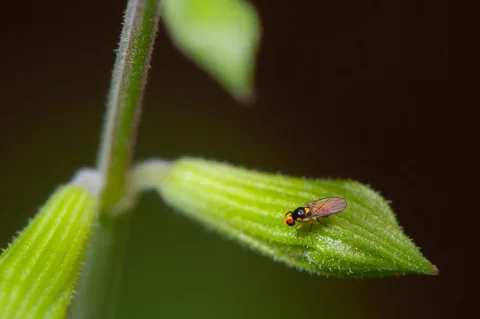 Vegetable Leafminer
Liriomyza sativae
The vegetable leafminer is a tiny fly whose maggots tunnel winding mines through the leaves of tomatoes, melons, beans and many other vegetables. It is native to the Americas and has spread to Africa, Asia and Oceania.
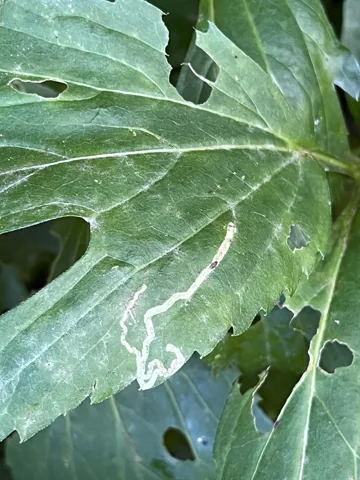 American Serpentine Leafminer
Liriomyza trifolii
The American serpentine leafminer is a tiny fly whose maggots tunnel winding, whitish trails through the leaves of many vegetables and garden flowers.
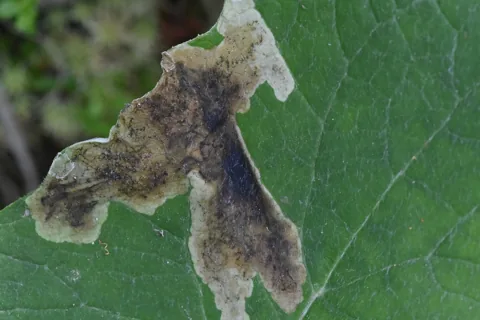 Spinach and Beet Leafminers
Pegomya hyoscyami and P. betae
Spinach and beet leafminers are small gray to brown flies whose white maggots feed between the upper and lower surfaces of spinach, chard, beet and related leaves, leaving blotchy mines that turn brown.
No photo yet
Allium Leafminer
Phytomyza gymnostoma
Allium leafminer is an invasive fly whose larvae feed in the leaves of onions, leeks, chives and garlic and burrow into the bulb, stunting plants.
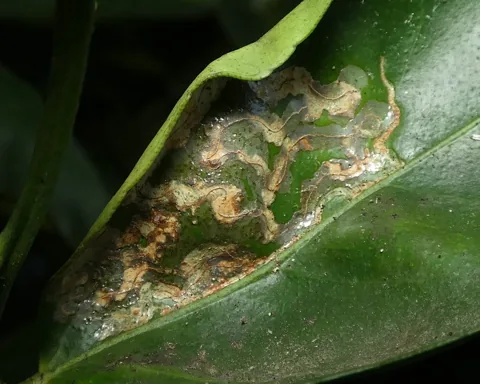 Citrus Leafminer
Phyllocnistis citrella
Citrus leafminer larvae tunnel through young citrus leaves and curl them. The damage looks bad, but mature backyard trees rarely suffer serious harm, and even heavily infested young trees are unlikely to die.
 Boxwood Leafminer
Monarthropalpus flavus
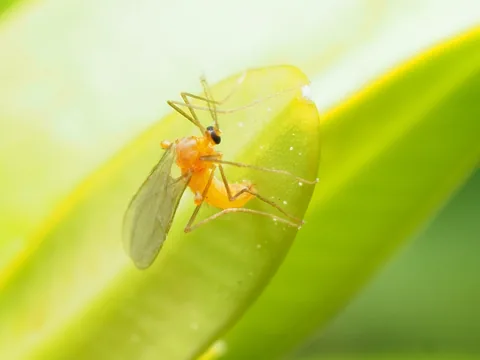
Swarms of tiny orange gnatlike flies around boxwoods in spring, and puffy, blistered, yellowing leaves later, point to the boxwood leafminer, the most serious insect pest of boxwood.
 Leafminers (boxwood leafminer)
Monarthropalpus flavus
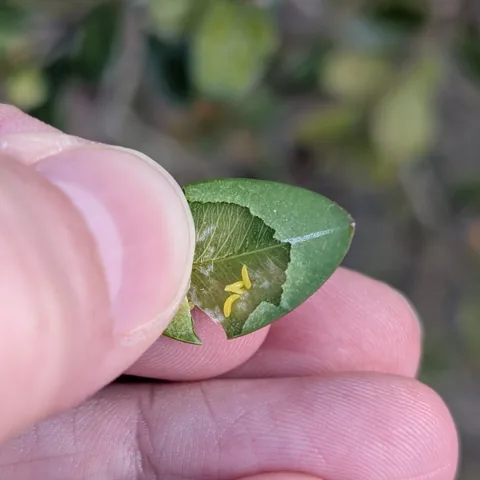
Leafminers are insect larvae that feed between the upper and lower surfaces of a leaf, leaving blotches, blisters or winding trails. Small moths, flies, sawflies and wasps all have leafmining species, and each kind feeds on only one or a few related plants.
No photo yet
Birch Leafminer
Fenusa pumila
Birch leafminer is a key pest of gray and paper birch, mining the leaves and browning the crown.
 Amber-marked birch leafminer
Profenusa thomsoni
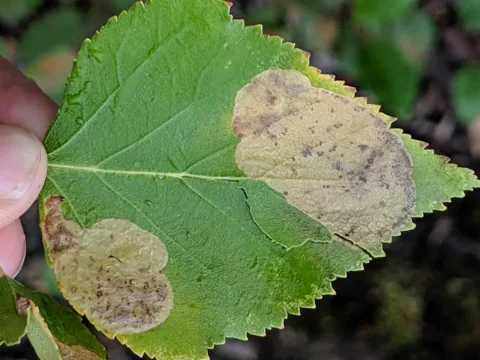
The amber-marked birch leafminer is a small, stingless sawfly from Europe and Asia whose larvae feed inside birch leaves. Believed to have reached eastern North America early in the twentieth century, it spread across Canada and into Alaska in the early 1990s, where it has caused heavy infestations of birch in Anchorage since 2002 and later around Fairbanks. Its mines turn leaves yellowish brown in late July and August, often mistaken for early fall color.
 Native Holly Leafminer
Phytomyza ilicicola
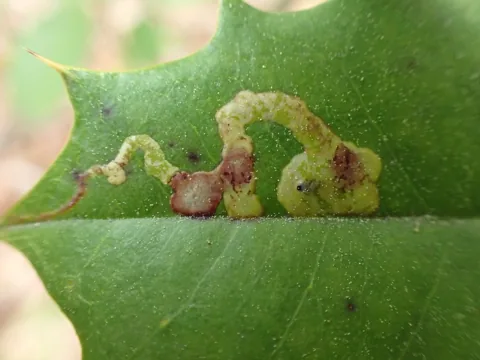
The native holly leafminer feeds only on American holly, leaving yellow serpentine or blotch mines in the leaves.
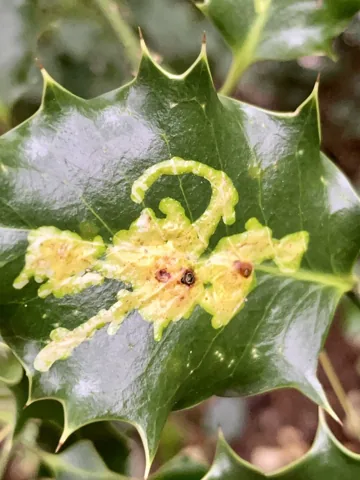 European Holly Leafminer
Phytomyza ilicis
The European holly leafminer is a tiny fly whose larvae mine the leaves of English holly.
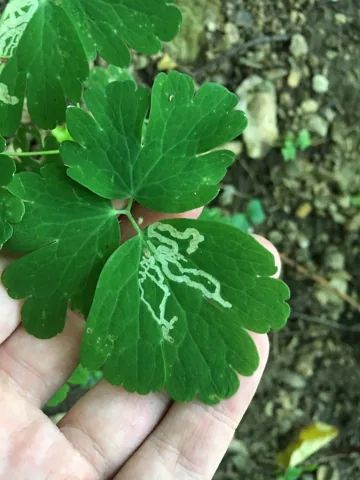 Columbine Leafminers
Phytomyza aquilegivora
Columbine leafminers are tiny native flies whose maggots tunnel white, winding trails inside columbine leaves.
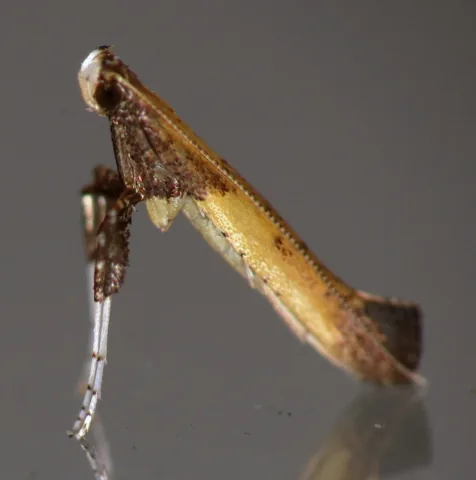 Azalea Leafminer
Caloptilia azaleella
The azalea leafminer is a tiny yellow moth with purplish wing markings. Its young caterpillars mine azalea leaves, making brown blisters, and older ones roll and tie the leaf tips with silk; azaleas are its only known host.
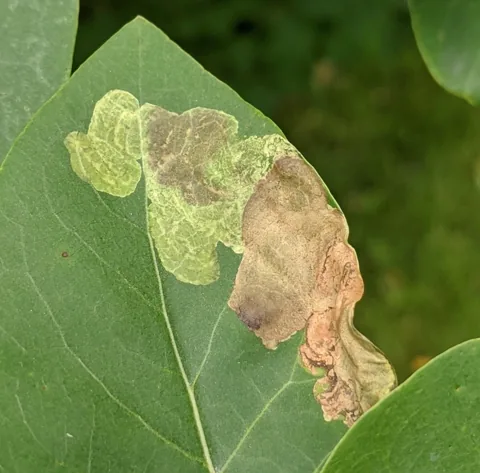 Lilac Leafminer
Gracillaria syringella (formerly Caloptilia syringella)
The lilac leafminer is a small European moth whose caterpillars mine, roll and skeletonize the leaves of lilac and privet.
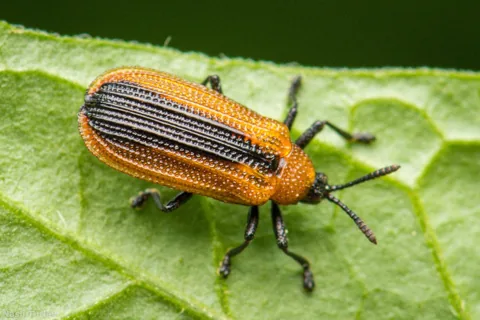 Locust Leafminer
Odontota dorsalis
The locust leafminer is a small, flat orange-and-black beetle whose larvae tunnel inside black locust leaves, turning trees brown and scorched-looking by midsummer; trees rarely die.
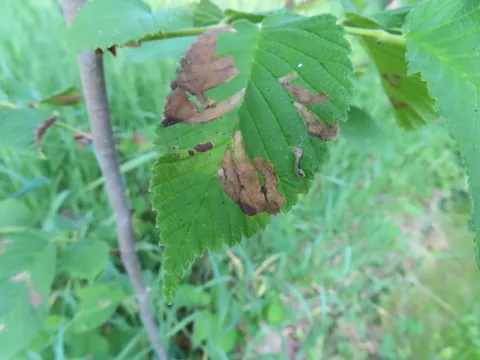 Elm Leafminer
Fenusa ulmi (syn. Kaliofenusa ulmi)
The elm leafminer is a small European sawfly whose larvae mine the leaves of elms in spring.
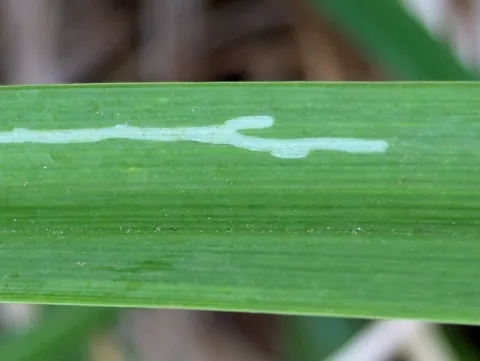 Daylily leafminer
Ophiomyia kwansonis
The daylily leafminer is a tiny black fly from Japan and Taiwan whose maggots tunnel through daylily leaves, leaving long pale lines. It was first confirmed in North America in 2011 and mostly disfigures the leaves rather than harming the plants.
What you're seeing
A leafminer eats the soft tissue between the two surfaces of a leaf, leaving the outer skin. That leaves a pale trail or blotch. Each kind of leafminer feeds on only one plant or a few closely related ones, so the plant and the shape of the mine are the best clues to which insect it is.[5][6][1]
Hold a mined leaf up to the light. You can often see the larva and a dark line or specks of droppings (frass) inside, which shows whether a larva is still there.[10][11][3][14]
- Winding (serpentine) trails that get wider as they go: typical of Liriomyza fly larvae on vegetables and flowers, columbine leafminer, and citrus leafminer, which leaves a thin dark line of frass down the middle of its silvery mine.[2][13][3][14]
- Trails that turn into large pale blotches: spinach and beet leafminer on spinach, chard and beets.[6][7][5]
- Puffy blisters, yellow or brown on the underside, on boxwood: boxwood leafminer. Breaking one open shows several orange-yellow maggots.[9][8]
- Brown, scorched-looking blotches on birch leaves, often starting at the top of the tree: birch leafminer, a sawfly.[10][11]
- Yellow serpentine or blotch mines on American holly: native holly leafminer.[12]
- Tiny white specks on the leaves (stippling) often come with Liriomyza mines. Females puncture leaves to feed on sap and lay eggs.[2][4]
- Look-alikes: on holly, leaves scratched by neighboring leaves' spines can resemble egg-laying damage, and on citrus a related peelminer tunnels in fruit and stems instead of leaves and leaves no frass line.[12][3]
How much damage is too much?
Deciding whether to act at all is the first step, because the damage is often done by the time it shows. UC IPM says leafminers rarely need treatment in gardens, and Wisconsin Extension says columbine leafminer damage is usually cosmetic, so chemical controls generally aren't recommended.[2][13]
- Vegetables: damage is not serious on most plants older than seedlings, though it can make spinach or chard unsightly. It matters most on crops grown for their leaves; Wisconsin Extension notes that a 5% threshold is often used on leafy crops such as spinach, lettuce and chard, and that young plants tolerate less damage than older ones.[2][5]
- Citrus: mature trees with a dense canopy of older leaves (UC IPM says more than 4 years old) tolerate damage to new growth with little effect on growth or fruit. Very young trees may grow more slowly, but even heavily infested young trees are unlikely to die.[3]
- Birch: Minnesota Extension says leafminer damage generally affects no more than 40% of leaves and well-watered birches tolerate even more than 60%; birches are treated mostly for looks. Penn State warns that repeated defoliation can seriously weaken or kill a tree.[11][10]
- Boxwood and American holly: heavy infestations make leaves drop early. UMass notes that persistent attacks on boxwood can lead to branch dieback and weaker plants, and Penn State describes heavily infested hollies as almost bare until new growth starts the following spring.[9][8][12]
Removing mined leaves: when it helps and when it doesn't
Picking off mined leaves kills the larvae inside before they can pupate and start the next generation, so it works best early and on plants that can spare the leaves.[13][7]
- Spinach, chard, beets, lettuce and cole crops: pick out infested leaves as you notice them and put them in the trash, or pinch the leaf at the mine to crush the larva. UC IPM suggests clipping off and removing older infested leaves.[7][2]
- Columbine: pick off affected leaves as early as possible, before the larvae leave to pupate, to reduce the next generation.[13]
- Boxwood: UMass suggests, where practical, pruning back all first-year growth by about a third of its length after egg-laying in June, and destroying the clippings away from the plants.[9]
- American holly: gather and destroy leaves that drop early, before the adults emerge, to cut the numbers that attack in spring.[12]
- Ornamental trees and shrubs in general: UC IPM says pruning out infested foliage restores appearance and gives some control.[1]
- Citrus is the exception. UC IPM advises not pruning off leaves damaged by citrus leafminer, because the undamaged parts keep making food for the tree.[3]
- Birch: once leaves show many large blotches, the larvae have usually finished and left, so Minnesota Extension doesn't suggest control at that point.[11]
Keep the flies off vegetables with row covers
Row cover fabric or fine insect netting stops leafminer flies from laying eggs on susceptible crops. UC IPM suggests protective cloth for small seedlings; Wisconsin Extension and Washington State list floating row covers, and UMass row covers or insect netting, for spinach, beets and chard.[2][5][6][7]
Timing and placement decide whether a cover helps or traps the problem underneath.[6][7]
- Put the cover on before the flies are active. Washington State gives April to May for spinach and beet leafminer in spring; UMass says to start scouting in mid-May.[7][6]
- Don't cover a bed where spinach, beets or chard grew before. These leafminers overwinter as pupae in the soil, and the flies can emerge right under the cover.[6][7]
- Check transplants for eggs before planting. UMass notes that unnoticed eggs on greenhouse transplants can start infestations inside row-covered crops.[6]
- For laying, sealing and venting covers, see our row covers and garden barriers guide.[6]
Clean up weeds, debris and old crops
Vegetable leafminers overwinter as pupae in the soil or in infested plant debris and move between crops and weeds through the season, so cleanup cuts down the next generation.[5][6][2]
- Control weed hosts. Wisconsin Extension names pigweed, lambsquarters, plantain, chickweed and nightshade; UMass lists chickweed, lambsquarters and nightshades for spinach and beet leafminer.[5][6]
- Rotate spinach, beets and chard to new beds, and don't replant where the crop was infested the year before.[6][7]
- Destroy heavily infested crops and crop debris before the larvae inside finish and the flies emerge.[6]
- Turn under infested weeds and plant material from the previous season early in spring; Wisconsin Extension says deep plowing at that time can reduce outbreaks.[5]
- Keep spring plantings of greens away from where winter greens grew, and away from other infested plantings.[6][4]
Let the parasitic wasps work
Leafminers have many natural enemies, mostly tiny wasps that lay eggs in or on the larva inside its mine. They don't sting people.[2][3][14]
UC IPM's vegetable guidelines say wasps in the genus Diglyphus often control leafminers, but they are often killed by insecticides sprayed for other pests, and a secondary leafminer outbreak is not uncommon after that.[2][4]
- Citrus: wasps such as Cirrospilus and Pnigalio species attack citrus leafminer larvae, and UC IPM says you don't need to buy and release them, because native parasites find the trees on their own. In Hawaii, the state agriculture department found a parasitic wasp, Ageniaspis citricola, established on all the major islands and providing good control.[3][14]
- Columbine: many parasitoid wasps kill columbine leafminers, but parasitized larvae still mine the leaf before they die, so the wasps reduce numbers rather than preventing damage.[13]
- Birch: Penn State notes that releases of natural enemies may have reduced birch leafminer outbreaks.[10]
- Boxwood: UMass says there are no known effective natural enemies.[9]
- Even organic sprays can hurt these wasps: UC IPM notes spinosad is harmful to parasitoids, so use it only where it is needed.[4]
Plant care and resistant plants
Vigorous plants handle leafminer damage better. UC IPM recommends proper care, especially irrigation, for both vegetables and landscape plants, and Minnesota Extension says well-watered birches tolerate heavy mining.[2][1][11]
- Boxwood: UMass lists more resistant choices, including some cultivars of littleleaf boxwood (Buxus microphylla) and of common boxwood such as 'Suffruticosa' (English boxwood), 'Vardar Valley' and 'Justin Brouwers'.[9]
- Birch: Penn State says whitebarked Himalayan birch, Dahurian birch and river birch are reported to be less susceptible than gray and paper birch. Minnesota Extension lists river birch among the birches the leafminer feeds on, so sources differ there.[10][11]
- Columbine: if leafminers keep disfiguring hybrid columbines, Wisconsin Extension suggests the native Aquilegia canadensis, which is usually less affected.[13]
- Citrus: avoid nitrogen fertilizer when leafminer numbers are high (summer and fall in California), remove water sprouts on trees where the pest is a problem, and don't prune live branches more than once a year, so flushes of new leaves are short and uniform. Once leaves harden, the moth can't mine them.[3]
If you spray, time it to the adults or egg hatch
Insecticides struggle against leafminers because the larvae are protected inside the leaf. Wisconsin Extension adds that some leafminer populations resist organophosphates and that any spray has to go on early in the life cycle; UC IPM calls insecticides not very effective for leafminers in vegetable gardens.[5][2][13]
Use only a product labeled for the plant and the pest, and follow the label. The windows below come from extension services in the named states, so shift them to match your local season.[9][8][11]
- Spinach, beets and chard: UMass, writing for growers, says to check leaf undersides for the neat rows of small white eggs, treat when eggs first appear so larvae are hit as they hatch, and check again 7 to 10 days later. It names spinosad, applied before egg hatch, as the most effective organic option. Washington State recommends no chemical controls in home gardens.[6][7]
- Boxwood: spray adults as they emerge, when weigela is in bloom; Penn State says May, UMass mid-May to early June. Adults live only a few weeks, so confirm them first with yellow sticky traps, by shaking the plants, or by looking for swarms early in the morning. UMass lists systemic soil drenches such as imidacloprid and clothianidin as another option, applied after bloom to protect pollinators.[8][9]
- Birch: treat when the first mines appear. Minnesota Extension expects them around May 15 in central Minnesota, about a week earlier in the south and later in the north; Penn State times sprays to early May as leaves are nearly expanded, and mid- to late June for the second generation. Minnesota notes that control is rarely needed to protect a birch's health from second-generation feeding. Penn State says registered systemic soil treatments early in the season may also work, if the soil is moist.[11][10]
- American holly: Penn State times foliage sprays to early May, when the adults emerge, with systemic soil treatments early in the season as an alternative.[12]
- Columbine: if you use a spray, apply it when the small puncture marks from adult flies first appear; once maggots are inside, sprays won't reach them, and the spray will likely kill beneficial insects too.[13]
- Citrus: only very young or high-value trees justify treatment, UC IPM says. Azadirachtin (neem) or spinosad sprays on new leaves have some effect on larvae and spare natural enemies but may need reapplying every 7 to 14 days. Imidacloprid applied to the soil lasts longest, 1 to 3 months, but takes 1 to 2 weeks to reach the leaves; apply it once a year as new growth begins, never within 1 month before or during bloom. UC IPM advises against malathion, carbaryl and pyrethroids, which kill natural enemies and can bring on whiteflies and scale.[3]
Common questions
- Can I just leave leafminers alone?
- Often, yes. UC IPM says leafminers rarely need treatment in gardens and seldom hurt plants older than seedlings, and established trees and shrubs tolerate a lot of mining. Treat when the leaves themselves are the harvest or a shrub is losing leaves year after year.[2][1][9]
- Should I remove leaves with leafminer trails?
- On vegetables and columbine, yes: pick them off early and throw them away, before the larvae finish. On citrus, no: UC IPM says the undamaged parts of the leaf still feed the tree.[7][13][3]
- Do neem (azadirachtin) sprays kill leafminers?
- UC IPM says azadirachtin products show some effect against citrus leafminer larvae but has to be reapplied every 7 to 14 days. Larvae deep inside a leaf are hard to reach with any spray.[3][5]
- Why did leafminers get worse after I sprayed for something else?
- Broad-spectrum insecticides kill the parasitic wasps that normally hold leafminers down. UC IPM notes a secondary leafminer outbreak is not uncommon after spraying for other pests.[2][4]
- Do row covers stop leafminers?
- They keep the egg-laying flies off spinach, chard and beets if they go on before the flies appear in spring. Don't put them over soil where those crops were infested before, since the flies can emerge under the cover.[6][7][5]
Photo credits
- Vegetable Leafminer: (c) Federico Figueroa Cabezas, some rights reserved (CC BY) — via iNaturalist, CC BY 4.0
- American Serpentine Leafminer: (c) Andrew Sebastian, some rights reserved (CC BY) — via iNaturalist, CC BY 4.0
- Spinach and Beet Leafminers: Braden J. Judson, public domain (CC0), via iNaturalist
- Citrus Leafminer: (c) Helio Lourencini, some rights reserved (CC BY) — via iNaturalist, CC BY 4.0
- Boxwood Leafminer: (c) Katja Schulz, some rights reserved (CC BY) — via iNaturalist, CC BY 4.0
- Leafminers (boxwood leafminer): (c) Adrienne van den Beemt, some rights reserved (CC BY) — via iNaturalist, CC BY 4.0
- Amber-marked birch leafminer: (c) Alexandria 'Alex' Wenninger, some rights reserved (CC BY) — via iNaturalist, CC BY 4.0
- Native Holly Leafminer: (c) W Rao, some rights reserved (CC BY) — via iNaturalist, CC BY 4.0
- European Holly Leafminer: (c) Kieran Roy Powell, some rights reserved (CC BY) — via iNaturalist, CC BY 4.0
- Columbine Leafminers: (c) Rose Zappa, some rights reserved (CC BY) — via iNaturalist, CC BY 4.0
- Azalea Leafminer: (c) Nick Block, some rights reserved (CC BY) — via iNaturalist, CC BY 4.0
- Lilac Leafminer: (c) alicia penney, some rights reserved (CC BY) — via iNaturalist, CC BY 4.0
- Locust Leafminer: (c) Nash Turley, some rights reserved (CC BY) — via iNaturalist, CC BY 4.0
- Elm Leafminer: (c) Eric Schmidt, some rights reserved (CC BY) — via iNaturalist, CC BY 4.0
- Daylily leafminer: (c) David Anderson, some rights reserved (CC BY) — via iNaturalist, CC BY 4.0
Sources
- University of California Statewide IPM Program, “Foliage Miners (Home and Landscape).” ipm.ucanr.edu/home-and-landscape/foliage-miners/ (accessed 2026-11-10)
- University of California Statewide IPM Program, “Vegetable Leafminers (Home and Landscape).” ipm.ucanr.edu/home-and-landscape/vegetable-leafminers/ (accessed 2026-11-10)
- University of California Statewide IPM Program, “Citrus Leafminer, Pest Notes Publication 74137.” ipm.ucanr.edu/PMG/PESTNOTES/pn74137.html (accessed 2026-11-10)
- University of California Statewide IPM Program, “Leafminers (Lettuce Pest Management Guidelines).” ipm.ucanr.edu/agriculture/lettuce/leafminers/ (accessed 2026-11-10)
- University of Wisconsin-Extension, Garden Facts, “Vegetable Leafminers (A3754-E, 2001).” hort.extension.wisc.edu/files/2014/11/A3754-E.pdf (accessed 2026-11-10)
- UMass Amherst Center for Agriculture, Food, and the Environment, “Beet and Spinach Leafminer.” www.umass.edu/agriculture-food-environment/vegetable/fact-sheets/beet-spinach-leafminer (accessed 2026-11-10)
- Washington State University Extension, “Spinach: Spinach or beet leafminer (HortSense).” hortsense.cahnrs.wsu.edu/fact-sheet/spinach-spinach-or-beet-leafminer/ (accessed 2026-11-10)
- Penn State Extension, “Boxwood Leafminer.” extension.psu.edu/boxwood-leafminer (accessed 2026-11-10)
- UMass Extension Landscape, Nursery and Urban Forestry Program, “Boxwood Leafminer.” www.umass.edu/agriculture-food-environment/landscape/fact-sheets/boxwood-leafminer (accessed 2026-11-10)
- Penn State Extension, “Birch Leafminer.” extension.psu.edu/birch-leafminer (accessed 2026-11-10)
- University of Minnesota Extension, “Birch leafminers.” extension.umn.edu/garden-and-home/yard-and-garden/yard-and-garden-insects/birch-leafminers (accessed 2026-11-10)
- Penn State Extension, “Native Holly Leafminer.” extension.psu.edu/native-holly-leafminer (accessed 2026-11-10)
- University of Wisconsin-Madison Extension, Wisconsin Horticulture, “Common Columbine Pests: Columbine Leafminer and Columbine Sawfly.” hort.extension.wisc.edu/articles/common-columbine-pests-columbine-leafminer-and-columbine-sawfly/ (accessed 2026-11-10)
- Hawaii Department of Agriculture, Plant Pest Control Branch, “Citrus Leafminer, New Pest Advisory No. 00-01 (revised September 2003).” dab.hawaii.gov/pi/files/2013/01/npa00-01-climiner2.pdf (accessed 2026-11-10)