How to identify it
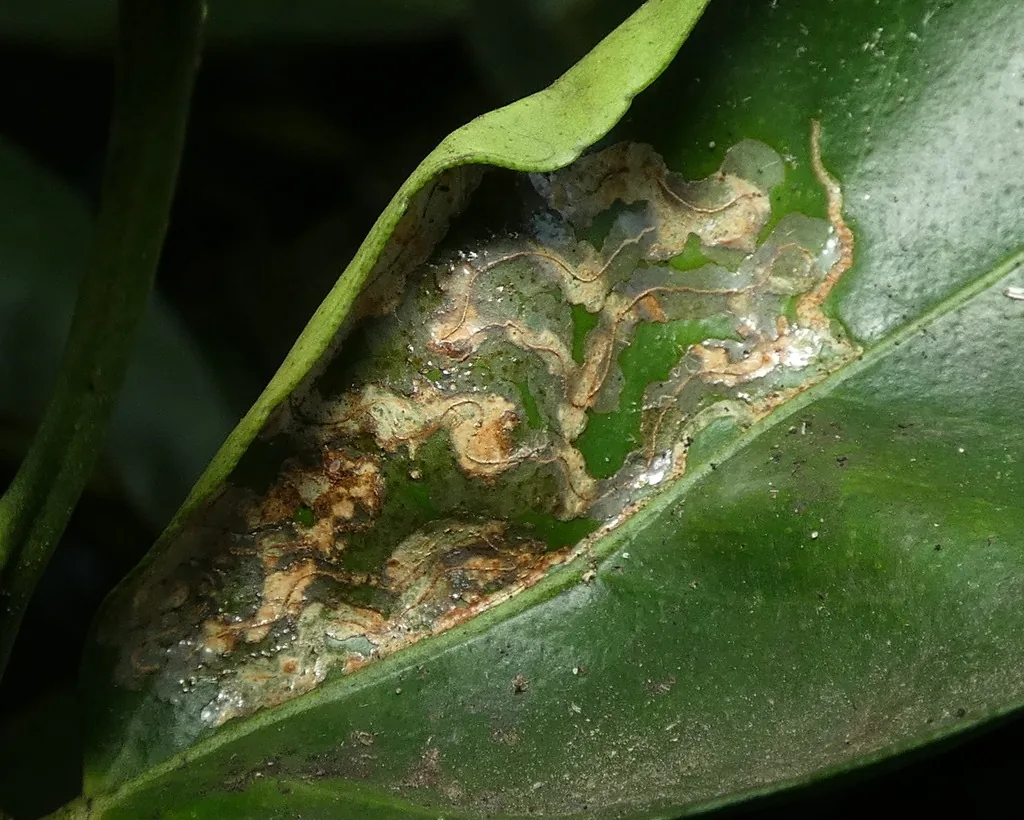
- Larvae make winding, shallow mines just under the leaf surface with a thin dark frass line down the middle.[1]
- At the end the larva rolls the leaf edge over itself to pupate, leaving curled, distorted leaves.[1]
- Adults are tiny silvery-white moths under 1/4 inch with a black spot at each wing tip, rarely seen.[1]
Look-alikes
| Look-alike | How to tell them apart |
|---|---|
| Citrus peelminer | Peelminer larvae leave no frass line and mine fruit and stems, not leaves.[1] |
| Other leafminers | Citrus leafminer is the only mining insect that commonly attacks citrus leaves.[1] |
Where it lives
Native to Asia, it reached Florida in 1993 and California in 2000, and now infests most of Southern California, the coast to San Luis Obispo County, and the San Joaquin Valley.[1]
Biology and life cycle
Females lay single eggs under tender new leaves, especially along the midvein; eggs hatch in about a week.[1]
Larvae feed two to three weeks, pupate one to three weeks, and the whole cycle takes three to seven weeks.[1]
Only young, shiny flush is attacked; hardened leaves are safe unless populations are extreme.[1]
Damage and signs
Health risk
It mines citrus leaves only; UC IPM describes no risk to people.[1]
Control
Prevention
Don't prune live branches more than once a year, and avoid nitrogen when populations are high in summer and fall.[1]
Leave damaged leaves on the tree; their undamaged parts still feed it.[1]
Traps and physical control
Remove water sprouts and rootstock suckers, which keep flushing and attract egg-laying moths.[1]
Biological control
Native nonstinging wasps such as Cirrospilus and Pnigalio parasitize larvae; avoid broad-spectrum sprays that kill them.[1]
Pesticides
Mature trees rarely need treatment; for young trees, azadirachtin or spinosad on new flush show some effect but need repeating.[1]
Common questions
Sources
- University of California Statewide IPM Program, “Pest Notes: Citrus Leafminer (Publication 74137).” ipm.ucanr.edu/PMG/PESTNOTES/pn74137.html (accessed 2026-10-06)
- iNaturalist, “Phyllocnistis citrella taxon page (order and family).” www.inaturalist.org/taxa/257156 (accessed 2026-10-06)