On this page
How to identify it
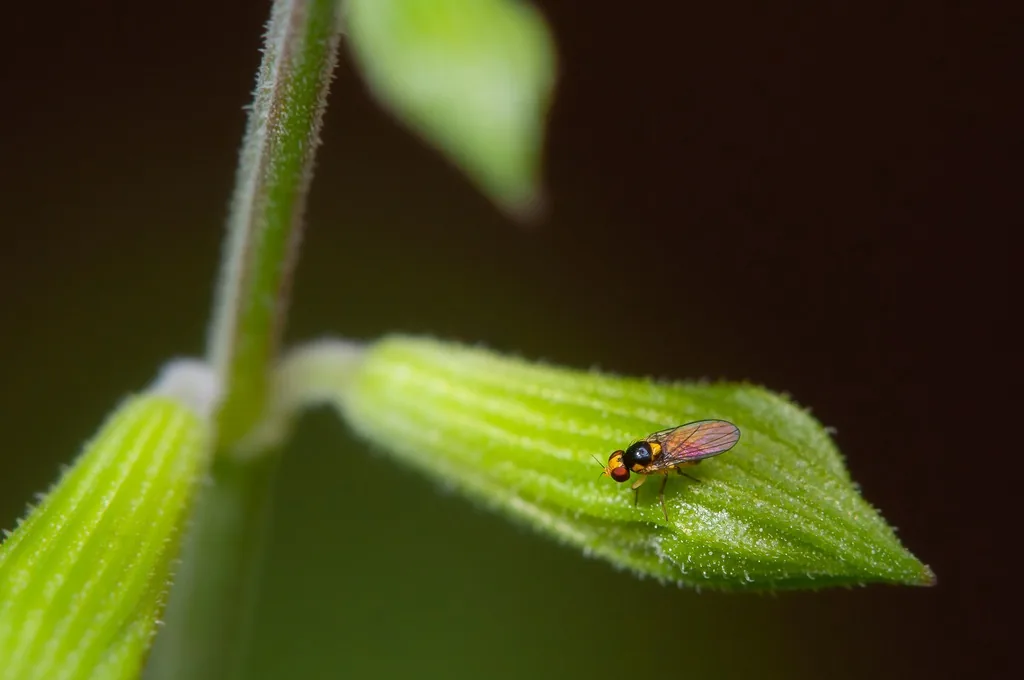
- Adults are small, mostly yellow and black flies; Wisconsin describes them as shiny yellow-brown with black markings.[1][2]
- It has a shining black back and dark rear margins on the eyes, which separate it from the American serpentine leafminer's grayish back and yellow eye margins.[1]
- Larvae grow to about 2.25 mm, starting nearly colorless and turning greenish, then yellowish.[1]
Look-alikes
| Look-alike | How to tell them apart |
|---|---|
| American serpentine leafminer | Nearly identical mines and impact; told apart by the color of the fly's back and eye margins.[1] |
Where it lives
Common in the southern United States from Florida to California and in Hawaii, and through Central and South America; it can't survive cold winters but is carried north on plants.[1]
Biology and life cycle
Females can lay 600 to 700 eggs, inserted just under the leaf surface; eggs hatch in about 3 days.[1]
At warm temperatures, egg and larval stages take about 7 to 9 days and the pupa another 7 to 9 days.[1]
Damage and signs
- It favors the cucurbit, legume and nightshade families, with nearly 40 hosts recorded in Florida.[1]
- Females' feeding punctures stipple leaves, but larval mines that widen as the larva grows do most of the damage.[1]
- Wisconsin notes it is more of a problem in greenhouses than in the field, and greenhouse-grown tomato and cucumber transplants are susceptible.[2]
Health risk
Control
Prevention
Check transplants for mines before planting, especially greenhouse-grown tomatoes and cucumbers.[2]
Biological control
Many parasitic wasps attack it and help keep numbers down.[1]
Pesticides
Many insecticides no longer work, and spraying disrupts natural enemies, sometimes triggering leafminer outbreaks.[1]
Common questions
Sources
- University of Florida IFAS Extension (EDIS, Featured Creatures), “Vegetable Leafminer, Liriomyza sativae (EENY-255).” ask.ifas.ufl.edu/publication/IN507 (accessed 2026-10-16)
- University of Wisconsin-Madison Extension (Garden Facts / Turfgrass Disorder fact sheets), “Vegetable Leafminers (Garden Facts A3754-E).” hort.extension.wisc.edu/articles/vegetable-leafminers/ (accessed 2026-10-16)
- iNaturalist, “Liriomyza sativae taxon page (order and family).” www.inaturalist.org/taxa/243752 (accessed 2026-10-06)