On this page
How to identify it
- Adults are slender gray to black or brown flies about 1/4 to 1/3 inch long, with dark stripes on the thorax and clear wings.[1][2]
- Larvae are whitish, cone-shaped maggots inside the leaf; eggs are white and laid in groups of four to eight under the leaves.[1]
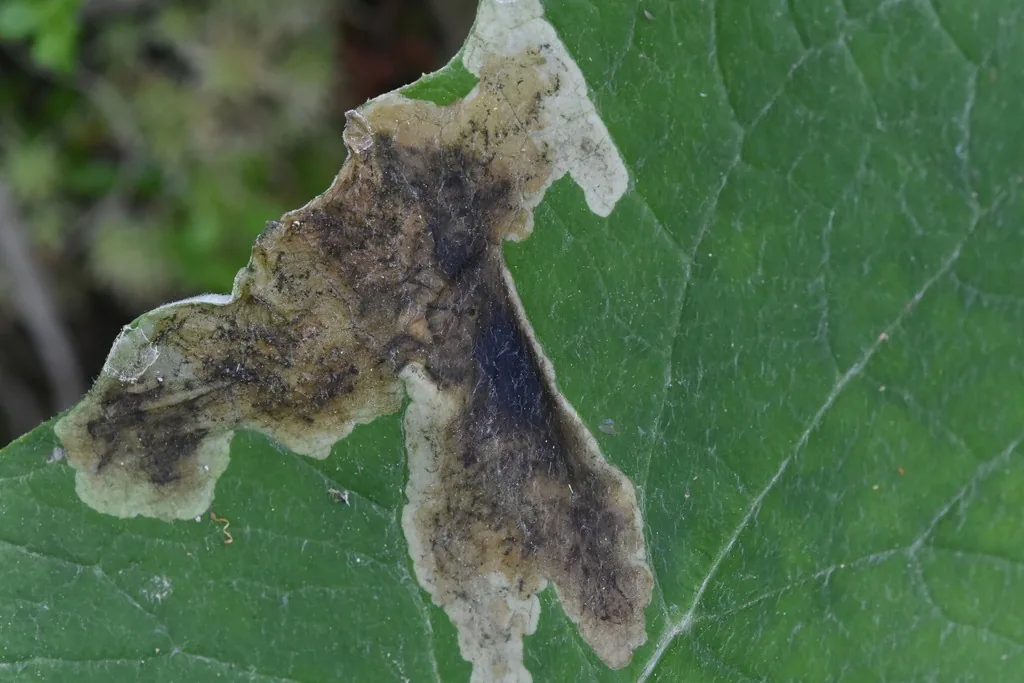
- Mines are irregular blotches, opaque at first and later brown.[1]
Look-alikes
| Look-alike | How to tell them apart |
|---|---|
| Other leafminers | Many flies and moths mine leaves; these attack the beet and spinach family.[1][2] |
Where it lives
Seen in Maryland and Minnesota gardens and high tunnels.[1][2]
Biology and life cycle
They overwinter as pupae in the soil; flies emerge in April and May to lay eggs, with a second generation in June.[1][2]
Larvae mine the leaves, then drop to the soil to pupate.[1]
Damage and signs
Health risk
Control
Prevention
Rotate plantings away from last season's spot, because pupae stay in that soil, and cover new plantings with row covers.[1]
Sanitation
Remove and destroy the first infested leaves and leaves with eggs, and control weed hosts.[1]
Pesticides
For spinach, labeled insecticides include spinetoram, dinotefuran and thiamethoxam; options are more limited for other crops.[1]
Common questions
- What are the brown blotches inside my spinach and chard leaves?
- Often spinach or beet leafminer mines.[1][2]
- Are the beets still safe to eat?
- Root crops are barely affected; mined leaves are the problem.[1][2]
- How do I prevent them?
- Remove early infested leaves, rotate, control weeds and use row covers.[1]
Sources
- University of Maryland Extension, “Beet and Spinach Leafminers (updated October 23, 2024).” extension.umd.edu/resource/beet-and-spinach-leafminers (accessed 2026-10-16)
- University of Minnesota Extension, “Spinach leafminer (What insect is this? diagnostic pages).” apps.extension.umn.edu/garden/diagnose/insect/garden/flies/small/spinachleafminer.html (accessed 2026-10-16)
- iNaturalist, “Pegomya hyoscyami taxon page (order and family).” www.inaturalist.org/taxa/1524674 (accessed 2026-10-06)