On this page
How to identify it
- Adults are less than 2 mm long, about the size of an eye gnat, dark gray and black with a yellow head and yellow markings.[1][2]
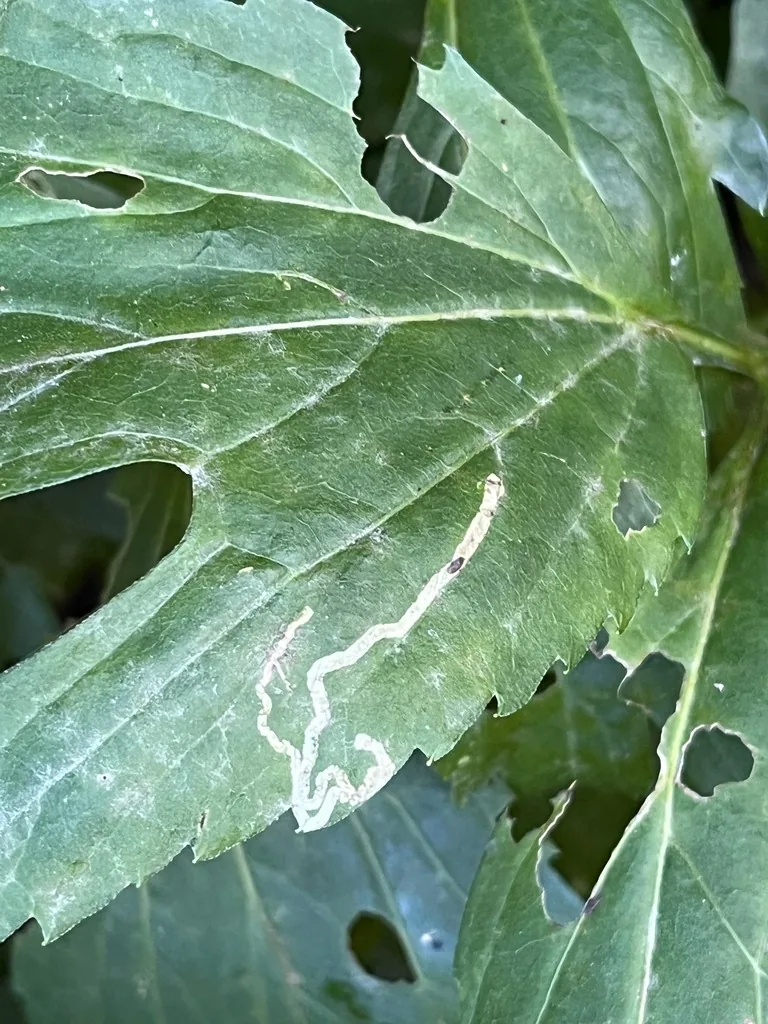
- Maggots are white to yellow and can be seen through the leaf surface inside a serpentine mine; the pupa is small and seed-like.[2]
- Females puncture the leaf to feed and lay eggs, leaving a stippled pattern, often near leaf tips and margins.[1][2]
Look-alikes
| Look-alike | How to tell them apart |
|---|---|
| Vegetable leafminer | A close relative; UF/IFAS separates the two by the vegetable leafminer's shining black back and darker rear eye margins.[1] |
| Spinach and beet leafminers | Another group of leafminer flies in vegetable gardens; the University of Maryland lists them with the serpentine leafminers.[3] |
Where it lives
Native to the eastern United States and Canada and the Caribbean, it has been spread to California and other regions on flower crops and readily infests greenhouses.[1]
Biology and life cycle
In warm places such as Florida a generation takes 21 to 28 days, so many generations occur each year.[1]
Females lay 200 to 400 eggs; NC State says they live three to four weeks, while UF/IFAS gives adults about 13 to 18 days.[1][2]
Grown larvae usually leave the mine and drop to the soil to pupate.[1]
Damage and signs
- Hosts include bean, beet, carrot, celery, cucumber, eggplant, lettuce, melon, onion, pea, pepper, potato, squash and tomato, plus aster, chrysanthemum, dahlia, marigold, petunia and zinnia.[1][2]
- The main damage is larval mining of the leaf tissue; tomatoes tolerate a lot of it, often one to three mines per leaf before yields drop.[1]
Health risk
Control
Sanitation
Remove broadleaf weeds that host leafminers, such as chickweed, lambsquarters, nightshade and plantain, and clear spent crops.[1][3]
Traps and physical control
Pinch mined leaves to crush the larvae inside, or remove and destroy them; cover young plants with row cover to stop egg-laying.[3]
Biological control
Tiny parasitic wasps usually keep this leafminer low; on chrysanthemums and similar flowers, NC State suggests ignoring it and letting the parasites work.[1][2]
Pesticides
Broad-spectrum sprays such as pyrethroids kill the parasites and can make leafminers worse; if a product is needed, NC State names a systemic such as imidacloprid.[1][2]
Common questions
- What makes the white squiggly lines in my leaves?
- Often leafminer maggots feeding between the leaf surfaces, such as the American serpentine leafminer.[2][3]
- Should I spray?
- Usually not: leafminers resist many insecticides, and spraying kills the wasps that control them.[1][3]
- Can I still eat mined leaves?
- Mined leaves are lower in quality; remove them, and pinch active mines to kill the larva.[3]
Sources
- University of Florida IFAS Extension (EDIS, Featured Creatures), “American Serpentine Leafminer, Liriomyza trifolii (EENY-254).” ask.ifas.ufl.edu/publication/IN506 (accessed 2026-10-16)
- NC State Extension, “American Serpentine Leafminer (PDIC Factsheet).” content.ces.ncsu.edu/american-serpentine-leafminer (accessed 2026-10-16)
- University of Maryland Extension (Home and Garden Information Center), “Leafminers on Vegetables.” extension.umd.edu/resource/leafminers-vegetables (accessed 2026-10-16)
- iNaturalist, “Liriomyza trifolii taxon page (order and family).” www.inaturalist.org/taxa/243751 (accessed 2026-10-06)