On this page
How to identify it
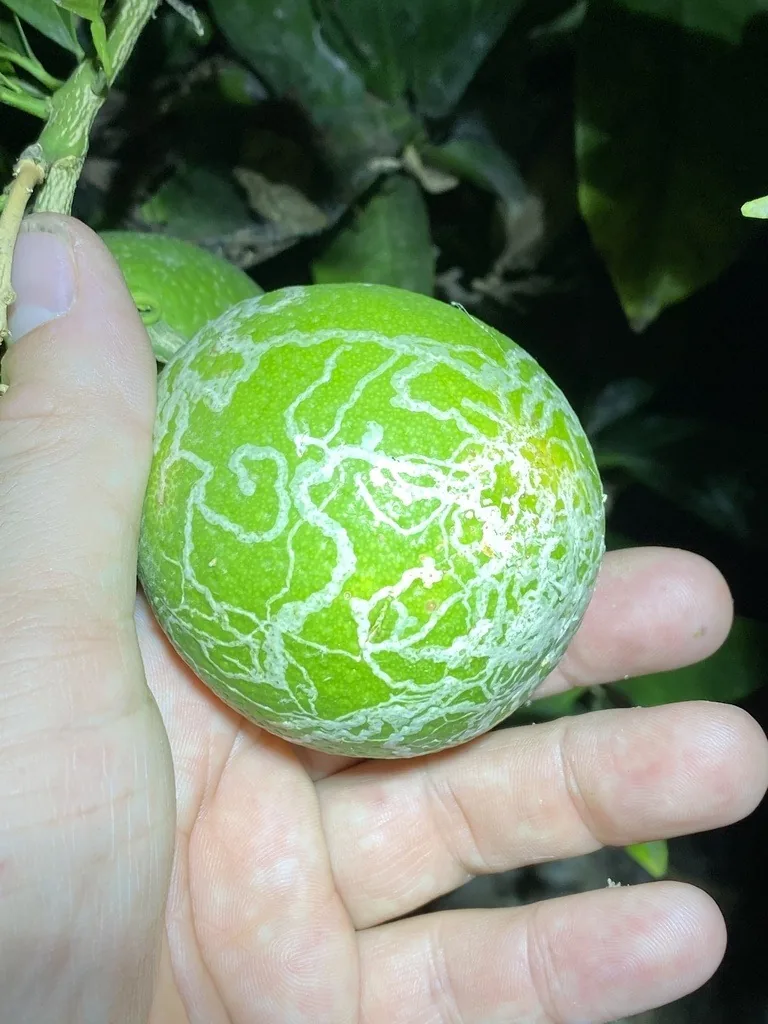
- The sign to look for is a winding mine on the surface of the fruit rind (or, on other hosts, in the stem) that starts just below the egg shell and widens as the larva grows and molts four to seven times.[1]
- Unlike the citrus leafminer, the peelminer leaves no frass trail inside its mine and attacks stems and fruit rather than new flush leaves; under heavy infestations it will mine leaves, but that is rare.[1]
- Just before pupation the larva changes to a pink form with spinning mouthparts, leaves the mine, and spins a flat cocoon on a twig, leaf or fruit that it decorates with little balls of silk. The citrus leafminer's pupa, by contrast, sits in a curled leaf edge with no decorative balls.[1]
- Mines that have been parasitized show small black wasp pupae surrounded by black dots of fecal material through the fruit epidermis, and old exit holes near the remains of pupae.[1]
Look-alikes
| Look-alike | How to tell them apart |
|---|---|
| Citrus leafminer | A related moth that mines only new flush leaves, leaves a dark frass trail inside the mine, and pupates in a curled leaf margin without silk balls; the peelminer mines fruit rind and stems and leaves no frass line.[1] |
Where it lives
A pest of susceptible citrus in the Coachella and San Joaquin valleys of California, described in the research literature as a sporadic pest of citrus and other crops in southern and central California. The San Joaquin Valley strain is genetically related to a strain from Mexico and probably arrived on infested fruit in 1998-99.[1][4]
Biology and life cycle
Adults lay eggs on the stems and fruit of citrus and neighboring crops. The hatching larva feeds on the rind just below the egg shell and mines the stem or fruit in a winding tunnel. There is no overwintering stage; development continues all year, faster in warm weather, with 6 to 8 generations a year at roughly monthly intervals from May to November.[1]
Laboratory work put the lower developmental threshold at 12.2 degrees C (UC IPM uses 55 degrees F) with an upper threshold near 33 degrees C, and a generation takes about 322 degree-days from egg to adult. Hot summer temperatures tend to stop development.[3][1]
The first flights of the year attack non-citrus hosts such as walnut stems, willows, oleander and weeds; the third flight finds pummelo and grapefruit suitable, and the fourth or fifth flight begins attacking susceptible navel oranges. In field studies the first citrus infestation came in June on pummelos and in August on oranges, once the fruit neared 60 mm in diameter, and researchers counted two, five and three overlapping generations in walnuts, pummelos and oranges.[1][3]
In Coachella Valley grapefruit groves studied from 1996 to 1999, larval densities rose at the start of summer, peaked in late July to early August and then stayed low for the rest of the year; the miners preferred the lower half of the tree canopy and kept developing in June on fruit left from the previous harvest.[2]
The female sex pheromone is a blend of four related compounds, one of them the first formate ester ever reported as a moth pheromone component. The formate alone attracts males as well as any blend, but trap catches have been inconsistent, so the lure is useful for detecting the moth and setting a biofix rather than for estimating population density.[4]
Damage and signs
- Larvae form mines on the surface of the fruit. Grapefruit, pummelo and certain smooth-skinned navel varieties (Fukumoto, Atwood, TI) are the most susceptible and can suffer 5 to 80 percent fruit damage, while nonsusceptible varieties rarely have more than 3 percent damaged fruit; the peelminer can still attack any variety.[1]
- The damage is cosmetic, but one mine can make a fruit unacceptable for the fresh market.[1]
- The moth also attacks grapes, cotton, beans, stone fruits, nuts, ornamentals such as willow and oleander, various vegetables and weeds. It is rarely an economic problem in those crops, so it is seldom controlled there, and when they mature and dry the moths emerge and move into neighboring citrus, which puts susceptible citrus next to cotton or beans at higher risk.[1]
Health risk
None of the sources mentions any effect on people; the citrus peelminer is a crop pest whose damage is confined to fruit rind, stems and occasionally leaves.[1][4]
Control
Prevention
Avoid planting the susceptible varieties (Fukumoto oranges, grapefruit, pummelos), and keep plantings of susceptible varieties away from cotton and grapes that could supply moths. If cotton is grown next to susceptible citrus, UC IPM suggests Bt cotton or an insecticide mixed with the defoliant to cut the number of moths emerging from the cotton.[1]
Biological control
Many native parasites attack the peelminer to a limited extent, and one native eulophid wasp, Cirrospilus coachellae, can control it in the Coachella Valley; in grapefruit groves its parasitism increased by midsummer as peelminer densities fell. The arrival of citrus leafminer in California in 2000 improved biological control of the peelminer because the two share many natural enemies, and UC IPM expects long-term control to be biological.[1][2]
Pesticides
Pesticides are only somewhat effective because the moths lay on low, inside fruit that is hard to spray and the larva is protected in its mine. Laboratory tests show the insect is susceptible to a wide range of insecticide classes, so field failures reflect coverage rather than resistance. UC IPM's strategy is to use degree-days to time three monthly sprays against the flights that will lay on a given variety (flights 3 to 5 for pummelo and grapefruit, 5 to 7 for navels); diflubenzuron kills mainly the egg stage, split applications work better than one high rate, and in a field trial two applications cut mined fruit by about two-thirds. Adding a pyrethroid helps somewhat but these broad-spectrum materials can flare other citrus pests by killing natural enemies.[1][5]
Common questions
- How do I tell citrus peelminer from citrus leafminer?
- Peelminer mines the fruit rind and stems and leaves no frass trail inside the mine; citrus leafminer mines only new flush leaves and leaves a visible frass line, and its pupa sits in a curled leaf edge instead of a silk-ball-decorated cocoon.[1]
- Does the mine ruin the fruit?
- The damage is cosmetic and skin deep, but one mine can render a fruit unacceptable for the fresh market; susceptible varieties such as grapefruit, pummelo and smooth-skinned navels can see 5 to 80 percent of fruit damaged.[1]
- Why are sprays so unreliable against it?
- The moths prefer to lay eggs on low, inside fruit that is hardest to reach, the larva is protected inside its mine, and there are 6 to 8 generations a year; lab tests show the insect itself is susceptible to many insecticide classes, so poor coverage, not resistance, explains most field failures.[1][5]
Sources
- University of California Statewide IPM Program, “Citrus Peelminer, UC Pest Management Guidelines: Citrus.” ipm.ucanr.edu/agriculture/citrus/citrus-peelminer/ (accessed 2026-11-10)
- Journal of Economic Entomology (via NCBI PubMed), “Seasonal variation and infestation incidence by Marmara gulosa (Lepidoptera: Gracillariidae) on grapefruit in the Coachella Valley, California (M. Guillen, J. M. Heraty and R. F. Luck, 2003) (abstract).” pubmed.ncbi.nlm.nih.gov/12852591/ (accessed 2026-11-10)
- Journal of Economic Entomology (via NCBI PubMed), “Temperature thresholds and degree-day model for Marmara gulosa (Lepidoptera: Gracillariidae) (M. J. O'Neal et al., 2011) (abstract).” pubmed.ncbi.nlm.nih.gov/21882694/ (accessed 2026-11-10)
- Journal of Economic Entomology (via NCBI PubMed), “Novel lepidopteran sex pheromone components from Marmara gulosa (Lepidoptera: Gracillariidae) (J. S. McElfresh et al., 2009) (abstract).” pubmed.ncbi.nlm.nih.gov/19449637/ (accessed 2026-11-10)
- Pest Management Science (via NCBI PubMed), “Response of citrus peelminer Marmara gulosa Guillen and Davis (Lepidoptera: Gracillariidae) stages to various insecticides (E. E. Grafton-Cardwell et al., 2008) (abstract).” pubmed.ncbi.nlm.nih.gov/18506674/ (accessed 2026-11-10)
- iNaturalist, “Marmara gulosa taxon page (order and family).” www.inaturalist.org/taxa/477573 (accessed 2026-11-10)