On this page
How to identify it
- The full-grown caterpillar is much smaller than other orangeworms in citrus. It has a light brown head, black mouthparts, a dark brown shield behind the head and a dark pinkish body.[1]
- On older larvae the pink color forms two bands on each body segment, one at the front edge and one at the rear, rather than a single band across the middle as on the pink bollworm.[3]
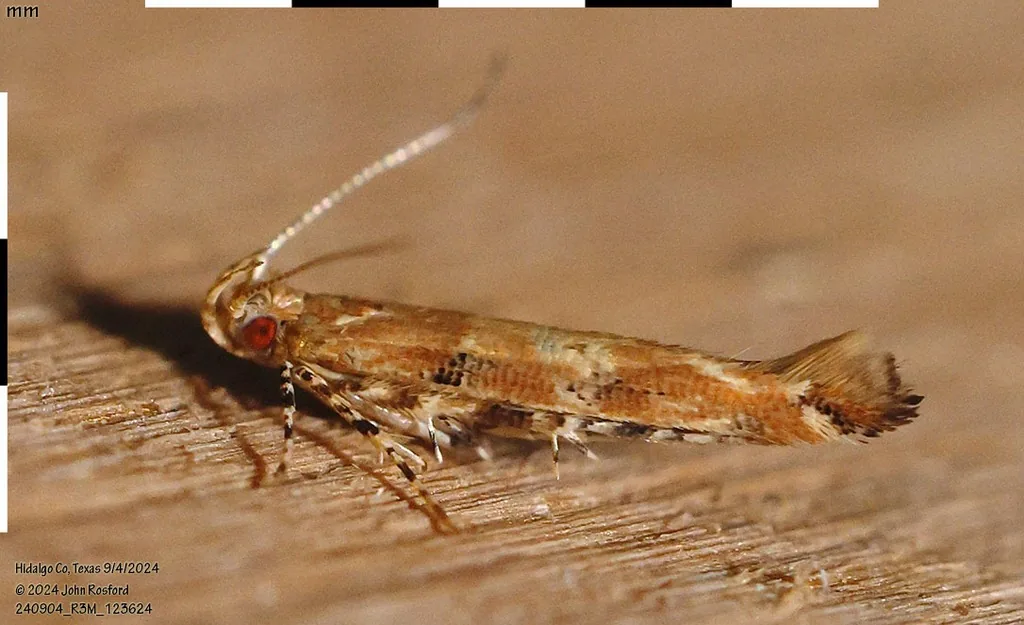
- The adult is a tiny moth with long, narrow, pointed wings edged with scale fringes much longer than the wings are wide. The last segment of each mouthpart palp has three dark bands.[2]
Look-alikes
| Look-alike | How to tell them apart |
|---|---|
| Pink bollworm | Pink scavenger moths are smaller, with narrow, pointed hind wings instead of broad ones. The larva's pink forms two bands per segment rather than one, and its shield behind the head lacks the pink bollworm's light patches.[2][3] |
| Navel orangeworm and other orangeworms | In citrus, a full-grown pink scavenger caterpillar is much smaller than the other orangeworms.[1] |
Where it lives
In California it occurs sporadically in citrus in the coastal areas of San Diego, Orange and Ventura counties. It also damages corn kernels in the southern United States.[1][4]
Biology and life cycle
It is a scavenger that can feed on many different plants. On orange and lemon trees it lives mainly among fruit clusters and under the sepals, eating dry or decaying fruit, dead flower parts and sooty mold.[2][1]
It sometimes gets into cotton bolls that other insects have already damaged and feeds on the damaged, rotting parts.[3]
Damage and signs
- In summer larvae may feed on the rind of ripe Valencia oranges, often near the stem end or where fruits touch in a cluster. The feeding is usually superficial and does little harm, but in a few cases serious damage has occurred, and a heavy infestation can cause fruit drop or decay in storage.[1]
- It has caused major problems in citrus and banana crops, and in the southern United States it is one of the insects that damage corn kernels on the ear.[3][4]
Health risk
These sources treat it only as a crop pest and do not describe any harm to people.[1][3]
Control
Prevention
When checking citrus, look for the larvae mainly among fruit clusters and under the sepals, where they feed on dead flower parts, decaying fruit and sooty mold.[1]
Pesticides
Insecticide applications against it are rarely needed in citrus.[1]
Common questions
- Do I need to spray for pink scavenger caterpillars in my citrus?
- Usually not. UC IPM says insecticide applications are rarely needed, because the larvae mostly eat decaying material and their feeding on rind is usually superficial.[1]
- How can I tell a pink scavenger caterpillar from a pink bollworm?
- On the pink scavenger caterpillar the pink color forms two bands on each segment, and the adult moth is smaller, with narrow, pointed hind wings.[3][2]
Sources
- University of California Statewide IPM Program, “Pink Scavenger Caterpillar (Pest Management Guidelines: Citrus).” ipm.ucanr.edu/agriculture/citrus/pink-scavenger-caterpillar (accessed 2026-11-09)
- USDA APHIS PPQ Identification Technology Program, “Pyroderces rileyi adult fact sheet, Pink Bollworm and Its Look-alikes (idtools.org).” idtools.org/id/pbw/Pyroderces_rileyi.html (accessed 2026-11-09)
- USDA APHIS PPQ Identification Technology Program, “Pyroderces rileyi larva fact sheet, Pink Bollworm and Its Look-alikes (idtools.org).” idtools.org/id/pbw/Pyroderces_rileyi_1.html (accessed 2026-11-09)
- Journal of Economic Entomology (via NCBI PubMed), “Evaluation of corn germplasm lines for multiple ear-colonizing insect and disease resistance (X. Ni et al.; Journal of Economic Entomology 105(4), 2012; abstract).” pubmed.ncbi.nlm.nih.gov/22928329/ (accessed 2026-11-09)
- iNaturalist, “Anatrachyntis rileyi taxon page (order and family).” www.inaturalist.org/taxa/649506 (accessed 2026-11-09)