On this page
How to identify it
- Mature larvae are about half an inch long with wide pink bands across the back; they turn pink only in the fourth and final larval stage, and younger larvae are tiny white caterpillars with dark brown heads that are hard to see against the white lint. Bolls have to be cracked open to find them.[1][2]
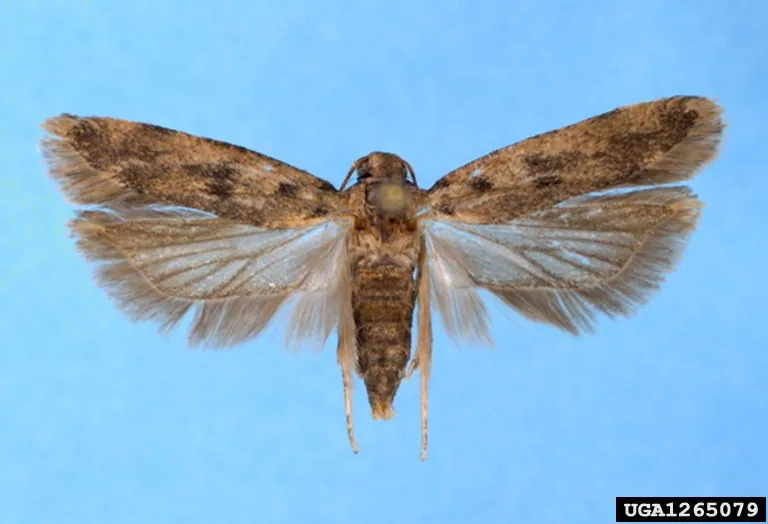
- The adult is a small, slender, grayish-brown moth that looks elongated with its wings folded; the forewings are much longer than wide, usually light brown or gray with darker scales forming spots or splotches, and end in a pointed tip surrounded by a conspicuous fringe of hair-like scales.[1][2]
- Under magnification, the hindwing has a broad fringe and an s-shaped curve at its outer end, the upturned labial palps carry two dark bands on the last segment, and ocelli are absent.[2]
- Eggs are very small and slightly elongated, white at first and turning orange before hatching, and are laid under the calyx or bracts of green bolls.[1][2]
Look-alikes
| Look-alike | How to tell them apart |
|---|---|
| Pink scavenger caterpillar | A moth covered as a pink bollworm look-alike in USDA's identification tool; the first sign that trapped moths are not pink bollworm is their small size, and their labial palps are longer and thinner than the pink bollworm's.[4] |
| Cotton bollworm (corn earworm), tobacco budworm and beet armyworm | Other cotton caterpillars; UC IPM notes that Bt cotton (Bollgard II) suppresses them along with the pink bollworm, which is told by its small pink-banded larva living entirely inside the boll.[1] |
Where it lives
Formerly a major pest of cotton in the southern California deserts and present in the San Joaquin Valley without economic infestations; it reached Texas in 1917, re-invaded the Rio Grande Valley in the 1930s, spread to surrounding states and reached California by 1963, with ten states under quarantine at the program's height and four (Arizona, California, New Mexico and Texas) still quarantined in 2003. USDA declared it eradicated from all commercial cotton areas of the continental United States in October 2018.[1][3]
Biology and life cycle
Eggs hatch in three to four days. The larvae bore into the boll to feed on the seeds, moving from seed to seed and chewing through the fibers, and take 12 to 15 days to develop before dropping to pupate in the top layer of soil for seven to eight days.[2]
Females mate and develop eggs within two or three days of emerging and lay most of their eggs within ten days, under the bracts of cotton bolls; adults feed on nectaries under the leaves and may live up to two months.[2]
The pest overwinters as fourth-instar larvae in the soil or in leftover bolls, with adults emerging around late April or early May. A generation takes about a month, so there can be one to four generations in a summer, and larvae begin entering diapause from late August as days shorten and cool.[2]
Because the larvae are inside the bolls or in the soil, they are hard to reach with insecticides; the control program relied instead on cultural controls, gossyplure mating disruption aimed at the overwintering generation, Bt cotton and sterile moth releases.[1][3]
Damage and signs
- Larvae damage squares and bolls, and boll damage is the most serious: as a larva burrows through the lint to reach the seeds it cuts and stains the lint, causing severe quality loss. Under dry conditions yield and quality losses track the percentage of infested bolls and larvae per boll, while in humid conditions one or two larvae can destroy an entire boll because the damage lets boll rot fungi in.[1][2]
- The feeding wounds also let other insects and fungi into the boll.[2]
Health risk
None of the sources mentions any effect on people; the pink bollworm is a cotton pest only.[1][2]
Control
Prevention
USDA's eradication rested on area-wide measures rather than sprays: quarantines, pheromone mating disruption, Bt cotton expressing insecticidal proteins, and release of sterile moths. ITP keeps its identification tool available for ongoing trapping and monitoring.[3][1]
Sanitation
UC IPM's cultural program was built around denying the larvae food: cut off irrigation early enough to stop green boll production by early September, shred cotton plants immediately after harvest, leave the debris on the surface for two or more weeks in hot falls, and plow or cross-disc to at least 6 inches; the San Joaquin Valley enforced a 90-day host-free period from plowdown to March 10.[1]
Traps and physical control
Winter irrigation can cut overwintering pink bollworm populations by 50 to 70 percent, with December flooding more effective than November or January; in spring, pre-irrigating in February and planting early brings the moths out before susceptible squares are present.[1]
Biological control
Planting Bt cotton (Bollgard II) helps prevent damage by pink bollworm and also suppresses cotton bollworm, beet armyworm and tobacco budworm.[1]
Pesticides
Do not apply insecticides against the larvae, which are inside the boll or in the ground. UC IPM limited sprays to periods when susceptible bolls were present and sampling showed infested bolls above threshold, and noted that treatments were rarely necessary against overwintered moths; spinosad (Entrust) was the organically acceptable spray.[1]
Common questions
- Is the pink bollworm still in the United States?
- USDA announced on October 19, 2018, after five years of extensive trapping, that all commercial cotton production areas in the continental United States were free of pink bollworm and lifted the remaining quarantines; trapping and monitoring continue, and the identification tool remains available for any moths caught.[3]
- How do I recognize a pink bollworm larva?
- Crack open a green boll: a mature pink bollworm is about half an inch long with wide pink bands across its back, while younger larvae are white with brown heads and easy to miss against the lint.[1][2]
- Why were insecticides not the answer to pink bollworm?
- The larvae feed inside the boll and pupate in the soil, where sprays cannot reach them, so control depended on host-free periods, crop destruction, winter flooding, pheromone mating disruption, Bt cotton and sterile moth releases.[1][3]
Sources
- University of California Statewide IPM Program, “Pink Bollworm, UC Pest Management Guidelines: Cotton.” ipm.ucanr.edu/agriculture/cotton/pink-bollworm/ (accessed 2026-11-10)
- USDA APHIS PPQ Identification Technology Program (ITP), “Fact Sheet: Pink Bollworm, from Pink Bollworm and its Look-Alikes (Identification Technology Program).” idtools.org/id/pbw/Pectinophora_gossypiella.html (accessed 2026-11-10)
- USDA APHIS PPQ Identification Technology Program (ITP), “Pink bollworm is declared eradicated (ITP News, December 11, 2018).” www.idtools.org/news.cfm?title=32 (accessed 2026-11-10)
- USDA APHIS PPQ Identification Technology Program (ITP), “Fact Sheet: Pink Scavenger Caterpillar Moth, from Pink Bollworm and its Look-Alikes (Identification Technology Program).” idtools.org/id/pbw/Pyroderces_rileyi.html (accessed 2026-11-10)
- iNaturalist, “Pectinophora gossypiella taxon page (order and family).” www.inaturalist.org/taxa/477943 (accessed 2026-11-10)