On this page
How to identify it
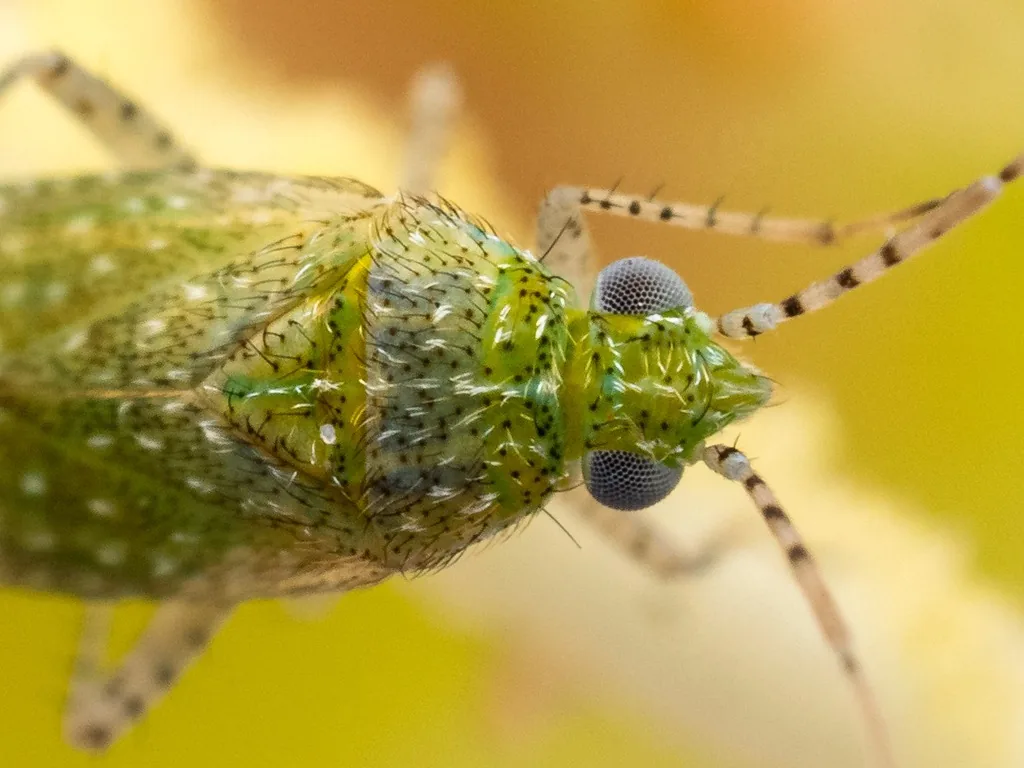
- Adults are about 1/8 inch long, flat and elongated oval, with prominent antennae. They are usually yellowish green, sometimes white or yellow, with minute black spots and hairs on the back.[1]
- Nymphs look like wingless adults. They start out almost white or pink and turn pale green after feeding, with prominent, often reddish eyes.[1]
- The eggs, about 1/30 inch long, are inserted under the bark of small stems and are rarely seen.[1]
- Adults are flighty: they fly off or hide in the canopy as you approach a plant.[1]
Look-alikes
| Look-alike | How to tell them apart |
|---|---|
| Minute pirate bug, big-eyed bug and lygus bug nymphs | Texas A&M notes that fleahopper nymphs get mistaken for young minute pirate bugs, big-eyed bugs and lygus bugs, and even for aphids, and that color, shape and behavior tell them apart. A fleahopper nymph is pale green with prominent, often reddish eyes.[1] |
Where it lives
Texas A&M sets action thresholds for it in cotton regions across Texas, from the Lower Rio Grande Valley, Coastal Bend and Blacklands to the South Plains, Panhandle and Trans-Pecos.[1]
Biology and life cycle
It spends the winter as eggs in wild hosts such as woolly croton, horsemints (spotted and lemon beebalm), cutleaf evening primrose, showy sundrops, woolly tidestromia and silverleaf nightshade.[1]
At 80 degrees F the eggs hatch in about 11 days, and the nymphs usually molt five times and reach adulthood in 14 to 15 days.[1]
There are six to eight generations a year, but only one to three of them develop in cotton.[1]
Numbers build on weeds in spring. When those hosts mature or are sprayed or mowed, the bugs move into cotton, and late-planted fields often catch bugs that built up in earlier fields.[1]
Cotton fleahoppers are omnivorous: besides plant tissue they eat other insects, particularly the eggs of bollworms and other caterpillar pests.[1]
Natural enemies and rain both kill fleahoppers; a Texas study built both into a cotton insect model used for treatment decisions.[2]
Damage and signs
- Cotton is most vulnerable during the first 3 weeks of squaring, and fleahoppers are not considered pests after first bloom.[1]
- Adults and nymphs suck sap from terminal buds, young leaves and pinhead-size or smaller squares and feed on the anthers inside, so the squares die, turn brown ('blasted') and soon drop.[1]
- Feeding also makes plants grow shorter main-stem internodes, more nodes and spindly branches ('suckers') from the lower stem. The saliva's effect stays local, and there is no evidence the bugs spread plant diseases.[1]
- Given time, cotton can make up for lost squares with little yield loss, especially squares lost in the first week in southern areas; late-planted fields and seasons cut short by cool weather leave less room to recover.[1]
Health risk
It feeds on plants and insect eggs; Texas A&M mentions no risk to people.[1]
Control
Sanitation
Managing weedy hosts in and around fields before planting can cut the local source of fleahoppers. Avoid spraying or mowing those weeds during the critical squaring weeks, though, since that can drive the bugs into adjacent cotton.[1]
Biological control
Conserve natural enemies. Texas A&M warns that sprays early in bloom can kill predatory insects and spiders and set off aphid, bollworm and tobacco budworm outbreaks, and the Texas modeling study concluded that growers can manage fleahoppers either with chemical control or by monitoring and conserving natural enemies.[1][2]
Pesticides
Scout from the first small squares (about the 4- to 6-leaf stage): check the top 3 to 4 inches of the main stem on 25 plants at each of at least four sites, weekly, or every 3 to 4 days when conditions favor a fast buildup on alternate hosts. Thresholds vary by Texas region, from 10 to 15 fleahoppers per 100 terminals in the Blacklands to square-set targets in the High Plains and Rolling Plains, and treatment is rarely justified after first bloom.[1]
When treatment is warranted, Texas A&M's table lists acephate, acetamiprid, dicrotophos, flonicamid, imidacloprid, oxamyl and thiamethoxam, and it favors a less disruptive, 'soft' insecticide over a broad-spectrum one in the third week of squaring or on late-planted cotton.[1]
Common questions
- Why are the tiniest squares on my cotton turning brown and falling off?
- Fleahopper feeding on pinhead-size squares makes them die, turn brown and drop. Check the top few inches of the main stems for the small green bugs. Squares also shed for other reasons, and a large scar usually means a big square was lost to something other than fleahoppers.[1]
- Do I need to treat fleahoppers once my cotton is blooming?
- Rarely. Texas A&M doesn't consider them pests after first bloom, and early-bloom sprays can trigger outbreaks of other pests by killing their predators.[1]
- Where do cotton fleahoppers come from each year?
- They overwinter as eggs on wild plants such as woolly croton and horsemint, build up there in spring, and move into cotton as those plants mature or get mowed or sprayed.[1]
Sources
- Texas A&M AgriLife Extension Service, “Cotton Fleahoppers, ENTO-073 (S. S. Vyavhare and D. Kerns, June 2017).” extensionentomology.tamu.edu/wp-content/uploads/2025/03/cotton-fleahoppers.pdf (accessed 2026-11-08)
- Journal of Applied Entomology (record in FAO AGRIS), “Natural control of the cotton fleahopper, Pseudatomoscelis seriatus (Reuter) (Hemiptera, Miridae), in Texas (R. G. Breene, A. W. Hartstack, W. L. Sterling and M. Nyffeler, 1989; abstract).” agris.fao.org/search/en/records/65de5e417c7033e84beabadb (accessed 2026-11-08)
- iNaturalist, “Pseudatomoscelis seriatus taxon page (order and family).” www.inaturalist.org/taxa/467557 (accessed 2026-11-08)