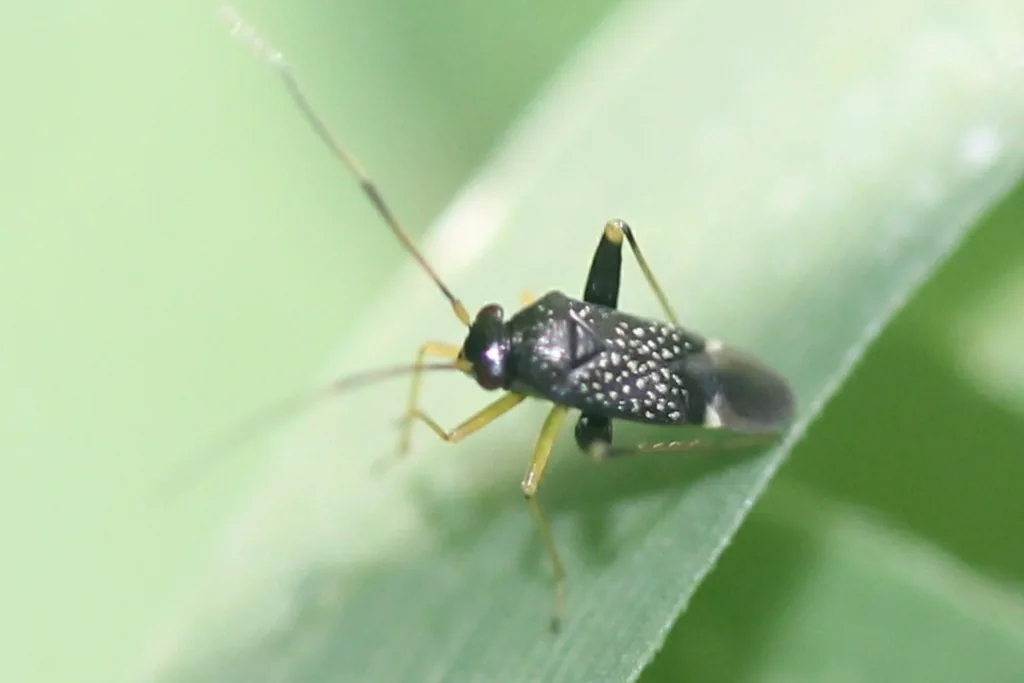
How to identify it
Look-alikes
| Look-alike | How to tell them apart |
|---|---|
| Flea beetles | Flea beetles chew small holes and jump to another plant; fleahoppers suck sap and jump only two or three inches.[1] |
| Black aphids | Fleahoppers look like black aphids, but all stages jump readily when disturbed.[1] |
Where it lives
It's common on vegetables such as beans, cucumbers, peppers, potatoes, squash and tomatoes, and on herbs and weeds.[1]
Biology and life cycle
Nymphs hatch in spring from overwintering eggs and feed 11 to 41 days before becoming adults.[1]
Females lay about 105 eggs inside stems and leaves over a 1 to 3 month life; eggs hatch 12 to 20 days later.[1]
Damage and signs
- Light feeding leaves pale spots like mite damage; heavy feeding can bleach, dry and drop leaves, stunting plants.[1]
Health risk
It feeds on plants; UK Extension mentions no risk to people.[1]
Control
Prevention
Remove weedy hosts such as quickweed, clover and morning glory near the garden.[1]
Pesticides
Only for severe infestations, insecticides listed for aphids should work; a second application may be needed after eggs hatch.[1]
Common questions
Sources
- University of Kentucky Entomology (ENTFACT), “Garden Fleahopper (ENTFACT-307).” entomology.mgcafe.uky.edu/ef307 (accessed 2026-10-06)
- iNaturalist, “Microtechnites bractatus taxon page (order and family).” www.inaturalist.org/taxa/472457 (accessed 2026-10-06)