On this page
How to identify it
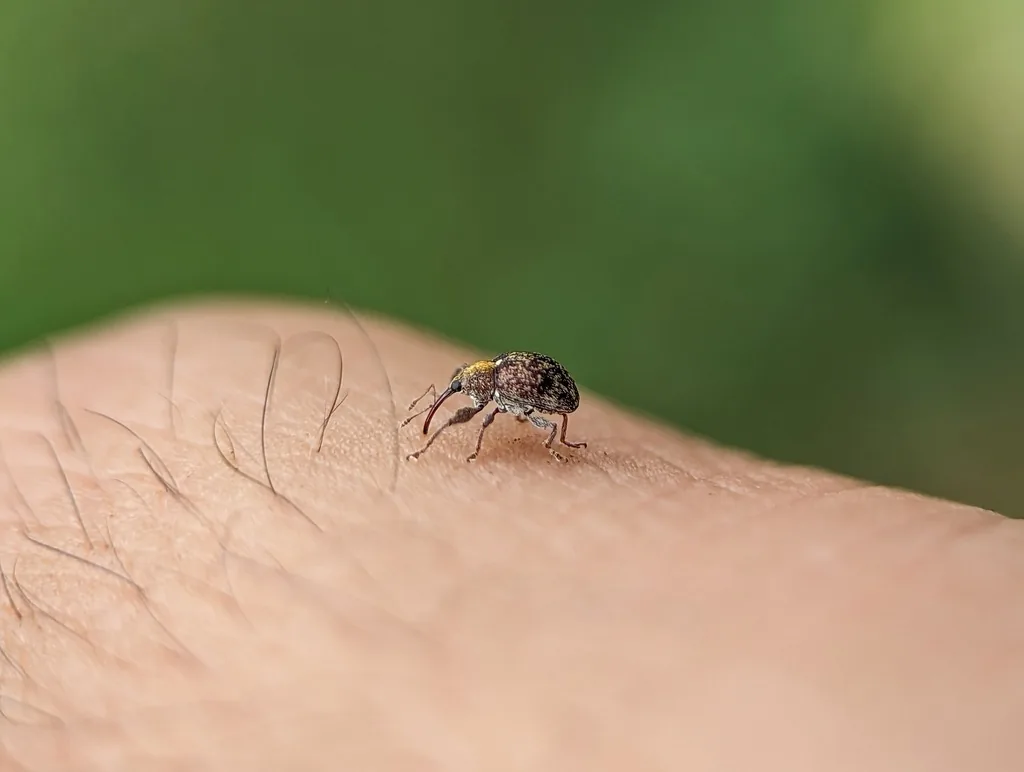
- Adults are 3.2 to 8.5 mm (1/8 to 1/3 inch) long, tan to dark gray or dark brown and densely covered with gray hair-like scales, with a long curved snout and elbowed antennae that attach just over halfway down it. The wing covers are pale with fine parallel lines, and the pronotum carries a white midline.[1]
- The front femur has a large double tooth on its inner edge, one of the screening characters CAPS surveyors use.[1]
- Larvae are legless, C-shaped, cream colored with a tan head, and grow to 9.5 mm (3/8 inch) inside a square or boll. Eggs are 1 mm, elliptical and opaque.[1]
- The plant tells you too: a puncture on the side of a flower bud, sealed with frass into a raised brown spot where an egg was laid, with the bracts around it flaring and turning yellow before the square drops.[1][2]
Look-alikes
Where it lives
Native to Mexico and Central America, where it fed on native tree cottons, it entered Texas about 1892 and by 1922 occupied the Cotton Belt to the Carolinas and the northern limit of cotton. Eradication began with a trial in northeastern North Carolina and southern Virginia completed in 1980 and spread west; by 2009 the weevil was gone from Alabama, Arizona, California, Florida, Georgia, Kansas, Kentucky, Mississippi, Missouri, New Mexico, North and South Carolina, Oklahoma, Virginia and parts of Arkansas, Louisiana, Tennessee and Texas. Endemic populations remain in the Lower Rio Grande Valley along the Texas-Mexico border.[1][2][3]
Biology and life cycle
Females lay 100 to 300 eggs, usually one per cotton square (flower bud), switching to young bolls when buds are scarce, and seal each puncture with frass and a mucous secretion. Eggs hatch in three to five days, the larvae feed inside the square or boll for one to two weeks through three instars, the pupa takes three to five days, and new females begin laying three to five days after emerging. The whole cycle runs about 18 to 21 days egg to egg in southeastern Missouri and two and a half to three weeks under favorable conditions elsewhere, so there can be three to five generations a year in Missouri and up to seven in the far south of the Cotton Belt.[1][2]
Newly emerged adults prefer the pollen of open flowers for a few days before their snout lets them bore into squares. Males feeding on squares release a pheromone in their frass that draws both sexes, which is the basis of the trap lure. Generations continue until cold weather kills the cotton; adults then overwinter in surface litter near fields, preferring leaf litter under hardwoods, and pre-diapause weevils in late summer feed heavily and may travel more than 30 miles looking for food or winter shelter.[1][2]
Winter is the great killer. Adults start dying at about 23 F and most do not survive an hour at 5 F, although leaf litter and snow insulate them, and CAPS notes that 95 percent winter mortality is common. In Missouri fewer than 10 percent of the weevils entering winter habitat usually reached spring, and a run of severe winters in the late 1970s virtually eliminated the weevil there until the late 1980s. Survivors emerge once average night temperatures reach 20 to 21 C, about 90 percent of them between April and early July.[1][2]
Its hosts are four related genera of the mallow family: cotton (Gossypium), Cienfuegosia, Hampea and Thespesia, with yellow flymallow (Cienfuegosia drummondii) the most important wild reservoir in the United States. Adults may also feed on okra, hibiscus, globemallows and Sida. Predators and parasites had little effect on populations, since most of the life cycle is spent inside the square, though fire ants were effective predators of what they could reach.[1][2]
Damage and signs
- Both sexes make feeding punctures, and larvae hollow out squares and bolls. Punctured squares and small bolls drop within a few days; large bolls may hang on but get invaded by boll-rot microorganisms, and infested locks produce little or inferior lint. In a heavy infestation nearly every square received an egg as soon as it reached pencil-eraser size, so virtually no fruit set, losses topped 50 percent and complete crop failures occurred.[1][2]
- The economics were brutal. Smith and Harris (1994) called it the most costly insect pest of US cotton, with yield losses over 8 percent a year on top of the cost of control. Loftin (1946) wrote that it affected the economic and social welfare of more Americans than any other insect, bankrupting farmers, merchants and bankers across the South. The repeated sprays it forced also wiped out the natural enemies that held aphids, plant bugs and bollworms in check.[1][2]
Health risk
A cotton pest with no known role as a disease vector; CAPS notes only that its wounds can be invaded by microorganisms. Neither source describes any effect on people.[1][2]
Control
Prevention
The pheromone trap is the core tool: a green plastic trap body with a screen cone and collection chamber, baited with a synthetic version of the male pheromone and an insecticidal strip, set on a 4 to 5 foot stake. In the pre-eradication era, Missouri growers placed one trap per 10 to 20 acres at crop emergence and sprayed at first squares if traps averaged one or two weevils a week.[1][2]
Sanitation
Destroying crop residue promptly after harvest, by mowing rather than disking, removed the late-season breeding that produced overwintering weevils, but it only worked when done areawide; a few fields left standing could reinfest the neighbors the next spring. Managing the crop for earliness, with early planting, early-maturing varieties and restrained fertility, set fruit before weevil numbers climbed.[2]
Pesticides
The program combined late-season insecticide treatments, pin-head square sprays timed by trap catches, in-season sprays at thresholds of 10 to 15 percent punctured squares (20 to 30 percent late in the season) and diapause-control sprays from about early September, along with diflubenzuron, sterile weevil releases and defoliants in the original trial. Where it succeeded the payoff was large: North Carolina cotton acreage grew from under 100,000 to over 450,000 acres with insecticide use cut by about half, and Georgia went from 10 to 12 sprays a season to about four.[1][2]
When to call a professional
Boll weevil control in the US is a cooperative federal-state-grower eradication program, not something an individual manages. Growers in a program area vote it in, participation is mandatory, and costs have been shared 70 percent by growers and 30 percent by government. CAPS tells surveyors to contact the regional cotton program manager before trapping and to forward suspect specimens to eradication program personnel or a state taxonomist.[1][2]
Common questions
- Is the boll weevil really gone from the United States?
- From nearly all of it. By 2009 it had been eradicated from most of the Cotton Belt, with the mid-South states and Texas the last to finish, but endemic populations persist in the Lower Rio Grande Valley on the Texas-Mexico border, and genetics traced a 2018 outbreak near Kingsville to a few weevils introduced from there.[1][3]
- What do I do if I find one in cotton?
- Report it. Captures in eradicated zones trigger intensified trapping and ground or aerial treatment by program personnel, and CAPS routes suspect specimens to eradication staff or state taxonomists for confirmation.[1]
- How did a quarter-inch beetle do so much damage?
- It bred inside the squares where sprays and predators could not reach it, ran a generation every three weeks or so, and in heavy years put an egg in almost every square as soon as it formed.[1][2]
Sources
- USDA APHIS Cooperative Agricultural Pest Survey (PDF hosted by Purdue University), “Anthonomus grandis (boll weevil), Cotton Commodity-based Survey Reference datasheet, Cooperative Agricultural Pest Survey (CAPS).” caps.ceris.purdue.edu/wp-content/uploads/2025/07/Anthonomus-grandis-cotton-manual-reference.pdf (accessed 2026-11-10)
- University of Missouri Extension, “The Boll Weevil in Missouri: History, Biology and Management, G4255 (revised September 2019).” extension.missouri.edu/publications/g4255 (accessed 2026-11-10)
- Journal of Economic Entomology (Entomological Society of America), “Cohen, Perkin, Fifield, Raszick, Sword and Suh (USDA ARS and Texas A&M). Source population determination for boll weevil re-infestation events in Texas. Journal of Economic Entomology 118: 1913-1921 (2025), PMID 40581346.” pubmed.ncbi.nlm.nih.gov/40581346/ (accessed 2026-11-10)
- iNaturalist, “Anthonomus grandis taxon page (order and family).” www.inaturalist.org/taxa/199328 (accessed 2026-11-10)