On this page
How to identify it
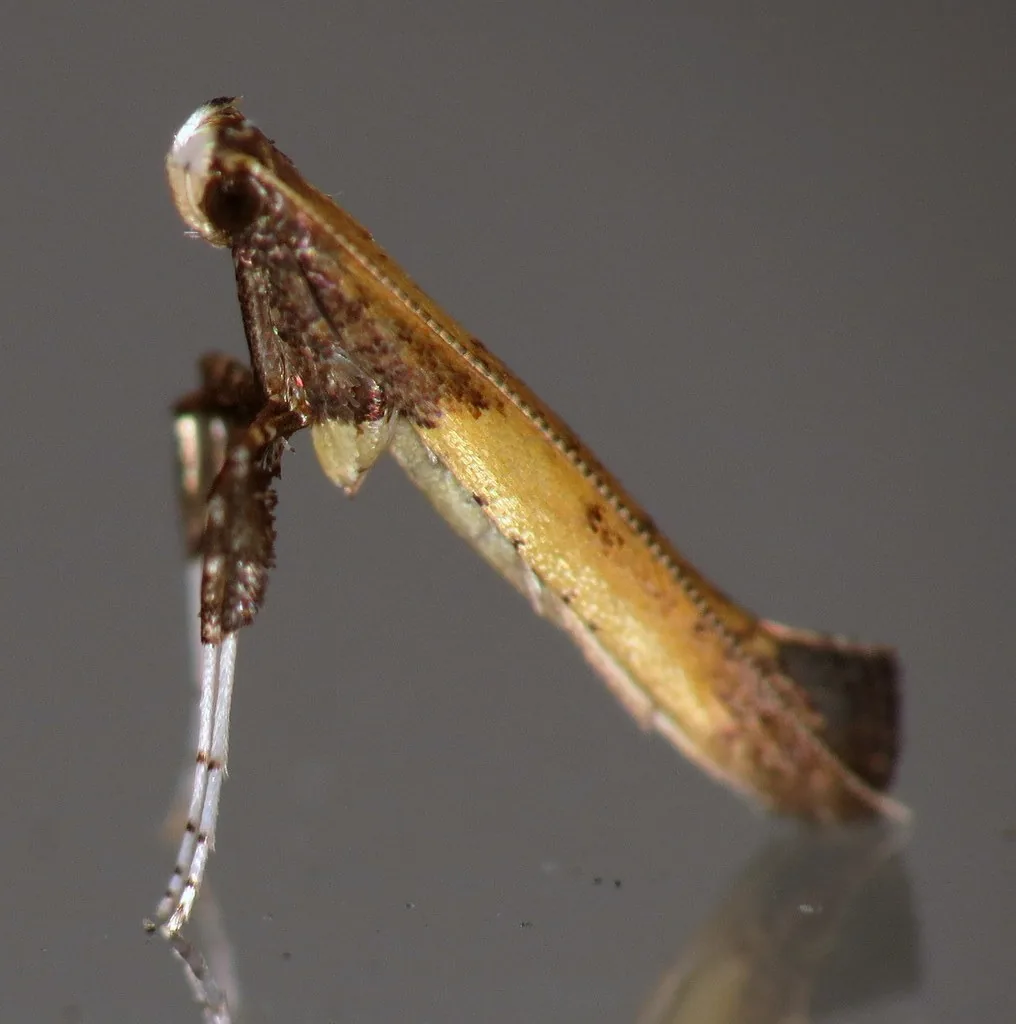
- Adults are tiny yellow or golden moths with purple markings, about 3/8 inch long with wings folded (wingspread 10 to 13 mm), resting tilted up at about a 60-degree angle.[1][2][3]
- Caterpillars are yellowish and about 1/2 inch long when they leave the mine.[1][2][3]
- Look for brown blotch mines in spring and curled, tied leaf tips later.[1][3]
Look-alikes
| Look-alike | How to tell them apart |
|---|---|
| Other azalea pests | Lace bugs cause pale stippling rather than mines and rolled tips.[1] |
Where it lives
Native to Japan and introduced worldwide; found almost everywhere azaleas grow, from Florida to Texas, north to New York and Massachusetts, and in northern California and the Pacific Northwest.[1][2]
Biology and life cycle
Eggs are laid along the midrib on the leaf underside; young larvae mine the leaf, then mid-sized larvae move to the leaf surface and fold or roll it with silk.[1][2]
It breeds continuously in Florida; Georgia has three to four generations a year, Oregon three and New York two.[1][2][3]
It overwinters as a pupa or late larva in a rolled or mined leaf.[1][3]
Damage and signs
Health risk
Control
Prevention
Shake plants in late June and August to flush and count adults, and look for new blotch mines in April or May and again in July.[3]
Biological control
Several parasitoid wasps attack the pupae.[2]
Pesticides
Because larvae feed inside mines and rolled leaves, systemic insecticides are preferred; treat in May if many mines are developing and recheck the second generation in July.[3]
Common questions
- What makes azalea leaves blister brown and roll at the tips?
- Often the azalea leafminer.[1][2][3]
- Will it kill my azaleas?
- Healthy outdoor plants usually tolerate and outgrow the damage.[2]
- Does it attack rhododendrons?
- UMaine says azaleas and rhododendrons; UF lists azaleas (Rhododendron) as the only hosts.[1][2]
Sources
- University of Florida IFAS Extension (EDIS, Featured Creatures), “Azalea Leafminer, Caloptilia azaleella (Brants) (EENY-379).” ask.ifas.ufl.edu/publication/IN736 (accessed 2026-10-16)
- University of Maine Cooperative Extension, “Azalea Leafminer (Home and Garden IPM fact sheets).” extension.umaine.edu/home-and-garden-ipm/fact-sheets/common-name-listing/azalea-leafminer/ (accessed 2026-10-16)
- University of Georgia Cooperative Extension, “Azalea Leafminer (Caloptilia azaleella) (Landscape Pest Management).” extension.uga.edu/programs-services/landscape-pest-management/pests-ornamental/azalea-leafminer-caloptilia-azaleella.html (accessed 2026-10-16)
- iNaturalist, “Caloptilia azaleella taxon page (order and family).” www.inaturalist.org/taxa/320764 (accessed 2026-10-06)