On this page
How to identify it
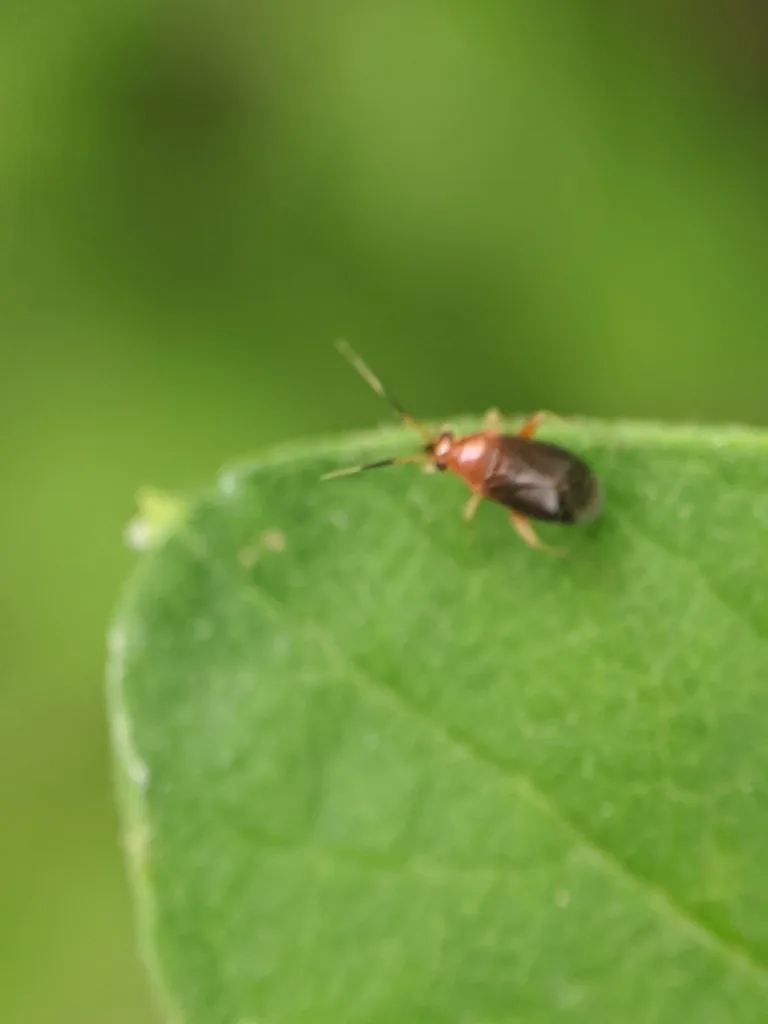
- Adults are about 1/8 inch (3.5 to 4 mm) long, shiny and oblong-oval, brown to dark brown or orange-winged on top and orange underneath with a black face.[1][2]
- Nymphs are bright red to vermilion with white antennae and feet, and are well camouflaged on red azaleas.[1][2]
- A beak for sucking juices separates it from similarly colored beetles; disturbed bugs dodge to the underside of the leaf.[2]
Look-alikes
| Look-alike | How to tell them apart |
|---|---|
| Azalea lace bug | A more damaging azalea pest; the azalea plant bug does far less harm to the plant's looks.[1] |
Where it lives
Generally distributed from Ontario south to North Carolina and west to Missouri.[2]
Biology and life cycle
Eggs overwinter in azalea stems and hatch around bloom time, in early to mid-May near Harrisburg, Pennsylvania.[1][2]
There are five nymphal stages and one generation a year; adults appear in early June and are gone by mid-July, some moving to raspberries, spirea and plum.[1][2]
Damage and signs
Health risk
It often bites gardeners working in azaleas, leaving a painful, chigger-like welt.[1][2]
Control
Pesticides
Control is rarely needed; many products labeled for plant bugs work if it is.[1]
Common questions
Sources
- NC State Extension, “Azalea Plant Bug (PDIC Factsheet).” content.ces.ncsu.edu/azalea-plant-bug (accessed 2026-10-16)
- American Rhododendron Society (Wheeler and Henry, Pennsylvania Department of Agriculture); Virginia Tech Libraries archive copy, “A Potential Insect Pest of Azaleas (Rhinocapsus vanduzeei), Quarterly Bulletin of the American Rhododendron Society 33(1).” scholar-dev.cloud.lib.vt.edu/ejournals/JARS/v33n1/v33n1-wheeler.html (accessed 2026-10-16)
- iNaturalist, “Rhinocapsus vanduzeei taxon page (order and family).” www.inaturalist.org/taxa/454095 (accessed 2026-10-06)