On this page
How to identify it
- Adults are small golden-yellow moths about 1/2 inch long.[1][2]
- Larvae are white, pale yellow or greenish caterpillars, 1/8 to 1/4 inch long.[1][2]
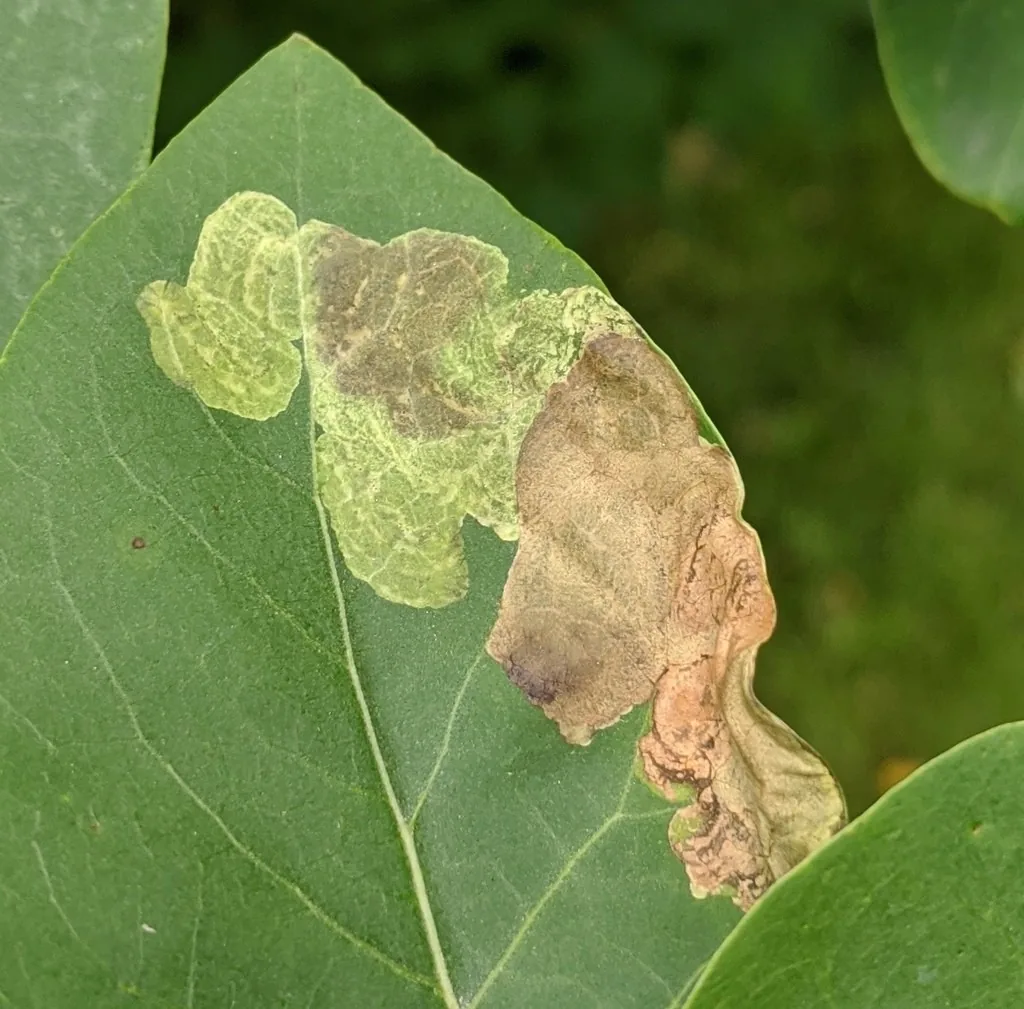
- Early mines are small, linear and brown and show only from the leaf underside; they grow into blotches, and older larvae roll and skeletonize the leaves.[1][2]
Where it lives
Native to Europe and first reported in the US around 1923; it is now found through the Northeast, parts of eastern Canada and the Pacific Northwest.[1][2]
Biology and life cycle
It overwinters as pupae in rolled leaves or as larvae in fallen leaves, and moths emerge with the new growth to lay eggs along veins on the leaf underside.[1][2]
Larvae mine the leaf, then leave the mine to roll a leaf over themselves with silk and keep feeding, and finally pupate in another rolled leaf; there may be several generations a year.[1][2]
Damage and signs
Health risk
Control
Sanitation
Raking fallen leaves in fall may remove overwintering insects, but the PNW handbook notes it can also remove helpful parasitoids.[1][2]
Traps and physical control
Pinch the mines to crush the larvae inside, or remove and destroy infested leaves through the season.[1][2]
Biological control
Parasitoids often kill the larva inside a mined leaf, so no moth emerges.[1][2]
Common questions
- What are the brown blotches on my lilac leaves?
- Often lilac leafminer mines; early in the season look for small linear mines on the leaf underside.[1][2]
- Should I rake leaves to control lilac leafminer?
- It may help or hurt: raking removes some overwintering insects but also parasitoids that keep it in check.[1][2]
Sources
- UMass Extension Landscape, Nursery and Urban Forestry Program (Landscape Insect & Mite Guide), “Gracillaria syringella, formerly Caloptilia syringella (Lilac Leafminer).” www.umass.edu/agriculture-food-environment/landscape/publications-resources/insect-mite-guide/gracillaria-syringella-formerly-caloptilia-syringella (accessed 2026-10-16)
- Pacific Northwest Insect Management Handbook (Oregon State, Washington State, University of Idaho), “Lilac (Syringa)-Lilac leafminer (Hosts and Pests of Landscape Plants).” pnwhandbooks.org/insect/hort/landscape/hosts-pests-landscape-plants/lilac-syringa-lilac-leafminer (accessed 2026-10-16)
- iNaturalist, “Gracillaria syringella taxon page (order and family).” www.inaturalist.org/taxa/320060 (accessed 2026-10-06)