On this page
How to identify it
- Mites are about 0.5 mm long, the size of a printed period; NC State describes them as gray with pale legs and UMD as yellowish green or reddish.[1][2]
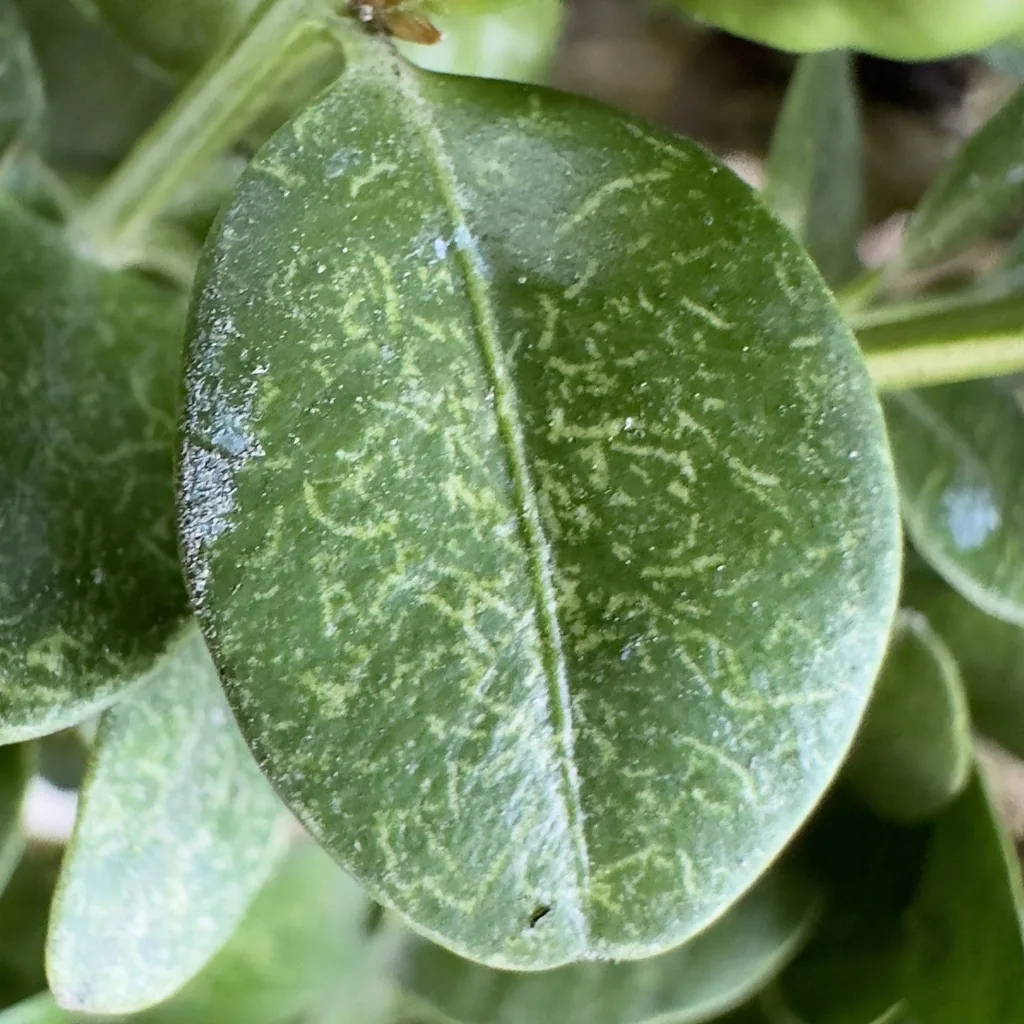
- Unlike most spider mites, they feed on the upper as well as the lower leaf surface, and their feeding tends to run in lines that look like tiny scratches under a hand lens.[1]
- Overwintering eggs are yellowish and flattened on the leaves.[1][2]
Look-alikes
| Look-alike | How to tell them apart |
|---|---|
| Twospotted spider mite | Twospotted and other spider mites usually leave tiny discrete pale dots, mostly from the leaf underside, rather than scratch-like lines.[1] |
| Boxwood psyllid | Boxwood psyllids cup the new terminal leaves in spring and leave white wax.[2] |
| Boxwood leafminer | Leafminers make blotch mines that leave the leaf underside blistered rather than stippled.[2] |
Where it lives
UMD calls it a common pest wherever boxwoods are grown.[2]
Biology and life cycle
Eggs laid in September and October overwinter on the leaves and hatch in spring (April in Maryland).[1][2]
A generation takes about 18 to 21 days; NC State counts at least eight a year and UMD five or six, with mites most active in hot, dry weather.[1][2]
Damage and signs
- Feeding causes fine whitish or yellow stippling early in the season, followed by a dull, dingy look; new growth is most susceptible.[1][2]
- Damage is mainly cosmetic and usually doesn't affect the plant's long-term health; it is often noticed later in the year than it occurred.[1][2]
- Boxwood is the only host, and some Buxus microphylla cultivars appear more resistant.[1][2]
Health risk
Control
Traps and physical control
For light infestations, a strong spray of water from a hose knocks mites off.[2]
Pesticides
Two applications of insecticidal soap, horticultural oil or another labeled miticide 10 to 14 days apart in spring when mites are present; avoid spraying above 85 F, which can burn leaves.[1][2]
Common questions
- What causes tiny pale scratches on boxwood leaves?
- Boxwood mites, which feed in lines on both leaf surfaces.[1]
- Will boxwood mites kill my shrubs?
- Usually not; the damage is mostly cosmetic.[2]
- When should I treat boxwood mites?
- In spring when mites are present, with two soap or oil sprays 10 to 14 days apart.[1]
Sources
- NC State Extension, “Boxwood Mite (PDIC Factsheet).” content.ces.ncsu.edu/boxwood-mite (accessed 2026-10-15)
- University of Maryland Extension, “Boxwood: Identify and Manage Common Problems.” extension.umd.edu/resource/boxwood-identify-and-manage-common-problems (accessed 2026-10-15)
- iNaturalist, “Eurytetranychus buxi taxon page (order and family).” www.inaturalist.org/taxa/903829 (accessed 2026-10-06)