On this page
How to identify it
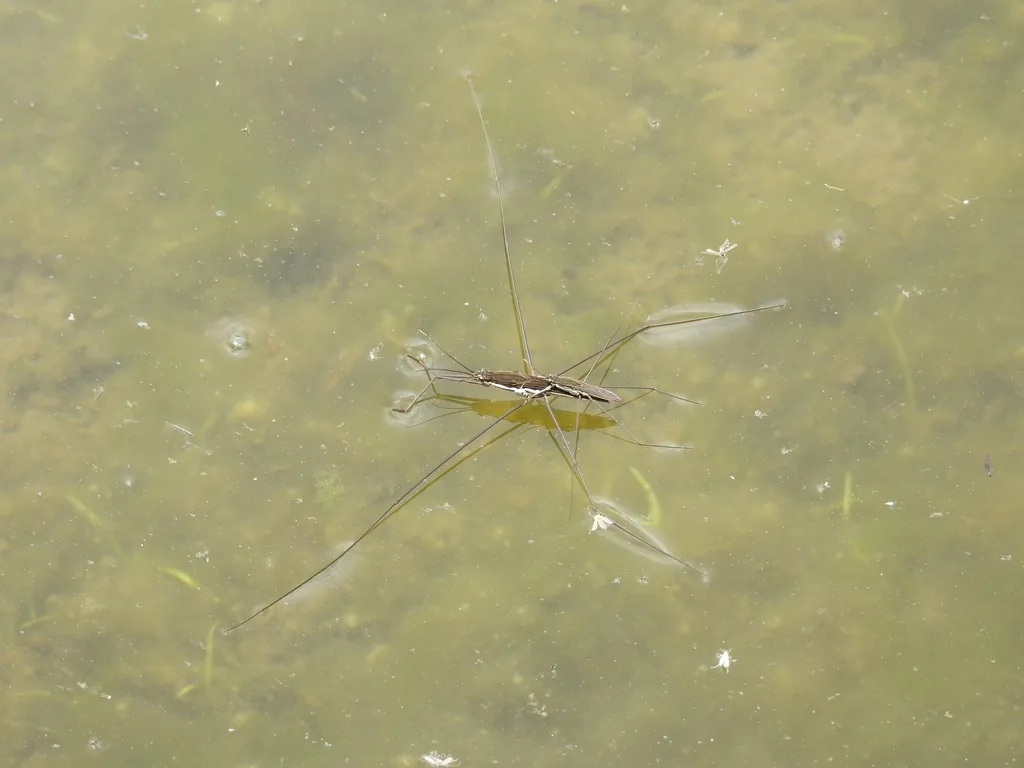
- Short front legs and very long, thin middle and hind legs spread far apart; the hind femur reaches beyond the end of the abdomen. The body is dark, 3 to 10 mm in the Utah key, and up to half to three quarters of an inch (not counting legs) in the large water strider.[2][1]
- Aquarius remigis has an elongated body that is dark brown or blackish above and below with a whitish or silvery stripe along each side; adults usually lack wings. Gerris species look similar but are under half an inch long.[1]
- They stand on the water rather than in it. Often the first thing you notice is the row of small round shadows their feet cast on the bottom, made by the dimples in the surface film.[1][2]
- Outside the mating season they gather in large groups on calm water and scatter to shelter when alarmed.[1]
Look-alikes
| Look-alike | How to tell them apart |
|---|---|
| Fishing spiders | Water striders are sometimes wrongly called water spiders. They are true bugs with six legs and a piercing, straw-like beak; the spotted fishing spider that also runs over the water has eight legs.[1][3] |
| Smaller water striders (Veliidae) | Bugs of the family Veliidae, the broad-shouldered water striders, look like small water striders, 2 to 10 mm, with a small, broad thorax, but their hind femur doesn't reach past the abdomen. They live on slow water and also in rivers and streams, and one common species favors riffles.[2][3] |
| Water measurers (Hydrometridae) | Marsh treaders are grayish or pale brown, 8 to 11 mm, with a very long, slender head whose eyes sit behind its middle; they live on vegetation along the edges of still water.[2] |
| Backswimmers | Backswimmers have oar-like hind legs without claws and a cylindrical body, often with ivory white on it, and are 8.5 to 16 mm long.[2] |
Where it lives
Several species occur in North America, in nearly any aquatic habitat. The Missouri Department of Conservation records them statewide and the Utah key lists them on still and slow-moving fresh water. GBIF holds about 27,000 US records of the family since 1990 from 49 states, counting the District of Columbia, most from California, Texas and Illinois.[1][2][6]
Biology and life cycle
Water striders live on ponds, lakes, swamps, ditches, creeks, streams and rivers, preferring calm water, although they can jerk their way upstream against a current.[1][2]
Their weight is held up by surface tension. They row with the middle pair of legs, and high-speed video shows the strokes push the water mainly by shedding small whirlpools rather than by making surface waves.[4][3]
To jump off the water, they push down with curved leg tips at a force just below what would break the surface film.[5]
Like other true bugs they have a hollow, straw-like beak. They are predators and scavengers, eating other insects alive or dead; because they live on the surface they often take land insects and spiders that fall in and struggle, homing in on the ripples, which they sense through their legs. They grab prey with the short front legs, and several striders may share one meal. They also eat mosquito larvae.[1][3]
Eggs are laid on rocks or aquatic vegetation. The nymphs look like small adults and go through incomplete metamorphosis; the final molt produces the sexually mature adult.[1]
They breathe through openings along the sides of the body, can dive while carrying air trapped in their body hairs, and the adults of the last brood of summer spend the winter at the bottom of the pond.[3]
Many birds eat water striders, returning nutrients from land insects to land ecosystems; fish apparently find them distasteful and rarely eat them.[1]
Damage and signs
- Water striders do no damage. They are harmless predators and scavengers of insects on the water surface, including mosquito larvae.[1]
Health risk
The Missouri Department of Conservation describes water striders as harmless, and none of the sources reports them biting people.[1][2][3]
Control
Prevention
No control is needed. Water striders are harmless and eat mosquito larvae and other insects that fall onto the water.[1]
Where sources disagree
Wings: the Missouri Department of Conservation says adults of the large water strider usually lack wings, while the UW-Milwaukee Field Station says water striders can fly. The Missouri statement is about adults of that one species.[1][3]
Common questions
- Are water striders spiders? Do they bite?
- They are true bugs with six legs, not spiders, and the Missouri Department of Conservation calls them harmless. The eight-legged animal that also runs on water is a fishing spider.[1][3]
- Why are there dozens of them bunched together on my pond?
- Outside the mating season water striders commonly collect in large numbers on calm water and scatter to individual shelters when alarmed.[1]
- How do they stay on top of the water?
- Surface tension holds them up. Water-repellent hairs on the middle and hind legs let them skate on the surface film, and velvety hairs on the body keep them dry.[1][4][3]
Sources
- Missouri Department of Conservation, “Water Striders (field guide).” mdc.mo.gov/discover-nature/field-guide/water-striders (accessed 2026-11-11)
- Utah State University Extension Water Quality Program, “Water Beetles and Bugs: Utah aquatic macroinvertebrate key.” extension.usu.edu/waterquality/resources/macrokey/beetles-bugs.php (accessed 2026-11-11)
- University of Wisconsin-Milwaukee Field Station, “Water Strider (Family Gerridae), Bug of the Week (K. Redmond, 'the BugLady').” uwm.edu/field-station/bug-of-the-week/water-strider/ (accessed 2026-11-11). University field station's natural-history column
- Nature, via PubMed, “The hydrodynamics of water strider locomotion (Hu, Chan and Bush 2003).” pubmed.ncbi.nlm.nih.gov/12904790/ (accessed 2026-11-11). Cited from the PubMed abstract.
- Science, via PubMed, “Jumping on water: surface tension-dominated jumping of water striders and robotic insects (Koh et al. 2015).” pubmed.ncbi.nlm.nih.gov/26228144/ (accessed 2026-11-11). Cited from the PubMed abstract.
- Global Biodiversity Information Facility (GBIF), “Gerridae: US occurrence records since 1990 by state (GBIF occurrence search API).” api.gbif.org/v1/occurrence/search?taxonKey=7881&country=US&hasGeospatialIssue=false&occurrenceStatus=PRESENT&year=1990%2C2026&facet=stateProvince&facetLimit=400&limit=0 (accessed 2026-11-11). State counts are records reported (iNaturalist research-grade, museum specimens, surveys), not abundance.
- iNaturalist, “Gerridae taxon page (order and family).” www.inaturalist.org/taxa/59653 (accessed 2026-11-11)