On this page
How to identify it
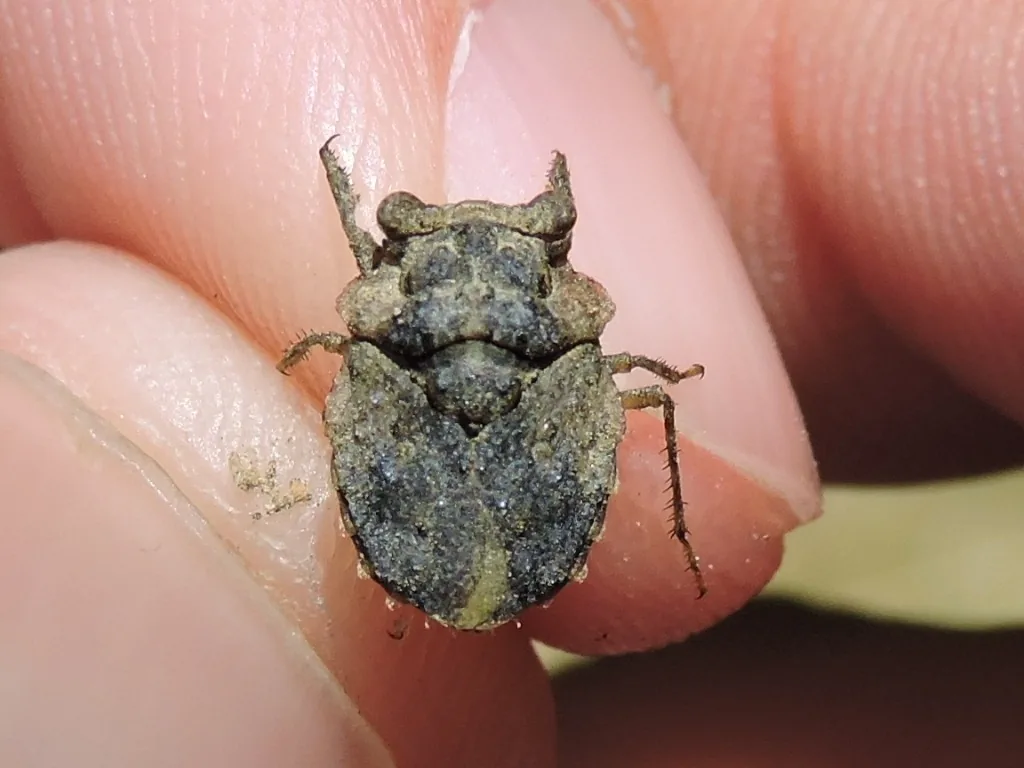
- A widely oval, flattened body 1/4 to 1/2 inch (6 to 10 mm) long with a distinctly toad-like look; the sides of the prothorax (the shoulder-like plate) stick out.[1][2]
- Mottled camouflage in browns, rusts, tans, grays and blacks, often with a rough, warty, bumpy back that blends into soil, sand or rock.[1][2]
- Bulging, protruding eyes and short antennae that rest below the head.[1][2]
- Raptorial (grasping) forelegs that are notably shorter than the hind pair; the bug hops onto prey and holds it with them.[1][2]
- Found on muddy, sandy or rocky shorelines and in riparian vegetation, where it walks rapidly or hops like a toad and is nearly invisible until it moves.[1][2]
Look-alikes
| Look-alike | How to tell them apart |
|---|---|
| Shore bugs (Saldidae) | Shinier and more tapered, dark brown or black with white spots on the wings, with narrower heads and longer four-segmented antennae; they prefer grassier shorelines and fly short distances when disturbed.[1] |
| Velvety shore bugs (Ochteridae) | Dark blackish or bluish brown, often spotted, with a velvety look; the front legs are not modified for grasping and the long beak reaches the bases of the hind legs or farther. Like toad bugs they are shoreline predators that can jump.[1] |
| Giant water bugs | Much larger (to 2 inches) brownish aquatic bugs with oval, flattened bodies and claw-like forelegs for grabbing prey; they live in the water itself rather than hopping along its edge.[3][1] |
| Water boatmen | Slender, streamlined bugs that swim with long, hair-fringed, oar-like hind legs; they live in the water, not on the shoreline.[4][1] |
Where it lives
The big-eyed toad bug occurs throughout North America from Mexico into southern Canada and statewide in Missouri; Utah State University's key records the family in riparian and aquatic vegetation, mud and sand in southern Utah. The other North American Gelastocoris species occurs only in the desert Southwest, and the family has some eight species in two genera north of Mexico.[1][2]
Biology and life cycle
Toad bugs eat smaller insects. They hop onto prey, grab it with the raptorial forelegs and pierce it with a straw-like beak that delivers a digestive enzyme and then draws out the body fluids.[1]
Females deposit eggs in mud or sand, or under stones, near the edge of the water. Most eggs do not hatch until early summer, and how fast the nymphs grow depends on how much prey is available.[1]
Like other true bugs, toad bugs pass through several nymph stages that resemble the adult; after the final molt they are winged, sexually mature adults. The species overwinters as an adult.[1]
Toad bugs may walk rapidly or hop, toad-like, along muddy, sandy or rocky shorelines. Their camouflage is so good that they are hard to see until they move and hard to photograph with autofocus cameras.[1]
As small predators they are in turn eaten by birds and fish, moving nutrients up the shoreline food chain.[1]
Damage and signs
- Toad bugs feed on other insects along shorelines and do no damage to plants, property or people.[1]
Health risk
The sources describe the big-eyed toad bug as a predator of smaller insects on shorelines and do not report bites to people.[1][2]
Control
Prevention
No control is needed. Toad bugs live at the water's edge, eat other insects and are themselves food for birds and fish; enjoy them where you find them.[1]
Common questions
- Something that looked like a tiny toad hopped away from me on the pond bank, but it was an insect. What was it?
- Almost certainly a big-eyed toad bug, a true bug with bulging eyes, a warty mottled back and a toad's hopping habit that lives on muddy, sandy and rocky shorelines across North America.[1]
- Do toad bugs bite?
- They are predators that pierce smaller insects with a beak, but neither Missouri's field guide nor Utah State's key reports them biting people.[1][2]
- Why is the family called Gelastocoridae?
- The name means 'laughing bug' or 'funny bug', from the Greek for laughing; an entomologist was evidently amused by these minute, bouncy insects.[1]
Sources
- Missouri Department of Conservation, “Big-Eyed Toad Bug (Field Guide).” mdc.mo.gov/discover-nature/field-guide/big-eyed-toad-bug (accessed 2026-11-10)
- Utah State University Extension Water Quality Program, “Water Beetles and Bugs: Utah aquatic macroinvertebrate key.” extension.usu.edu/waterquality/resources/macrokey/beetles-bugs.php (accessed 2026-11-10)
- Missouri Department of Conservation, “Giant Water Bugs (Field Guide).” mdc.mo.gov/discover-nature/field-guide/giant-water-bugs (accessed 2026-11-10)
- Missouri Department of Conservation, “Water Boatmen (Field Guide).” mdc.mo.gov/discover-nature/field-guide/water-boatmen (accessed 2026-11-10)
- iNaturalist, “Gelastocoris oculatus taxon page (order and family).” www.inaturalist.org/taxa/53497 (accessed 2026-11-10)