On this page
How to identify it
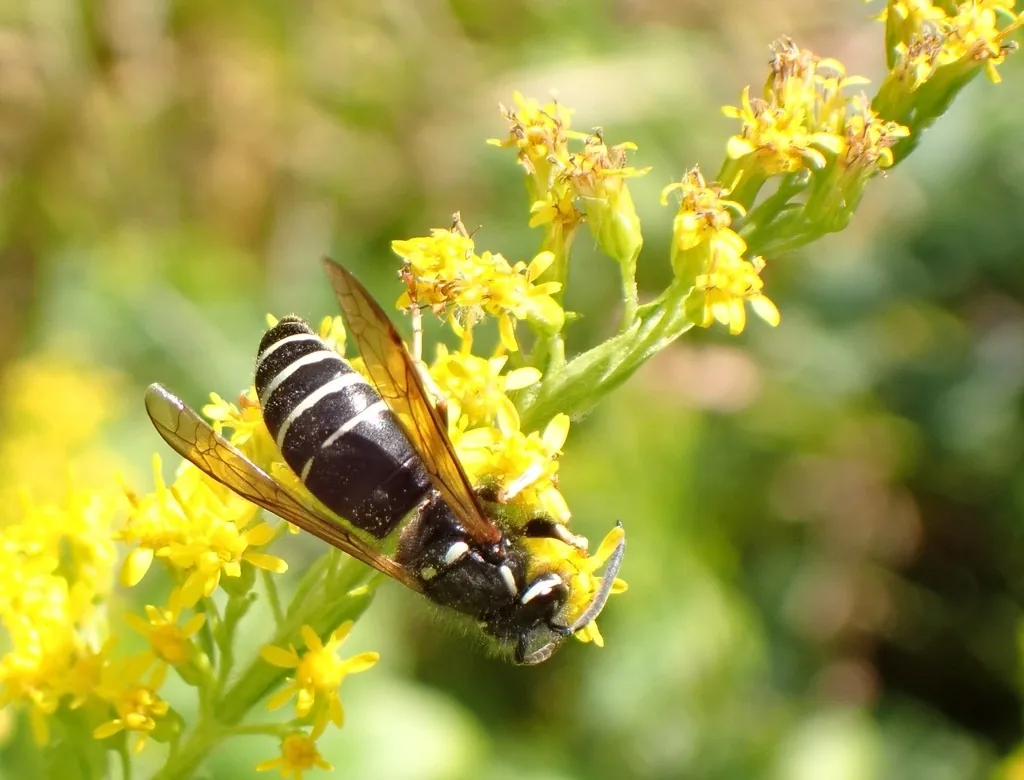
- The pale markings on the body are whitish, not yellow.[1]
- The pale band at the back edge of the second abdominal segment is narrow and has parallel sides.[1]
- The first abdominal segment is black, with a partial white band along its rear edge and often another partial white band at the front of the segment.[1]
- There are no reddish markings on the first two abdominal segments.[1]
- As in other Vespula yellowjackets, the eye comes close to the base of the jaw (a narrow cheek), unlike the wide gap in Dolichovespula species such as the bald-faced hornet.[3]
Look-alikes
| Look-alike | How to tell them apart |
|---|---|
| Bald-faced hornet | Also black and white, but it is a Dolichovespula with a wide gap between eye and jaw, is 15 mm or longer, and has the top of the first three abdominal segments entirely black. Its aerial nests are usually built in exposed places.[3] |
| Northern red-banded yellowjacket (Vespula intermedia) | Another white-marked yellowjacket of the far north, found from Alaska to Newfoundland and south to Vermont or New England. Its first two abdominal segments carry reddish markings, which the blackjacket lacks.[1][2] |
Where it lives
Southern Alaska and the Yukon east to Newfoundland, south in the East to Georgia, Illinois and North Dakota, and south in the western mountains to Colorado, Utah and California. Kimsey and Carpenter place it in the Canadian and Transition life zones of northern and central North America. GBIF's 1990-2026 U.S. records (about 1,300) come from 28 states on the map, most from Vermont, Maine, Washington and New York.[2][1][8]
Biology and life cycle
The blackjacket is a predator of live insects.[1]
It usually nests in cavities, using sites in logs, wall voids and rodent burrows.[1]
As with other yellowjackets, a colony is started in spring by a single mated queen that has overwintered. Workers forage mostly for protein, usually other insects, while the nest is growing from spring to midsummer.[4]
Ground- and cavity-nesting yellowjackets defend their nests vigorously when disturbed, and defensive behavior increases as the season goes on and colonies grow.[4]
Damage and signs
Health risk
A wasp sting usually causes pain, redness, swelling and itching. People allergic to the venom can have anaphylaxis, a fast, life-threatening reaction with trouble breathing, face or mouth swelling, chest pain or fainting that needs emergency care. MedlinePlus advises washing the sting with soap and water and applying wrapped ice 10 minutes on, 10 minutes off; CDC/NIOSH advises having someone stay with a stung person to watch for an allergic reaction, and says people with a history of severe reactions should carry an epinephrine auto-injector and wear a medical ID.[6][7]
Control
Prevention
Social wasps kill large numbers of other insects, so UC IPM advises leaving nests alone where people and animals seldom go. If one wasp flies around you, stay calm and still rather than swatting; if several attack, run away.[4][7]
Traps and physical control
The usual yellowjacket trap lure, heptyl butyrate, attracts mainly the western yellowjacket and not other species, so lure traps are unlikely to help against blackjackets.[4]
Pesticides
Aerosol insecticides labeled for wasp and hornet nests can work, but wasps attack when they sense the spray, and agitated wasps may still be around the next day. Use them with extreme caution, wearing clothing that covers the whole body, a veil, gloves and eye protection.[4]
When to call a professional
If a nest must be removed, calling a professional is the easiest and safest option. Removing a cavity nest by hand isn't practical because it is underground or otherwise out of reach.[4]
Common questions
- Is a black-and-white yellowjacket a bald-faced hornet?
- Not always. The blackjacket is a true Vespula yellowjacket marked in white; the bald-faced hornet is larger (15 mm or more), has a wide gap between eye and jaw, and usually builds aerial nests in exposed places.[1][3]
- Where do blackjackets nest?
- Usually in cavities: hollow logs, rodent burrows and wall voids of buildings.[1]
- What should I do after a blackjacket sting?
- Wash the sting, use wrapped ice, and watch for signs of a severe allergic reaction such as trouble breathing or face swelling; call 911 if they appear.[6][7]
- Will a yellowjacket trap catch blackjackets?
- Probably not. The common lure attracts mainly the western yellowjacket.[4]
Sources
- Pensoft (Journal of Hymenoptera Research), “Kimsey LS, Carpenter JM. The Vespinae of North America (Vespidae, Hymenoptera). Journal of Hymenoptera Research 28:37-65 (2012).” doi.org/10.3897/jhr.28.3514 (accessed 2026-11-11)
- E-Fauna BC, University of British Columbia, “Checklist of the Yellowjacket and Paper Wasps of British Columbia (R. Cannings, Royal BC Museum; revised October 2018).” linnet.geog.ubc.ca/biodiversity/efauna/documents/Checklist%20of%20the%20Yellowjacket%20and%20Paper%20Wasps%20of%20BC%20RAC%20revised%2020Oct2018.pdf (accessed 2026-11-11)
- Bohart Museum of Entomology, University of California, Davis, “Key to the Yellow Jackets of California (Information No. 61).” bohart.ucdavis.edu/sites/g/files/dgvnsk4616/files/media/documents/note_61_yellow_jacket_key.pdf (accessed 2026-11-11)
- University of California Statewide IPM Program, “Pest Notes: Yellowjackets and Other Social Wasps (UC ANR Publication 7450).” ipm.ucanr.edu/home-and-landscape/yellowjackets-and-other-social-wasps/ (accessed 2026-11-11)
- iNaturalist, “Vespula consobrina taxon page (order and family).” www.inaturalist.org/taxa/82328 (accessed 2026-11-11)
- MedlinePlus, U.S. National Library of Medicine, “Insect bites and stings (Medical Encyclopedia).” medlineplus.gov/ency/article/000033.htm (accessed 2026-11-11)
- Centers for Disease Control and Prevention, NIOSH, “Insects and Scorpions at Work (Outdoor Workers).” www.cdc.gov/niosh/outdoor-workers/about/insects-and-scorpions.html (accessed 2026-11-11)
- Global Biodiversity Information Facility (GBIF), “Vespula consobrina: occurrence records in the U.S., 1990-2026 (GBIF occurrence search).” api.gbif.org/v1/occurrence/search?taxonKey=1311657&country=US&hasGeospatialIssue=false&occurrenceStatus=PRESENT&year=1990%2C2026&facet=stateProvince&facetLimit=400&limit=0 (accessed 2026-11-11). State counts are records reported (iNaturalist research-grade, museum specimens, surveys), not abundance.