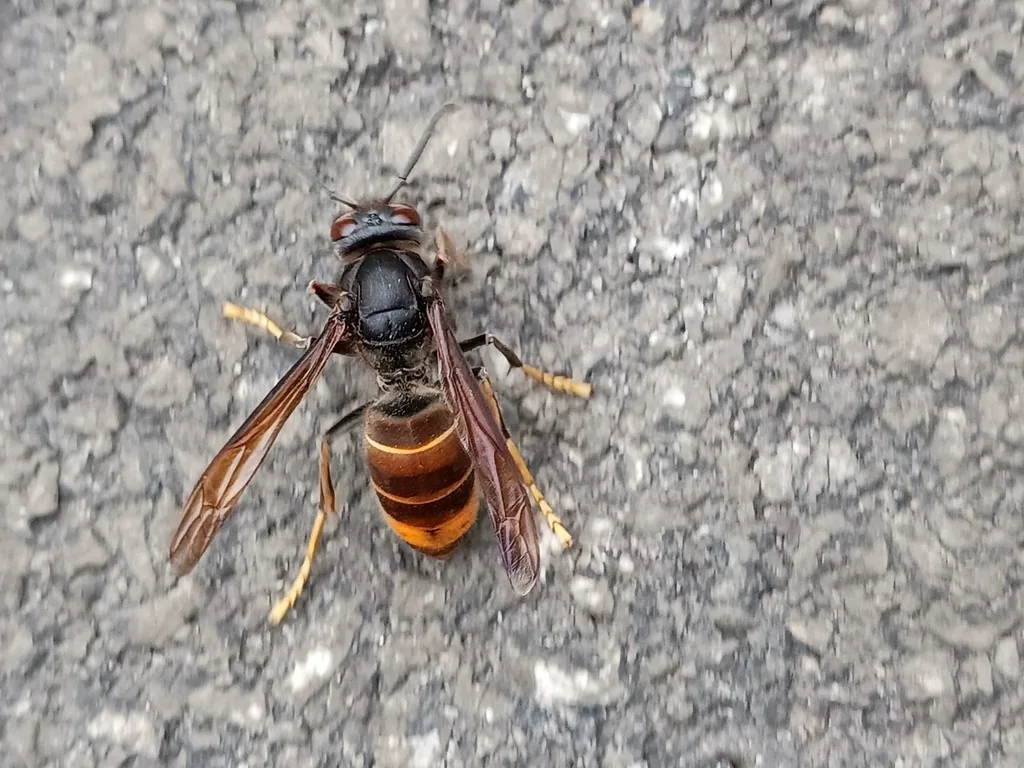
How to identify it
Look-alikes
| Look-alike | How to tell them apart |
|---|---|
| Bald-faced hornet | Black and white with all-black legs; its round paper nests are far more common.[1] |
| European hornet | Larger, reddish-brown and yellow, and nests in cavities such as hollow trees rather than exposed nests.[1] |
| Cicada killer | About 2 inches long and solitary, nesting in the ground.[1] |
| Northern giant hornet | Has a fully yellow head and isn't found in eastern North America.[1] |
Where it lives
As of summer 2026 it's found in South Carolina and Georgia, mainly between Savannah and Charleston.[1]
Biology and life cycle
Queens overwinter, build an embryo nest, then workers build a primary nest and a summer secondary nest.[1]
Mature colonies average about 400 workers but can approach 2,000.[1]
Damage and signs
- In Europe, one study found 30 percent of commercial honey bee colonies weakened by hornet attacks and 5 percent killed.[1]
Health risk
Stings hurt like other wasp stings; people who are allergic or stung many times should get immediate medical care.[1]
Control
Prevention
Check the wasps themselves before assuming an egg-shaped paper nest belongs to this hornet.[1]
When to call a professional
Report suspected yellow-legged hornets with photos of the wasps: in South Carolina through Clemson, in Pennsylvania to Penn State's Insect ID Lab.[1]
Common questions
- How can I tell a yellow-legged hornet from a bald-faced hornet?
- Bald-faced hornets are black and white with black legs; yellow-legged hornets have yellow-tipped legs and a yellow face.[1]
- Where are yellow-legged hornets in the US?
- As of summer 2026, mainly between Savannah, Georgia, and Charleston, South Carolina.[1]
Sources
- Penn State Extension, “Yellow-Legged Hornet.” extension.psu.edu/yellow-legged-hornet (accessed 2026-10-06)
- iNaturalist, “Vespa velutina taxon page (order and family).” www.inaturalist.org/taxa/119019 (accessed 2026-10-06)