On this page
How to identify it
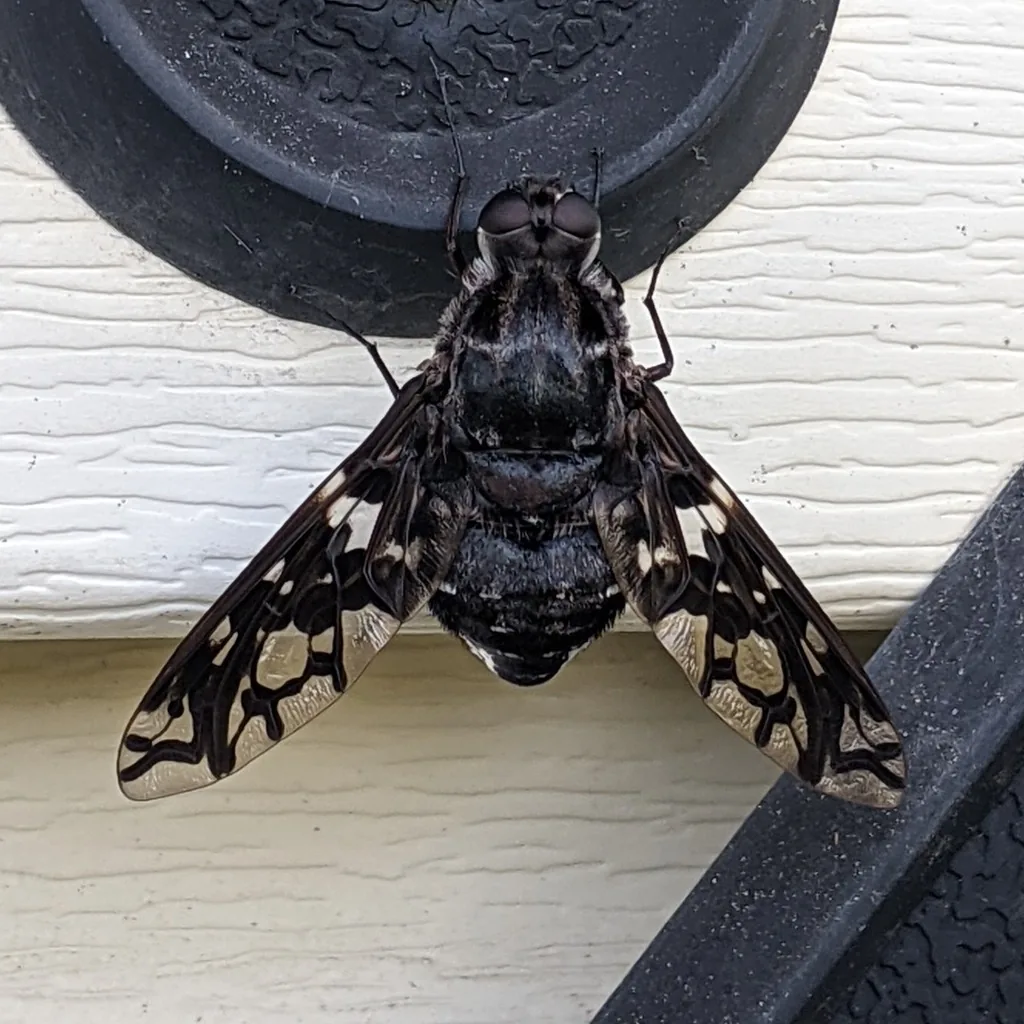
- It is a big, fuzzy black fly. Missouri gives a body length of about 3/4 inch, Cornell notes that some top an inch, and Georgia DNR gives 0.75 to 1.75 inches.[1][2][3]
- The wings are the giveaway: black with clear spots in an intricate pattern, with markings along the trailing edge that look a bit like tiger stripes.[2][3][1]
- At rest it holds its wings spread out to the sides in a triangle.[2]
- The black abdomen carries a few white flecks or spots.[2][3]
- Seen from the front, its long, slender beak makes it look like a giant mosquito, but the beak is for sipping nectar and can't draw blood.[3]
- It is usually seen hovering around wooden fences, decks, roof overhangs and the outside walls of homes, and it may fly straight at a person before landing gently in plain sight.[1][2]
Look-alikes
| Look-alike | How to tell them apart |
|---|---|
| Eastern carpenter bee | Both buzz around wooden decks and fences, but the tiger bee fly is a true fly, not a bee, and can't sting or bite. It is there because carpenter bees are nesting in the wood.[1][2][4] |
| Horse flies | Its size, big eyes and fuzzy black body can suggest a biting fly; a Georgia DNR column likens it to a horse fly with stained-glass wings. Its long beak can't draw blood, and people often kill it by mistake.[3] |
| Spring bee flies (Bombylius) | These brown, furry bee flies imitate bumble bees and hover over bare ground in early spring, looking for the nests of ground-nesting bees rather than holes in wood.[5] |
Where it lives
It lives where its hosts, the carpenter bees, nest. Wildlife, museum and extension sources from Missouri, New York, Georgia and Virginia describe it around homes, decks and fences where carpenter bees nest.[1][2][3][4]
Biology and life cycle
Bee flies are true flies, about 800 species in North America and some 5,000 worldwide. They visit flowers as adults, and as larvae they are parasitoids of other insects; their bee-like look helps them avoid predators.[1][6]
Adults drink nectar and hover in front of flowers. They are especially fond of coneflowers and asters and visit many mid- to late-summer native flowers.[3][2]
After mating, the female searches out carpenter bee nests and hovers at the dime-sized entrance holes to lay eggs.[2][4][3][1]
The newly hatched fly larvae are very active and crawl through the tunnels until they find young carpenter bee larvae.[2][3][4]
Each fly larva attaches to a bee larva and drinks it dry as it grows, so the bee never leaves the nest. Some wait until the bee reaches the more vulnerable pupal stage.[2][3][4]
The Virginia Museum of Natural History names the eastern carpenter bee as its host and says that while the tiger bee fly isn't the only parasite of carpenter bees, it is the most common one.[4]
Health risk
It can't sting or bite people or pets, and its long beak can't draw blood. Georgia DNR and the Virginia Museum of Natural History call it harmless.[2][1][3][4]
Control
Prevention
No control is needed. The tiger bee fly attacks carpenter bees and pollinates flowers, so leave it alone; Georgia DNR asks people not to kill it.[2][3][1]
Biological control
To encourage tiger bee flies, grow native nectar plants that bloom through as much of the year as possible, such as coneflowers and asters, and use fewer insecticides.[3][2]
Where sources disagree
Size: about 3/4 inch (Missouri Department of Conservation), some over an inch (NYS IPM) or 0.75 to 1.75 inches (Georgia DNR).[1][2][3]
Where the eggs go: inside the nest opening (NYS IPM), near the mouth of the tunnel (Virginia Museum of Natural History) or alongside the carpenter bee's eggs (Georgia DNR).[2][4][3]
Common questions
- Can a tiger bee fly sting or bite?
- No. It is a true fly, not a bee, and it can't sting or bite. Its long beak is only for sipping nectar.[1][2][3]
- Why are tiger bee flies hanging around my deck or fence?
- They are hunting for carpenter bee nests. Females lay eggs at the nest holes, and their larvae feed on the carpenter bee larvae inside, so a tiger bee fly usually means carpenter bees are nesting nearby.[2][1][4]
- Should I kill tiger bee flies?
- No. They help control carpenter bees and pollinate flowers, and Georgia DNR notes that many are killed by people who mistake them for stinging or biting insects.[3][2]
- Is the fuzzy fly hovering over bare ground in spring a tiger bee fly?
- Probably not. Spring bee flies of the genus Bombylius hover over bare ground looking for ground-nesting bee nests, while tiger bee flies hover around wood where carpenter bees nest.[5][1]
Sources
- Missouri Department of Conservation, “Tiger Bee Fly (Field Guide).” mdc.mo.gov/discover-nature/field-guide/tiger-bee-fly (accessed 2026-11-11)
- New York State Integrated Pest Management Program, Cornell University, “The Tiger Bee Fly: Friend or Foe? (Think IPM blog, August 21, 2023).” blogs.cornell.edu/nysipm/2023/08/21/the-tiger-bee-fly-friend-or-foe (accessed 2026-11-11)
- Georgia Department of Natural Resources, Wildlife Resources Division, “Out My Backdoor: Meet the Tiger Bee Fly (T. W. Johnson).” georgiawildlife.com/out-my-backdoor-meet-tiger-bee-fly (accessed 2026-11-11)
- Virginia Museum of Natural History, “#BenInNature: Xenox tigrinus, the tiger bee fly (B. Williams, July 29, 2021).” www.vmnh.net/article/ben-here-with-today-s-edition-of-beninna/7-29-2021 (accessed 2026-11-11)
- USDA Forest Service, “Bee Flies (Bombylius spp.), Pollinator of the Month.” www.fs.usda.gov/wildflowers/pollinators/pollinator-of-the-month/bee_flies.shtml (accessed 2026-11-11)
- PLoS Currents, via PubMed, “Trautwein, Wiegmann and Yeates (2011), Overcoming the effects of rogue taxa: evolutionary relationships of the bee flies.” pubmed.ncbi.nlm.nih.gov/21686308/ (accessed 2026-11-11)
- iNaturalist, “Xenox tigrinus taxon page (order and family).” www.inaturalist.org/taxa/133799 (accessed 2026-11-08)