On this page
How to identify it
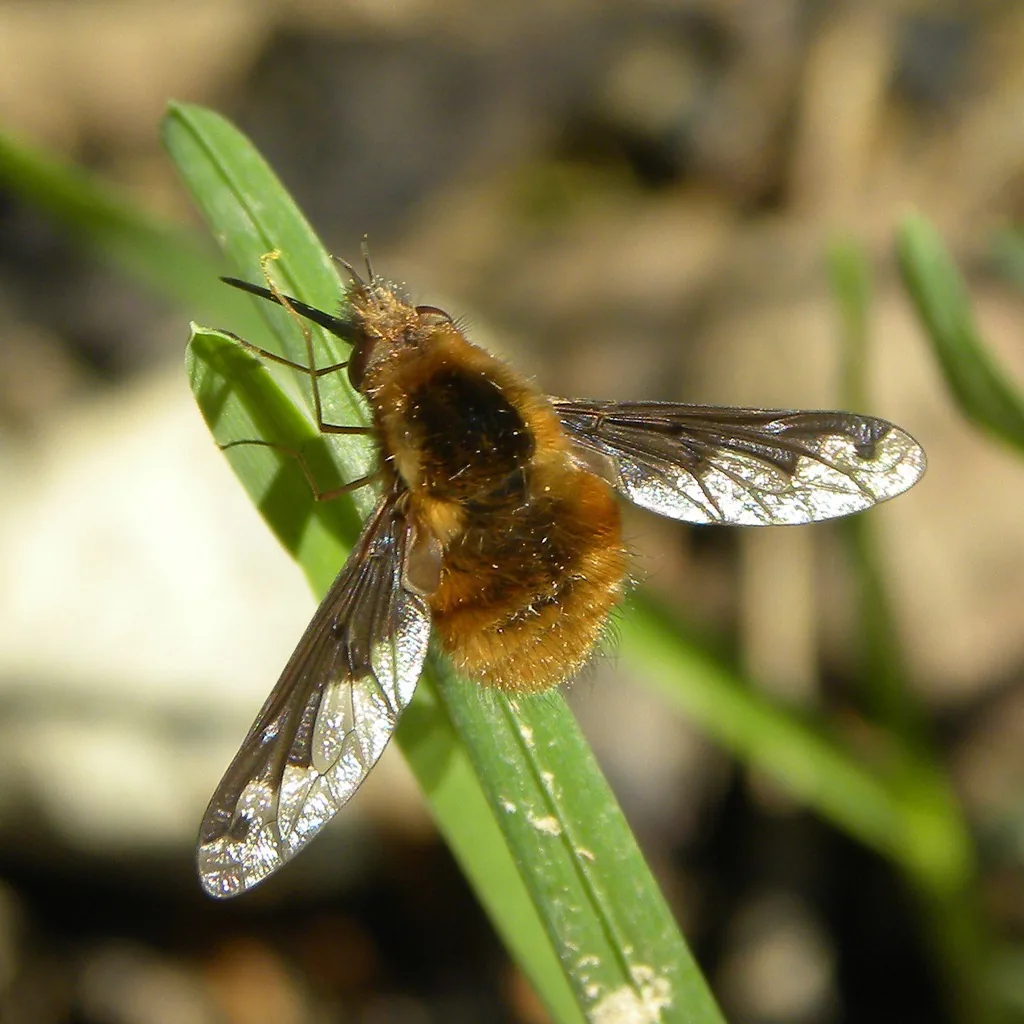
- Hairy and usually stout, often brightly colored, though many are dark or speckled. Some look like pudgy bees, others like fuzzy mosquitoes with a long, straight beak.[1][2]
- Count the wings: a bee fly has one pair, a bee has two. Bee flies also have very short antennae and large eyes that often nearly touch.[1][2][4]
- The wings are long and usually marked with dark patches. At rest they are held out to the sides in a V or triangle, about 45 degrees from the body.[1][3]
- Length ranges from about 1/4 inch to 1 3/4 inches, depending on species. The small fuzzy ones in the genus Bombylius look like flying teddy bears; the Forest Service describes them as brown and furry, with skinny long legs, and notes they buzz in flight.[1][3][4]
Look-alikes
| Look-alike | How to tell them apart |
|---|---|
| Bees | Bees have two pairs of wings. A bee fly has one pair, plus very short antennae and large eyes that often nearly touch.[1][2][4] |
| Hover flies (Syrphidae) | Hover flies also mimic bees and hover at flowers, but their bodies are smooth; bee flies are hairy.[3] |
| Tiger bee fly (Xenox tigrinus) | A bee fly about 3/4 inch long with distinctive wing markings, usually seen hovering around wooden fences and roof overhangs where carpenter bees nest.[5][1] |
Where it lives
Found across the country, in every part of Missouri, and especially varied in dry regions. The genus Bombylius ranges across the Northern Hemisphere, in North America, Europe and Asia. Adults visit flowers in fields, prairies and gardens.[1][3][4]
Biology and life cycle
Adults fly by day and feed on nectar and pollen, often while hovering in front of the flower. Sunflower-family plants such as coneflowers and asters are favorites; some visit lilac, apple or plum blossoms.[1][3]
Most larvae are parasites of the young of other insects: beetles, moths and butterflies, flies, grasshoppers and katydids, bees and wasps, and antlions. Some feed in grasshopper egg pods, and a few attack other parasites such as ichneumon wasps and tachinid flies.[1][2][3]
Females hover near the nests of their hosts and drop or flick eggs onto the soil or into the nest opening. The newly hatched larva is active and crawls to its host; later stages are sedentary maggots that feed on the host from the outside, then pupate and leave the nest as adults.[1][3]
Some Anthrax bee flies are nicknamed bombers for tossing eggs into tunnels while hovering. UW-Milwaukee's Field Station mentions accounts of females mistaking a dark spot on clothing for a tunnel and lobbing eggs at it.[3]
Hosts are still unknown for many species. UW-Milwaukee notes gaps in the life histories of many bee flies, and a 2026 study gave the first host record for Anthrax midas after rearing it from the nests of a wasp, Montezumia cortesia, in Brazil.[3][6]
Damage and signs
Health risk
None. Bee flies don't sting or bite; the long beak sips nectar and isn't used on people or animals.[1][3]
Control
Prevention
No control is needed. Missouri's conservation department says bee flies should be appreciated for cutting down on cutworms, armyworms, carpenter bees and grasshoppers.[1]
Biological control
Tiger bee flies hovering around a wooden fence or eaves are a sign that carpenter bees nest nearby. MDC calls the tiger bee fly a friend because its larvae eat carpenter bee larvae.[5]
Pollinator and parasite
Early in spring, Bombylius bee flies visit flowers such as spring beauty. The Forest Service says they pollinate these flowers about as well as the bees that also visit them and come more often, so they probably pollinate more of them.[4]
Which visitor matters most changes with geography. A study of spring beauty found that the bee fly Bombylius major dominated visits in southern populations, while a pollen-specialist bee, Andrena erigeniae, dominated farther north.[7]
In a test of purple coneflower pollinators, bumble bees and honey bees were the most effective, but grasshopper bee flies (Systoechus vulgaris) were among the other noteworthy pollinators.[8]
The same flies hunt bee nests. The Forest Service describes Bombylius hovering over bare ground in spring and flicking an egg into an open burrow while the mother bee is away; the larva eats the stored pollen, then the bee larva, and stays in the nest until the next spring.[4]
Common questions
- What is the fuzzy bee with a long nose hovering at my flowers?
- Probably a bee fly. Look for one pair of wings, very short antennae and wings held out to the sides; a long, straight beak for sipping nectar is common in the small fuzzy species.[1][2][3]
- Can a bee fly sting or bite?
- No. They are true flies with no stinger, and they don't bite.[1][3]
- Why do bee flies hover over bare ground?
- Females hover while searching for the burrows and nests of the insects their larvae feed on, then drop eggs near or into the opening.[1][3][4]
- Are bee flies good or bad for native bees?
- Both. Some bee flies pollinate spring flowers, but the larvae of others develop in the nests of ground-nesting bees and eat the bee larvae.[4][1]
Sources
- Missouri Department of Conservation, “Bee Flies (Field Guide).” mdc.mo.gov/discover-nature/field-guide/bee-flies (accessed 2026-11-11)
- Clemson Cooperative Extension, Home & Garden Information Center, “What Is It? Wednesday: Bee Fly (J. Ballew, September 21, 2022).” hgic.clemson.edu/what-is-it-wednesday-bee-fly/ (accessed 2026-11-11)
- University of Wisconsin-Milwaukee Field Station, “Big Bee Flies (Family Bombyliidae), Bug of the Week (K. Redmond, 'the BugLady').” uwm.edu/field-station/bug-of-the-week/big-bee-flies/ (accessed 2026-11-11). University field station's natural-history column
- USDA Forest Service, “Bee Flies (Bombylius spp.): A Pollinator with a Bad Reputation (Pollinator of the Month).” www.fs.usda.gov/wildflowers/pollinators/pollinator-of-the-month/bee_flies.shtml (accessed 2026-11-11)
- Missouri Department of Conservation, “Tiger Bee Fly (Field Guide).” mdc.mo.gov/discover-nature/field-guide/tiger-bee-fly (accessed 2026-11-11)
- Zootaxa, via PubMed, “Description of the pupal case of Anthrax midas Fabricius, with the first host record for the species (2026).” pubmed.ncbi.nlm.nih.gov/42408430/ (accessed 2026-11-11)
- Evolution, via PubMed, “Geographic patterns and pollination ecotypes in Claytonia virginica (Miller et al. 2018).” pubmed.ncbi.nlm.nih.gov/29055134/ (accessed 2026-11-11)
- Journal of Economic Entomology, via PubMed, “Evaluation of inflorescence visitors as pollinators of Echinacea angustifolia (Asteraceae): comparison of techniques (Wist and Davis 2013).” pubmed.ncbi.nlm.nih.gov/24224247/ (accessed 2026-11-11)
- iNaturalist, “Bombyliidae taxon page (order and family).” www.inaturalist.org/taxa/51558 (accessed 2026-11-10)